

[the4est] put together this quick how to for making a laser based light bulb night light. First, you need to break out the black glass base of the bulb and remove the filament. Scrub the inside of the bulb and pour in the paraffin. Once it sets, you can break the glass, leaving a solid wax bulb. Hollow out the inside, insert a laser pointer, and you’ll have fine glowing night light.
laser534 Articles
HP Color LaserJet 2600n Teardown
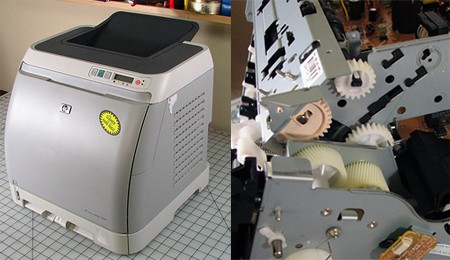
In the ongoing quest to find parts for new projects by scavenging old devices, the curiously sane and benevolent team at Evil Mad Scientist Laboratories took apart an HP Color LaserJet 2600n. They wanted to see what makes it tick and what parts can be culled from it for later use.
PCB Milling Hell Sunday Extra
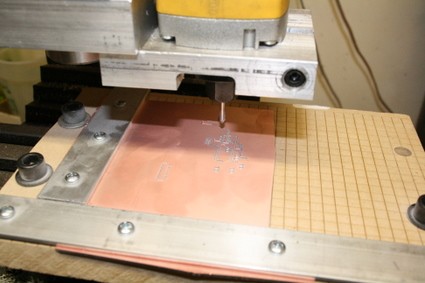
I’ve spent about 18 of the last 24 hours working on milling a PC board for my upcoming how-to. So far I’ve murdered several copper clad boards, built a hold down table, redesigned the board in eagle at least five times and snapped off a $15 half round engraving bit.
If you’re wondering, my new board milling table is a piece of MDF that I laser etched a .25″ grid onto, then added some aluminum strips to act as hold-downs. On the side of the strip opposite the board, I put thin slices of PC board to level out the hold downs. As usual, I’m building the board in eagle. To turn the board into something the mill can handle, I’m using pcb-gcode, a nice little g-code generation tool for eagle. I may switch methods later, but if I can get the settings tweaked, it’ll make my design to board milling process very fast.
[Scott] sent in the beginning of his attempt to build a frequency detector. He’s started out with just simple LCD matrix. Nothing intensely interesting just yet, but I like it when people send in stuff they’re working on.
If you haven’t checked out the Arduino yet, do it. It’s the easiest micro controller dev platform I’ve seen. If you’ve got one, now you can hook up a Wii-Nunchuck to it. If you like smaller and cheaper, check out [ladyada]’s boarduino.
[eliot] wanted me to mention this video on hacking drive through speakers. It’s a bit cheesy – and all I could think of was Thunder Run – where the geek character swapped the crystals in the CB radios. (Warning, The FCC might have some expensive words for you if you get caught.) Update: this is what you get if you don’t watch the entire video and catch the joke about taking apart toasters.
Tomorrow I should be picking out some winners for my laser etched laptop (or whatever) offer. You can still win some free etching time! Just send in a tip! The winners are selected from the ones that get published on Hack-A-Day.
Wiimote Headtracking FPS Laser Gaming

Remember [John]’s Halloween laser tracking game? He’s been busy since then. After building his own version of multi-player missile command based on his laser interaction game, he added head tracking (using the same method as [Johnny Lee] . Check out the video after the break, and grab the full source for Mac or Linux.
IPod Laser Pointer

If you thought there wasn’t anything else to shove on the end of your iPod, [Alex] is here to set you straight. He used the DC power that’s available on the iPod’s dock to drive a cheap laser pointer. It’s pretty easy to do – just get a dock connector (sparkfun has em) and add a laser pointer module. If you’d rather access everything else, check out the super dock I put together a while back. Hit the read link if you’d rather see the picture in color.
Switchmode Power Supply Hacking (power Your Laser)
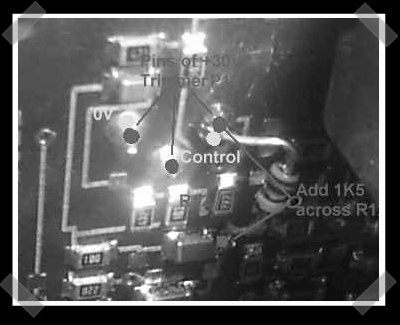
[Mike] wanted a better power supply for his argon laser, so he modded some switchmode power supplies. With a few tweaks, he had a few adjustable voltage outputs and a nice solid supply of electrons for his laser projects. If you need a lab quality adjustable power supply for your projects, this is a nice way to get it on the cheap. (He’s in the UK, but the same ideas should apply to us models.
Webcam Laser Rangefinder
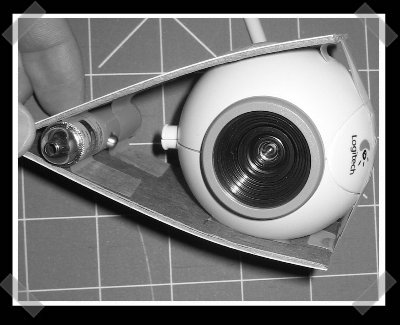
This has been around for a while, but I thought it deserved some attention. [Todd] used a laser pointer, a webcam, some trig and (sigh) some windows development tools to create his own laser range finder. Given the position of the beam strike and that the camera is located at a right angle to the laser, calculating the distance is pretty simple. This could be handy if you’re building a bot for defcon…









