Mini Waterproof LED Lanterns Charge Without Wires

inductive-charge-led-lights

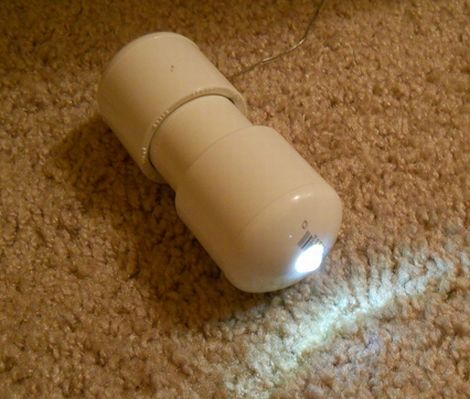
If you’re in search of a flashlight that can stand up to the elements, or simply looking for an easy way to spruce up your pool for those hot summer nights, check out these rechargeable PVC LED lights. Inspired by a post in Make: Magazine featuring Indestructible LED Lanterns, [John Duffy] decided to take the project one step further.

While he liked Make’s iteration of the waterproof lantern, he thought it would be best to permanently seal the lights for maximum durability. Not satisfied with a one-use light, he equipped the PVC lanterns with a single rechargeable AA battery, step-up circuitry to drive the LED, and an inductive charging coil.

His floating, waterproof lights sport a slightly bigger footprint than their predecessors to house the extra electronics, but we think that’s more than a fair trade off considering they can be charged wirelessly.

Place your Digikey/Mouser/Jameco orders now and check out [John’s] how-to video – you just might get some of these built in time for the weekend!

[via HackedGadgets]

Continue reading “Mini Waterproof LED Lanterns Charge Without Wires”
A Game Of Skill For The North Carolina Maker Faire

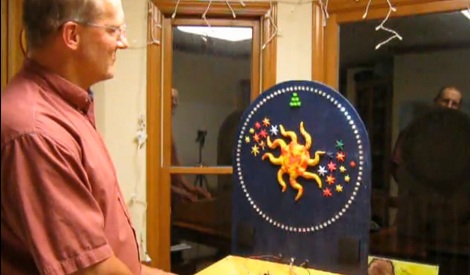
The North Carolina Maker Fare was last weekend, and over the course of the festivities  [Dave] was asked for the documentation for the arcade game he built. It’s a neat build, so we’re very glad he chose to share it with us.

Anyone who has been to an arcade in the last 15 years has seen the game [Dave] was inspired by. The object of the game is to hit a button when the sequentially illuminated lights are in a particular position. [Dave] built his own version out of 90 LEDs and a very tiny FPGA dev board.

The 90 LEDs are controlled by the FPGA using charlieplexing, and are illuminated in sequence when the game starts. A heavy-duty emergency switch button modified into a momentary push button takes a hit whenever the player thinks the LED will land in the ‘jackpot zone.’  If the player wins, a buzzer sounds and much excitement is had by all.

Seeing as how the arcade version of this game is a complete rip off and is impossible to win, we really like [Dave]’s version. You can check out his demo video after the break.

Continue reading “A Game Of Skill For The North Carolina Maker Faire”

Adding The Apple ‘breathing LED’ To A Motorcycle

[spiralbrain] has a beautiful KTM Duke 200 motorcycle, but he’s found the factory configuration is a little bit plain. Wanting to add his own unique touch to his bike, he decided to add a ‘breathing LED’ to the parking light that slowly changes its brightness much like the LED on recent Macs.

From the factory, [spiralbrain]’s bike uses extremely inefficient (and somewhat ugly) T10 lamps for the parking light. This was changed over to a 12 Volt white SMD light bulb, but what really makes this build special is the way [spiralbrain] is controlling this lamp.

[spiralbrain] added a very tiny circuit consisting of an 8-pin microcontroller (a PIC12F683) that slowly dims the new SMD light bulb using the built-in PWM module. When the bike is taken out of neutral, the microcontroller stops at the highest PWM setting so the ‘breathing’ LED function is only engaged when not moving.

It’s an interesting mod that’s sure to draw some attention when [spiralbrain] is showing off his bike. As a bonus, the mod is completely reversible, so the bike’s warranty is still good.

Homemade Silicon Carbide LED

Here’s an LED indicator which was made at home out of a Silicon Carbide (SiC) crystal (Internet Archive Mirror). The concept is simple, but a bit of trial and error goes into getting that tiny amber spot to light up.

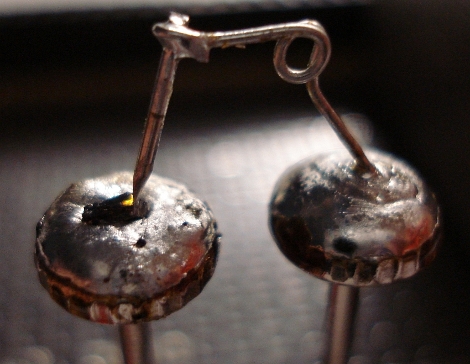
The guesswork comes in finding the right piece of crystal. First [KOS] broke it into tiny pieces, then he started poking the chunks with electrified probes to see if he could get some light out of them. Once an active area was found he needed a base for the crystal. The image above shows the two nails which he used. This provides a large mounting area that also acts as a heat sink to make sure the LED won’t burn itself out. There’s a solder blob which he kept molten with his iron until the crystal could be pushed into place. That holds it securely as the pin which serves as the cathode is positioned.

The whole setup is soldered to some protoboard and is ready to use. This is the second time we remember seeing this technique used to fabricate LEDS. The first time was an accident.

Bike Alert Tells Drivers To Back Off

Bicycle commuters are often in a battle with drivers for space on the road. [Hammock Boy] does all of his commuting on two human-powered wheels, and is quite interested in not getting hit by a car. He decided to ply his hobby skills to build a device that helps keep him safe. It’s not just a tail light, it’s a sensor that shines brighter the closer a car is to the back of the bike.

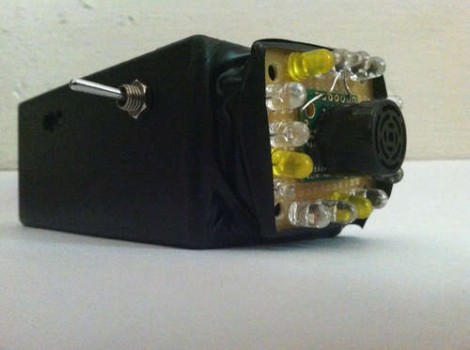
The sensor portion is the ultrasonic range finder seen in the center of the protoboard. Surrounding it is a set of LEDs. Each is individually addressable with the whole package controlled by an Arduino. The sketch measures the distance between the back of the bike and whatever’s behind it. If there’s nothing, one Red led is illuminated. If there is an object, the lights shine brighter, and in different patterns as the distance decreases.

Certainly the next iteration could use a standalone chip without the need for the whole Arduino. This could even work with two battery cells and no voltage regulator. We also think the use of any other color than Red LEDs is suspect but we do love the concept.

Building A Quiz-show Style Buzzer System

Theses are the team buzzer boxes which [Philippe Chrétien] built for his mother. She’s a big fan of quiz shows (we’re thinking Jeopardy and the like) and he thought she’d enjoy a proper setup for home gaming.

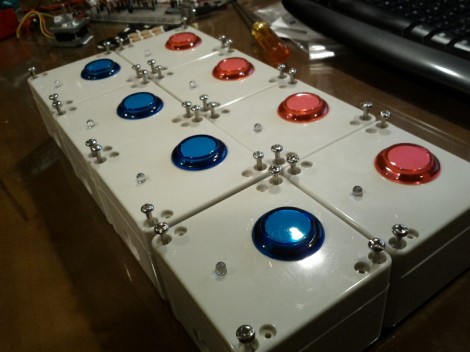
Each unit consists of an arcade button and one LED, both housed in a project box. He uses telephone wire to connect each buzzer to the base unit. We like that idea since we’ve got a lot of old telephone cable lying around and our RJ-45 crimp includes an RJ-11 slot. This is perfect for making our own cables.

The base unit houses an Arduino board which polls the buttons to see which is pressed first. The LED on the appropriate buzzer box is illuminated so the players know who got in first. One special feature of this setup is the ability to choose from 30 different buzzer sounds.

There are several other quiz buzzer projects kicking around Hackaday if you’re interested. One of our favorites is this system which uses plastic bowls as the buttons.

[via Adafruit]

A Wedding Cake Made Out Of LEDs

[Andrew] wanted to do something special for his wedding. Since he and his fiance [Missy] decided on a cupcake wedding cake, [Andrew] decided to wow his guests with an RGB LED cupcake holder.

The tiers of [Andrew] and [Missy]’s cupcake holder are made of acrylic laser etched with a damask pattern. These tiers are supported by a cylinder embedded with RGB leds that provide edge lighting for the acrylic panels. The effect is a series of permutating lights that illuminate the cupcake holder with every imaginable color. On the top of the cupcake cake, there’s a great cake topper made of frosted and laser cut acrylic that has the same color fade effect as the cupcake holder.

On the electrical side of things, the cupcake holder has 44 LEDs on all it’s levels. FETs driven by a 40-pin PIC18F control all the LEDs and the whole piece is powered by a computer power supply.

It’s an awesome build, especially considering it was finished just days before the wedding. After the break, you can check out a few more videos showing off the beauty of [Andrew] and [Missy]’s wedding cake.

Continue reading “A Wedding Cake Made Out Of LEDs”