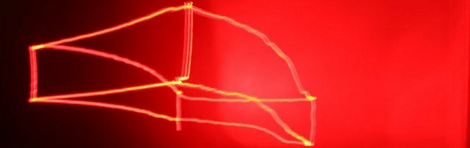
Robotic Light Painting In 3D

For the last few months, [Ben] has been building a 3D light painting robot. Instead of a couple Arduino-controlled LEDs that a person moves around the Lightplot, as [Ben] calls it, uses a robotic arm to move a LED in 3D space.

The build started with [Ben] testing his idea by putting a laser pointer on an altitude and azimuth mount made out of LEGO. Eventually [Ben] decided to build a 3D plotter rig for a more impressive show. The 3D plotter sits in on a tripod with three axes of motion – up and down, clockwise and counterclockwise, and ‘in’ and ‘out’. A small RGB LED at the end of the robotic arm is controlled along with the servos and motors, making it possible to plot vector lines in 3D space.

There are a whole bunch of demo videos after the break. They look fantastic, but we’d really like to see the Lightplot be used outside on a dark, starry night.
Continue reading “Robotic Light Painting In 3D”

Wristwatch Measures Your Perception Of Time; Also Tells Time

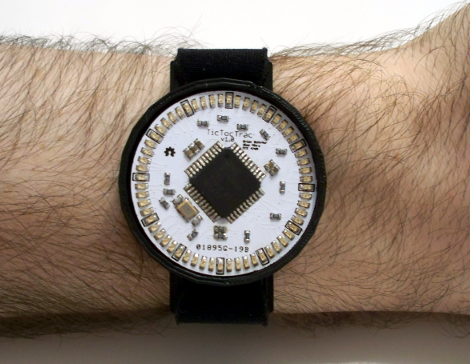
This wristwatch is hiding a lot of features in its hardware and its software. It’s called the TicTocTrac and it’s a Senior project for a pair of students at Cornell University. Judging from the sheer volume and quality of the project documentation we wonder if someone has a science writing career ahead of them? Be we digress… It’s a clock and we love it!

First off, this does more than just tell the time. In fact, that’s almost an ancillary function in this case. The wristwatch is more of a metering device to record your own time-based behaviors. Find yourself checking your watch frequently as the lunch break approaches? This watch records that activity and you can later graph the data. This allows you to analyze how you percieve the passage of time. The more often you check the time, the slower you feel time progressing. The documentation does a much better job of describing this than we have time for, so check it out.

On the hardware side of things we’re quite impressed. The housing is 3D printed. It hides two half-circle PCBs below the full-circle PCB face plate. The half-boards leave space for a tiny rechargeable battery, and host a vibrating motor and RTC chip. Instead of using buttons, there’s a piezo sensor which detects when you tap on the top of the watch.

Building Main Street, USA In A Coffee Table

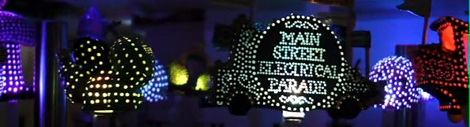
[Alex George] has been collecting miniatures of Main Street, USA in Disney Land hand crafted by artist [Robert Olszewski]. These models are incredibly accurate, but sadly static. [Alex] has some of the floats from the Main Street Electrical Parade that light up with the help of a few LEDs. One day, [Alex] found himself wishing he could watch a miniature parade circling around his diorama and did what any of us would do: make a tiny electrical parade move around his miniature town.

[Alex] began his build by designing a system of chains and sprockets underneath his miniature Main Street. When not on display, the parade floats are hidden underneath the town. At night, though, the parade ascends to the surface to put on a show.

It’s not an electrical parade if there aren’t any lights, so [Alex] grabbed a couple Blinkms to attach to the underside of each float. These are small programmable RGB LEDs that can repeat the same sequence of lights for the entire time the parade is visible. A very excellent job and a masterwork of craftsmanship for both [Alex] and [Robert Olszewski].

[Alex]’s ‘making of’ video and a full demo of the float are available after the break.

via boingboing

Continue reading “Building Main Street, USA In A Coffee Table”

Huge Water And Light VU Meter Plus More

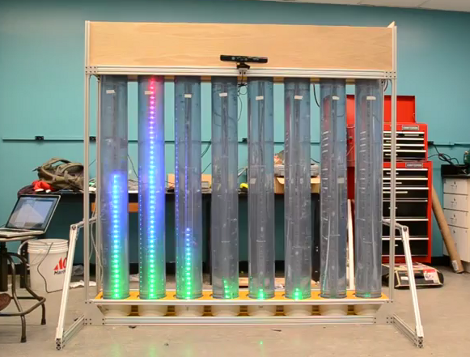
This is the senior design project for a group at the University of Vermont. It’s a wet, bubbly, blinky, interactive thing. Each column is a clear tube filled with water, with a string of fully addressable RGB LEDs suspended in the center. In idle mode, the lights scroll through a series of interesting patterns while the water is filled with bubbles to add some depth to the presentation. There is also a VU meter function, as seen here and during the Portal theme song that ends the video demo after the break.

A Teensy++ board is used to address the display. It’s set up to receive serial commands from a Processing script which is responsible for generating the animations. At the top of the frame you can see there’s a Kinect sensor. By standing in the standard post (we think it should be called the Kinect mug shot) the installation will automatically switch over to body control. We could see this thing making its way into a long airplane terminal hallway, following the travelers along their trek from one terminal to the next.

Continue reading “Huge Water And Light VU Meter Plus More”

Fiber Optic Chandelier With Wireless Controls

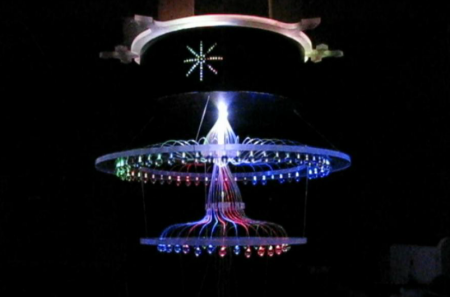
After seeing a cool fiberoptic chandelier on Ebay for over $1,000, [Apex Logic] figured he could build one himself that would not only be cheaper, but have more features. Some of the features he was after were for it to be wirelessly controlled, have the ability for full RGB control, and of course to have a custom look. He pulled it off quite nicely as you can see in the video below. He has a wireless controller with 3 sliders representing RGB that you can catch a glimpse of in the second video below.

His page with the build details and the code seems to have suffered some ill fate this morning. Here it is, for when it returns.

[via Adafruit]

Continue reading “Fiber Optic Chandelier With Wireless Controls”

LED Case Lights Reflect CPU Usage

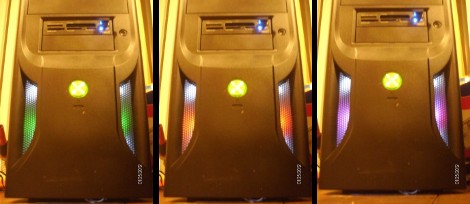
A lot of Linux users include system monitor information in their status panel so that they can see when the CPU is grinding away. [Kevin] is taking the concept one step further by changing his case lights based on CPU usage. Above you can see green, orange, and magenta, but [Kevin’s] implementation uses the full spectrum of color.

The project is based on an ATmega48. It’s running the V-USB stack and connects to one of the motherboard’s internal USB ports. This lets him easily push the CPU usage data over to the microcontroller where it is translated into color. One RGB LED has been installed behind each fan panel on the front of the case, with a white LED above and below as an accent. Pulse-width modulation via some MOSFETs lets him mix and match for just the right color. He’s powering the add-on off of the PSU rails rather than USB so that it turns off when the computer goes to standby.

Don’t miss [Kevin’s] explanation of the system, and a demo of it in action after the break.

Continue reading “LED Case Lights Reflect CPU Usage”

Interactive Table Is Slightly Different Than Most.

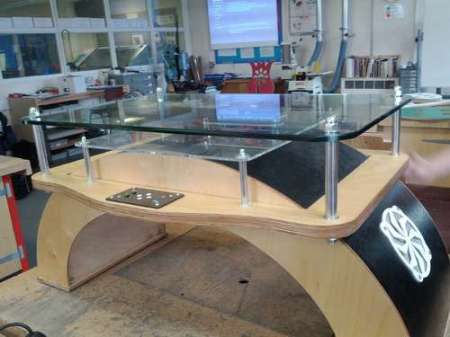
[DanNixon] has put together this unique interactive table concept. Usually, when we see the term interactive table, we think of an LED grid. That just happens to be what we see the most of. While this table does, in fact, have an LED grid in the table top, it also has several other features and some very nice construction.

Instead of going the usual boring rectangular route, [DanNixon] decided to build a more visually appealing structure. The build log on that part alone is worth a peek. After that, he has a small LCD screen for displaying headlines and song titles as well as a compact LED matrix for some visualizations.

Great Job [DanNixon]

Continue reading “Interactive Table Is Slightly Different Than Most.”