Very Accurate Clock Can’t Be Read Accurately

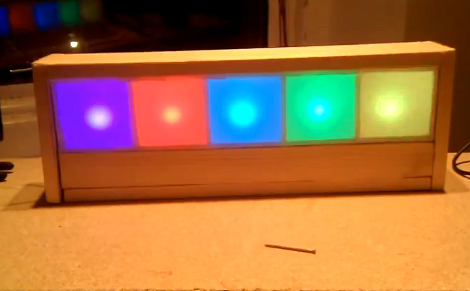
[Martijn] is showing off his new clock which he calls a Light Spectrum Clock. We like to look of it, using RGB LEDs in five squares that remind us of some of those LED coffee table builds. From left to right this shows the week, day, hour, minute, and second. Simple, right?

We had to smile a little bit when looking through his write up. He chose an Arduino nano as a controller, using a TLC5940 chip to drive the LEDs. But it is the inclusion of a DS1307 real-time clock that we find amusing. It will keep quite accurate time (not quite as well as the DS3232 but still respectable) but the fuzzy display technique makes telling the time accurately an impossibility. But like other color-based clocks, that’s part of the fun. The real reason for using an RTC chip is that they usually include battery-backed operation so that you can shut off the LEDs when you’re not around and the clock will continue to tick.

You can watch the seconds pass by as fading colors in the clip after the break.

Continue reading “Very Accurate Clock Can’t Be Read Accurately”
Building A LED Strip The Minimal Way

For his first big build with an MSP430, [Javon] decided to an RGB LED fader. Having worked with Arduinos in the past, he figured that his MSP430 would have a few PWM channels. After being proved wrong by the data sheet, [Javon] needed to figure out a way to switch a bunch of RGB LEDs with only one PWM channel on his microcontroller.

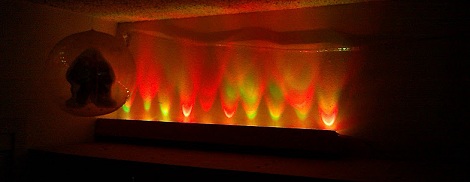
Because there was only one PWM pin on [Javon]’s micro, he needed a way to multiplex his output. He ended up using a 74HC4052 mux/demux chip to drive 20 LEDs. The LEDs were mounted onto hard board and the main part of the circuit built on a bit of perfboard. While there’s no total cost for his build, we’re guessing [Javon] didn’t spend much on his project; certainty much less than this explosion of LEDs.

[Javon] put all the build pictures up as a Google+ album and a few video demos up. Check those out after the break (009 Sound System warning, you might want to hit mute).

Continue reading “Building A LED Strip The Minimal Way”

Fixing The Control Scheme For An Aftermarket Headlight Assembly

The headlight enclosures on [Bill Porter’s] 2004 Passat had yellowed with age and were not outputting the kind of light they should. He decided to replace them with some aftermarket modules that also incorporated LED strips. When they arrived he was surprised at how easy there were to drop into place. But when testing he was certainly not satisfied with how they worked. The day-driving mode used the HID bulbs at full power, where the factory assembly had dimmed them during the day. He set out to alter the electronics to work as he prefers.

Always the mad scientist, [Bill] started off by making a truth table showing how the lights reacted to the various states of the ignition and headlight switches. What he came up with is an AND gate built from a relay and diode. It allows him to have the LEDs on as the running lights (without the HIDs on at all), and leaves the rest of the functionality unaffected.

Rainbow Board Of Many Ping-pong Balls

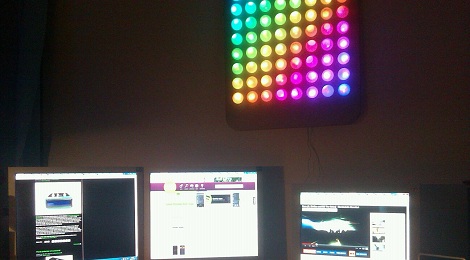
[George] just finished his first project: an 8×8 matrix “Board of Many Ping-Pong Balls” with 64 RGB LEDs. He started this project when he was 14 years old and finished the build over this last Christmas break. We won’t make any presumptions about [George]’s age, but we couldn’t think of a better project to start out on.

For the build, [George] used a Colorduino LED driver shield for his Arduino. This made the wiring simple, but the finished product is where this project really shines. For the base, [George] got a board laser cut at his school and used ping-pong balls to diffuse the LEDs. We’ve seen this many times but with this build there’s a neat way to drill a hole in a ping-pong ball; simply put the drill into reverse. The friction is enough to open the ball up, and the chips of plastic come outside instead of remaining in.

We’re really impressed with [George] and his winter break project. He’s lucky enough to have access to a laser cutter at school, and from a look at his monitor, he’s reading the right websites. You can check out his demo rainbow pattern after the break.

Continue reading “Rainbow Board Of Many Ping-pong Balls”

Minimalist RGB LED Cube Has A Very Short BoM

charlieplexed-led-cube

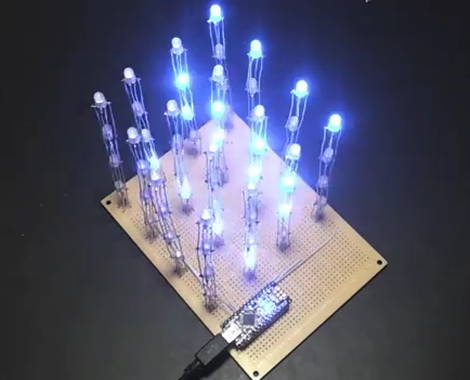
[Asher Glick] wrote in to share a project he has been working on with his friend [Kevin Baker], a 4x4x4 RGB LED cube. The pair are students at Rensselaer Polytechnic Institute and also members of the newly-formed Embedded Hardware Club on campus. As their first collaborative project, they decided to take on the ubiquitous LED cube, trimming down the component count to nothing more than 64 LEDs, a protoboard, some wire, and a single Arduino.

Many cubes we have seen use shift registers or decade counters to account for all the I/O required to drive so many LEDs. Their version of the cube has none of these extra components, solely relying on 16 of the Arduino’s I/O pins for control instead. You might notice something a bit different about the structure of their cube as well. Rather than using a grid of LEDs like we see in most Charlieplexed cubes, they constructed theirs using 16 LED “spires”, tucking the additional wiring underneath the board.

The result looks great, as you can see in the videos below. The cube looks pretty easy to build, and with a cost around $60 it is a reasonably cheap project as well.

Nice job, we look forward to seeing all sorts of fun projects from the Embedded Hardware Club in the future!

Continue reading “Minimalist RGB LED Cube Has A Very Short BoM”

Doomsday Keg Of Radness Helps Ring In The New Year

doomsday-keg

Lots of people buy noise makers for New Year’s eve, others opt to sing Auld Lang Syne – then there’s these guys.

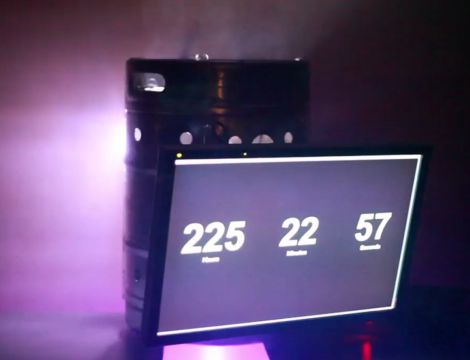
The crew at Stone Brewing Company throw an annual bash at their brewery in celebration of New Years, and while [Dino’s] countdown timer is great for intimate settings, they needed something bigger to wow the crowd. A busted half barrel was all the inspiration they needed to build the “Doomsday Keg of Radness”.

[Mike Palmer], the Creative Director at Stone handed the keg off to the maintenance crew for some remodeling, and got ready to fit it with all sorts of lights and other goodies. Holes drilled in the keg were fitted with bright pulsing LEDs, while additional LED light strips were laid out around the perimeter. The bottom was cut out to accommodate a Moonflower LED module, and a 24” monitor was strapped to the side in order to display a countdown timer. An old Macbook jammed inside the keg runs the video display, while the rest of the lighting is remotely controlled with an RF transmitter.

Now mind you this all went down last year, but since the display was such a hit, they will be busting it out again for the 2011 celebration.

Check out the short demo video below to get a look at the Doomsday Keg in action.

Continue reading “Doomsday Keg Of Radness Helps Ring In The New Year”

A Floppy Drive Orchestra

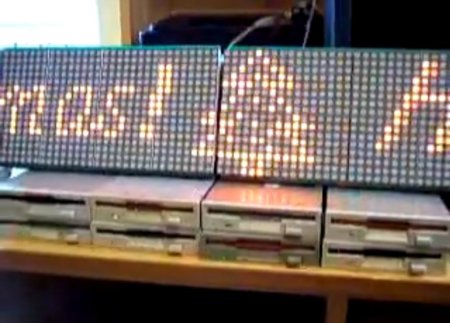
With 8 drives working in concert, this “floppy drive array orchestra” takes drive music to a whole new level!  As if that wasn’t enough, [SileNT] decided to use the16x64 LED array that he’s been working on in concert with the drives.

For those that remember, we’ve actually featured [SileNT], AKA [Pawel]’s, work before, where we were impressed that he was able to play the Imperial March from Star Wars on 2 floppy drives. He’s planning more information about his floppy drive music making in the future and maybe even instructions on building your own personal disk drive orchestra. Apparently [SileNT] has an abundant supply of 3 1/2 inch drives, so maybe even this feat can be topped…

Be sure to check out the video after the break of these 8 drives in action. In the video, more tunes are promised “soon”, so be sure to check back or subscribe to him on Youtube for more sweet melodies. Continue reading “A Floppy Drive Orchestra”