DIY LED Photography Lights

led-light-box

[Markus] had been drooling over some LED panels to use as a soft light source for photography, but being a hobbyist, he didn’t want to spend a ton of money to buy them. He figured that he had enough electronics know-how to build his own panels, while saving a boatload of cash in the process.

He hoped to keep the total cost under £100, so along with new items like LED light strips, he would have to use some stuff he had sitting around, like the metal cooking containers that make up the body of the lights. While originally planned for use in a different project, it turns out that the cooking containers were ideal for his lighting setup, since they are both durable and great heatsink material.

The remainder of the build is pretty straightforward. [Markus] used a pre-made LED dimmer to control the panel’s brightness, along with some tinted plexiglas to diffuse the light while bringing the color temperature into a more usable range.

While he missed his £100 mark, the lights look great – we just might have to build a few of them ourselves.
ColorNode: A Drop-in GE Color Effects LED Controller

colornode-ge-color-effects-controller

[Paul] was looking to spice up his holiday decorations this year, so he picked up some GE Color Effects lights and started hacking away.

We’ve already seen how hacker-friendly these LED bulbs are, which is why [Paul] decided to give them a try. His ultimate goal was to synchronize several sets of lights from one location, which would unfortunately require that he run wires from his control board to each of the strings.

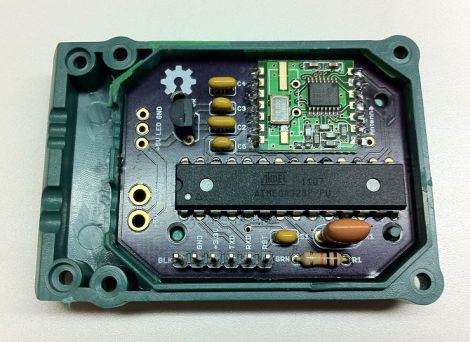
He then decided to go a different route, and build his own control board that would work as a drop-in replacement for GE’s controller circuitry. He wanted to retain the wireless control aspect of the lights, so he picked up some RFM12B wireless modules which happen to be well-supported by the folks at JeeLabs.

He modified their JeeNode board design to fit it in the Color Effects electronics enclosure, paring it back to the minimum components necessary to control his lights.

The hardware side of the ColorNode is complete, but the software is a work in progress. [Paul] says that once he gets things wrapped up, he will make the code available on his site.

Controlling Shift Registers Via SPI

Hack a Day’s very own (and very prolific contributor) [Mike Szczys] put up a great tutorial on how to drive shift registers with an SPI interface.

[Mike]’s earlier tutorial of the 595 shift register goes through the functions of a shift register pin by pin. In a 595, bits for each position in the register are sent over one at a time. Most microprocessors have an Serial Peripheral Interface, and using an SPI bus means a lot less mucking about.

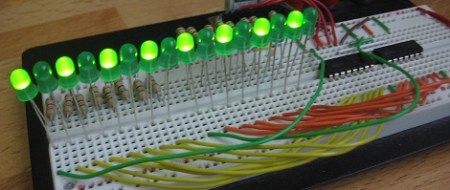
An ATmega168 was used for this build, although most Atmel chips can be made to work as an SPI master device. There are just three wires connecting the microcontroller to the shift register – SER, SRCLK, and RCLK. Like any other shift register setup, the build can be expanded by connecting the QH’ pin of the first 595 to the SER pin of the second.

[Mike] graciously made all the code for his build available. The video after the break is a 16-bit binary counter, a good stopping point before [Mike] rebuilds his Larson scanner/Cylon/Kitt, moving away from a PWM-based build to a register-based one.

Continue reading “Controlling Shift Registers Via SPI”

Shutter Trigger Remote With Some Nice Design Considerations

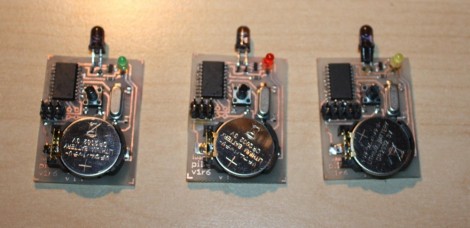
Here are the guts of [Lukasz’s] infrared camera remote control. He based it off of an existing design, but looked for places where improvements could be made. He felt the ATtiny2313 was a bit wasteful in this case. But further investigation led him to see why it was chosen. If you were to drop down to an ATtiny13 the ability to connect a crystal oscillator is lost (that chip only offers a 1-pin clock signal input) and the internal RC oscillator isn’t quite up to his standards for reliable IR communications.

Instead of driving the IR LED directly from an AVR pin he used a transistor in hopes that it will allow the maximum current to flow through the diode when in use. We’re not sure if it’s necessary, but we can see how it makes sense. Power is received from an unregulated 3 volt coin cell, so maybe as that voltage drops over time this will come into play.

Speaking of that coin cell, battery life is a concern here. [Lukasz] is using the sleep functions of the AVR after three seconds of use. This should keep the cell alive for quite a long time. But his 0 volt measurement is an anomaly with the multimeter he’s using. To get a precise measurement for tiny current flow you need extra equipment, like [Dave Jones’] uCurrent adapter.

The schematic for this Canon camera compatible project is only provided in Eagle format so we’ve embedded an image of it after the break for your convenience. You should have no problem making this work with a Nikon if you swap out some of the code from the TV-B-Gone shutter release we saw on Thursday.

Continue reading “Shutter Trigger Remote With Some Nice Design Considerations”

Looking Toward Christmas Decor By Learning About DMX

So Halloween finally arrived, we hope you had enough time to pull off your frightening feats in the way you had originally envisioned. Now it’s time again to look to the future and start planning this year’s Christmas decorations. Lights are always a popular theme, and this year you might want to look into DMX lighting controls and decide if that’s a route you want to take. [Akiba] has your back, he just put together a set of videos explaining the DMX lighting protocol and how to use it with an Arduino.

The thought here is that the Arduino can be used as a sort of DMX hub that is connected directly to a computer running open source controller hardware. It can send commands which the Arduino decodes, deciding whether to just pass them on to DMX compatible devices, or to do what it does best and control other hardware that is not normally accessible through the lighting command protocol. To the control program your four-dollar strand of LED lights looks no different from a thousand dollar stage light, making it cheap and easy to build your own entertaining holiday show right in your front yard. See the second video in this series after the break where [Akibo] details the hardware setup for his system. The other parts are available at the link above.

Be careful, this can be a consuming endeavor. Don’t believe us? Just look around and you’ll find no shortage of large DMX builds just for Christmas lights.

Continue reading “Looking Toward Christmas Decor By Learning About DMX”

Hackaday Links: October 28th, 2011

An accidental radial engine

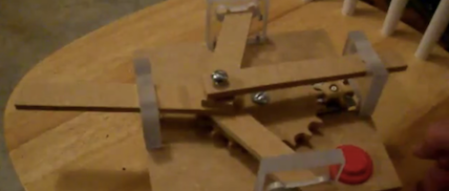
Hack A Day’s very own [Jeremy Cook] was trying to figure out how to push four ‘arms’ out one at a time. What he came up with is a very nice model of a radial engine. Everything was cut on a CNC router and a motor from an air freshener provides the power.

Using a candle to produce light

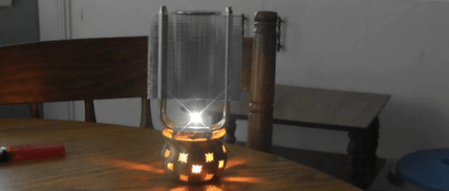
[Chris] sent in his Candela Amplifier. It’s a Pentium 4 heat sink with a very bright Cree Xlamp LED attached to the base. A bunch of Peltier thermoelectric units are attached to the underside of the heat sink. Put the whole thing on top of a candle, and you can light a room. With a candle. Oh, he’s selling these, by the way.

Objectification and video games?!

We really feel sorry for our lady readers. Guys have so many choices for Halloween costumes, but just about every costume available for women can be reduced to, “Sexy [noun].” Whelp, here’s the Sexy Game Boy, just in time for Halloween. [kazmataz] gets a few bonus points because she went with the DMG-01. It’s better than Sexy Chewbacca, so she’s got that going.

Prototypable 32-bit uCs

[Ng Yong Han] wrote in to tell us about some newish 32-bit PICs that are floating around. The datasheet for the PIC32MX1xx/2xx chips is pretty interesting – USB support and an audio and graphics interface. Oh, they come in PDIPs for ease of prototyping as well. We haven’t seen much from the PIC microcontroller faction recently (Atmel is winning the holy war, it seems). Anybody feel like building something with these?

Makerbot dual extruder


[Lomo] at TU-Berlin is taking a class in rapid prototyping. He built a second print head for his department’s Makerbot Cupcake with a few other students. The result are pretty impressive, although from what we’ve seen, it’s generating the G-code that’s a pain in the butt.

Huge Flexible LED Matrix Can Be Worn Almost Anywhere

lightbright_led_mesh

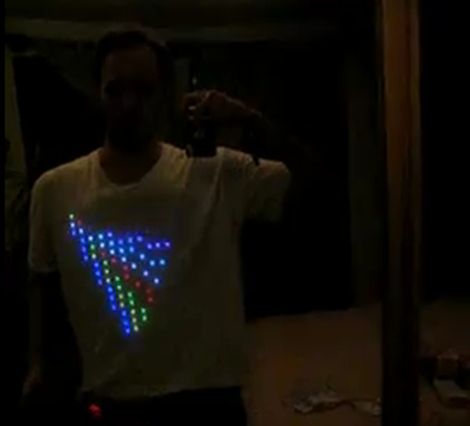
[Erik] has been keeping extremely busy with his latest project, a flexible RGB LED matrix that he calls “Project Light Bright”. The folks at BuildLounge tell us that this is the first entry they have received so far in their “Light Contest”, in which they are giving away a free laser cutter to the best entry.

[Erik] hand soldered ten 16×16 RGB LED panels together in order to build this display, and the results are awesome. The entire thing is controlled by a WiFi-enabled Beagleboard, which drives all of the panels and then some. The Beagleboard features embedded web and DNS servers, which allows it to act as a wireless AP, enabling him to control the display using any WiFi capable device. The Light Bright displays all sorts of predefined artwork, but [Erik] can also alter the display on the fly via his phone as well. The entire thing is powered by a reasonably sized LiPo battery pack that he keeps tucked away in his pocket, which allows the display to run continuously for about 20 hours.

Check out the video below to see a quick walkthrough of [Erik’s] Light Bright suit, then be sure to stop by his site for more videos, details and updates on the project.

Continue reading “Huge Flexible LED Matrix Can Be Worn Almost Anywhere”