Tired Of Web Scraping? Make The AI Do It

[James Turk] has a novel approach to the problem of scraping web content in a structured way without needing to write the kind of page-specific code web scrapers usually have to deal with. How? Just enlist the help of a natural language AI. Scrapeghost relies on OpenAI’s GPT API to parse a web page’s content, pull out and classify any salient bits, and format it in a useful way.

What makes Scrapeghost different is how data gets organized. For example, when instantiating scrapeghost one defines the data one wishes to extract. For example:

from scrapeghost import SchemaScraper
scrape_legislators = SchemaScraper(
schema={
"name": "string",
"url": "url",
"district": "string",
"party": "string",
"photo_url": "url",
"offices": [{"name": "string", "address": "string", "phone": "string"}],
}
)

The kicker is that this format is entirely up to you! The GPT models are very, very good at processing natural language, and scrapeghost uses GPT to process the scraped data and find (using the example above) whatever looks like a name, district, party, photo, and office address and format it exactly as requested.

It’s an experimental tool and you’ll need an API key from OpenAI to use it, but it has useful features and is certainly a novel approach. There’s a tutorial and even a command-line interface, so check it out.

Why LLaMa Is A Big Deal

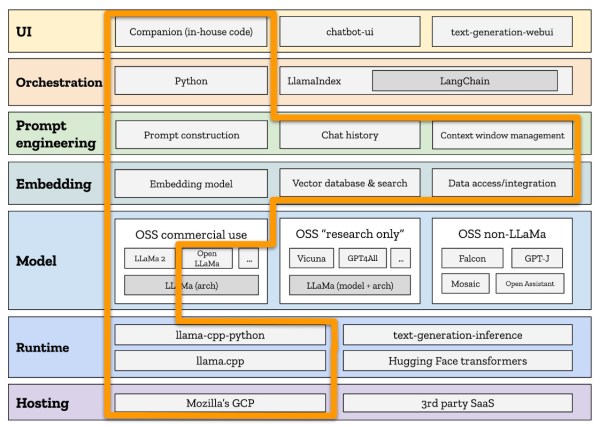
You might have heard about LLaMa or maybe you haven’t. Either way, what’s the big deal? It’s just some AI thing. In a nutshell, LLaMa is important because it allows you to run large language models (LLM) like GPT-3 on commodity hardware. In many ways, this is a bit like Stable Diffusion, which similarly allowed normal folks to run image generation models on their own hardware with access to the underlying source code. We’ve discussed why Stable Diffusion matters and even talked about how it works.

LLaMa is a transformer language model from Facebook/Meta research, which is a collection of large models from 7 billion to 65 billion parameters trained on publicly available datasets. Their research paper showed that the 13B version outperformed GPT-3 in most benchmarks and LLama-65B is right up there with the best of them. LLaMa was unique as inference could be run on a single GPU due to some optimizations made to the transformer itself and the model being about 10x smaller. While Meta recommended that users have at least 10 GB of VRAM to run inference on the larger models, that’s a huge step from the 80 GB A100 cards that often run these models.

While this was an important step forward for the research community, it became a huge one for the hacker community when [Georgi Gerganov] rolled in. He released llama.cpp on GitHub, which runs the inference of a LLaMa model with 4-bit quantization. His code was focused on running LLaMa-7B on your Macbook, but we’ve seen versions running on smartphones and Raspberry Pis. There’s even a version written in Rust! A rough rule of thumb is anything with more than 4 GB of RAM can run LLaMa. Model weights are available through Meta with some rather strict terms, but they’ve been leaked online and can be found even in a pull request on the GitHub repo itself. Continue reading “Why LLaMa Is A Big Deal”

ChatGPT, Bing, And The Upcoming Security Apocalypse

Most security professionals will tell you that it’s a lot easier to attack code systems than it is to defend them, and that this is especially true for large systems. The white hat’s job is to secure each and every point of contact, while the black hat’s goal is to find just one that’s insecure.

Whether black hat or white hat, it also helps a lot to know how the system works and exactly what it’s doing. When you’ve got the source code, either because it’s open-source, or because you’re working inside the company that makes the software, you’ve got a huge advantage both in finding bugs and in fixing them. In the case of closed-source software, the white hats arguably have the offsetting advantage that they at least can see the source code, and peek inside the black box, while the attackers cannot.

Still, if you look at the number of security issues raised weekly, it’s clear that even in the case of closed-source software, where the defenders should have the largest advantage, that offense is a lot easier than defense.

So now put yourself in the shoes of the poor folks who are going to try to secure large language models like ChatGPT, the new Bing, or Google’s soon-to-be-released Bard. They don’t understand their machines. Of course they know how the work inside, in the sense of cross multiplying tensors and updating weights based on training sets and so on. But because the billions of internal parameters interact in incomprehensible ways, almost all researchers refer to large language models’ inner workings as a black box.

And they haven’t even begun to consider security yet. They’re still worried about how to construct obscure background prompts that prevent their machines from spewing hate speech or pornographic novels. But as soon as the machines start doing something more interesting than just providing you plain text, the black hats will take notice, and someone will have to figure out defense.

Indeed, this week, we saw the first real shot across the bow: a hack to make Bing direct users to arbitrary (bad) webpages. The Bing hack requires the user to already be on a compromised website, so it’s maybe not very threatening, but it points out a possible real security difference between Bing and ChatGPT: Bing gives you links to follow, and that makes it a juicy target.

We’re right on the edge of a new security landscape, because even the white hats are facing a black box in the AI. So far, what ChatGPT and Codex and other large language models are doing is trivially secure – putting out plain text – but Bing is taking the first dangerous steps into doing something more useful, both for users and black hats. Given the ease with which people have undone OpenAI’s attempts to keep ChatGPT in its comfort zone, my guess is that the white hats will have their hands full, and the black-box nature of the model deprives them of their best hope. Buckle your seatbelts.

AI-Controlled Twitch V-Tuber Has More Followers Than You

Surely we have all at least heard of Twitch by now. For the as-yet uninitiated: imagine you had your own TV channel. What would you do on it? Although Twitch really got going as a place for gamers to stream the action, there are almost as many people jamming out on their guitars, or building guitars, or just talking about guitars. And that’s just the example that uses guitars — if you can think of it, someone is probably doing it live on Twitch, within the Terms of Service, of course.

Along with the legions of people showing their faces and singing their hearts out, you have people in partial disguise, and then you have v-tubers. That stands for virtual tubers, and it just means that the person is using an anime avatar to convey themselves.

Now that you’re all caught up, let’s digest the following item together: there’s a v-tuber on Twitch that’s controlled entirely by AI. Let me run that by you again: there’s a person called [Vedal] who operates a Twitch channel. Rather than stream themselves building Mad Max-style vehicles and fighting them in a post-apocalyptic wasteland, or singing Joni Mitchell tunes, [Vedal] pulls the strings of an AI they created, which is represented by an animated character cleverly named Neuro-sama. Not only does Neuro-sama know how to play Minecraft and osu!, she speaks gamer and interacts regularly with chat in snarky, 21st century fashion. And that really is the key behind Twitch success — interacting with chat in a meaningful way.

Continue reading “AI-Controlled Twitch V-Tuber Has More Followers Than You”