Art of 3D printer in the middle of printing a Hackaday Jolly Wrencher logo

3D Printering: Is Hassle-Free Bed Leveling Finally Here?

3D printers have come a long way over the past several years, but the process of bed leveling remains a pain point. Let’s take a look at the different ways the problem has been tackled, and whether recent developments have succeeded in automating away the hassle.

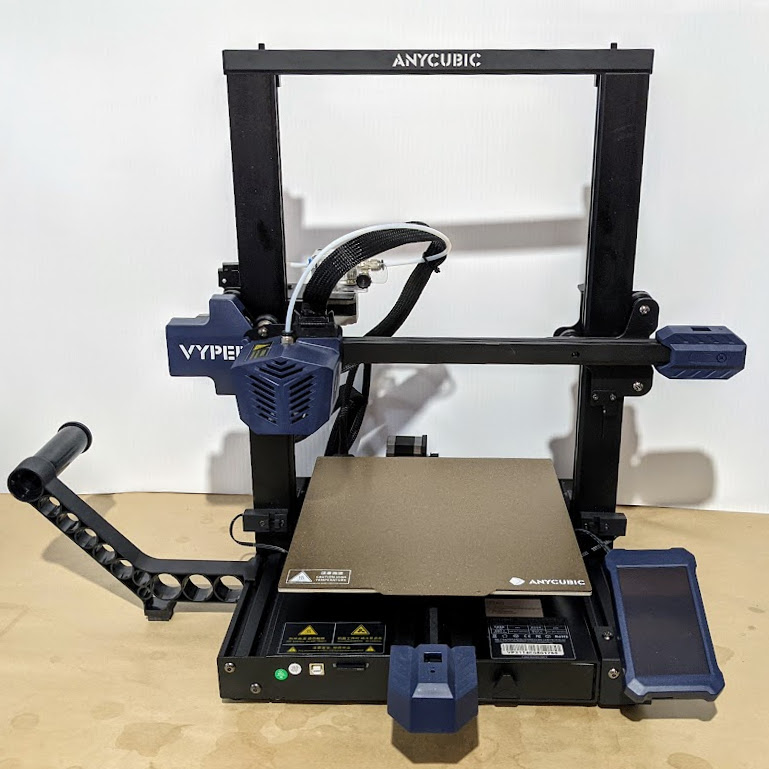
Anycubic Vyper 3D printer, front view
Anycubic Vyper, with an auto-leveling feature we decided to take a closer look at.

Bed leveling and first layer calibration tends to trip up novices because getting it right requires experience and judgment calls, and getting it wrong means failed prints. These are things 3D printer operators learn to handle with time and experience, but they are still largely manual processes that are often discussed in ways that sound more like an art than anything else. Little wonder that there have been plenty of attempts to simplify the whole process.

Some consumer 3D printers are taking a new approach to bed leveling and first layer calibration, and one of those printers is the Anycubic Vyper, which offers a one-touch solution for novices and experienced users alike. We accepted Anycubic’s offer of a sample printer specifically to examine this new leveling approach, so let’s take a look at the latest in trying to automate away the sometimes stubborn task of 3D printer bed leveling.

Continue reading “3D Printering: Is Hassle-Free Bed Leveling Finally Here?”

Occam’s Razor: Gardening Edition

While the impulse to solving problems in complex systems is often to grab a microcontroller and some sensors to automate the problem away, interfacing with the real world is often a lot more difficult than it appears. Measuring soil moisture, for example, seems like it would be an easy way of ensuring plants get the proper amount of water, but soil is a challenging environment for electronics and this solution often causes more problems than it solves. [Kevin] noticed this problem with soil moisture sensors and set about solving this problem with a much simpler, though indirect, method of monitoring his plants electronically.

Rather than relying on soil conductivity for testing soil moisture levels, he has developed an alternate method of determining if the plants need to be watered simply by continuously weighing them. The hypothesis that he had was that a plant that needs water will weigh less as the available water respirates out of the plant or evaporates from the soil. This means that using a reliable sensor like a load cell to measure weight rather than an unreliable one like a soil moisture sensor will result in more reliable data he can use to automate his plants’ watering.

[Kevin]’s build is based around an ESP32 and a commercially-available load cell which are all built into the base of the plant’s pot. The design hides all of the electronics in a pleasant enclosure and is able to communicate relevant info wirelessly as well. The real story here, however, isn’t a novel use of an ESP32 chip, but rather out-of-the-box problem solving by using an atypical sensor to solve this problem. That’s not to say that you can’t ever use other sensors to directly monitor your garden and automate its health, though.

Building An Electronic Tester For Measuring Arrow Stiffness

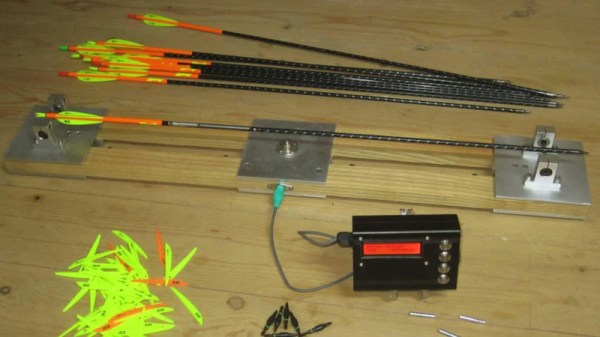
When shooting archery, if you want to be accurate, you need arrows of uniform specification and quality. One important part of this is making sure each arrow has a spine of similar stiffness. Traditionally, this is checked in a very analog way by using weights and measuring deflection of the arrow spine, but it can be done electronically too with this tester from [dvd8n].

The principle of operation is simple. The arrow is held up by two supports, 28 inches apart. The user then presses down in the center of the arrow, deflecting it by a 1/2 inch where itreaches a stop , and load cells at either end of the tester measure the force required to deflect the arrow by the set amount.

It allows arrows to be electronically measured in a fashion that is compatible with existing standards for measurement. The Arduino hardware which measures the load cells can also easily run conversion maths to display the arrow’s measured stiffness in whatever common spine measurement standard is desired. The system can also weigh the arrows, a useful thing to know for the home fletcher.

It’s a tidy build and one that should prove useful when [dvd8n] is building out their next quiver. We’ve seen other capable DIY archery hacks before, too. If you’ve got your own, drop us a line!


FISHBOT Reels Them In So You Don’t Have To

Fishing is generally thought of as a relaxing and laid-back activity, but it still requires a certain amount of physical strength and dexterity. This can be a problem for older anglers or those with physical disabilities. To bring back the simple joy of fishing to those who may no longer be able to hold a rod on their own, [Ozz] has been working on the FISHBOT.

The FISHBOT looks like a miniature crane, complete with an electric motor and winch to pull in the line. But there’s a bit more going on here than meets the eye. Anyone who’s tried to land a large fish knows you have to be cautious of snapping the line, so [Ozz] has added a load cell to the system that can tell when its being pulled too tightly. In the future he hopes to make this feature a bit smarter by taking into account additional variables, but for now it should at least keep the more energetic of your quarry from getting away.

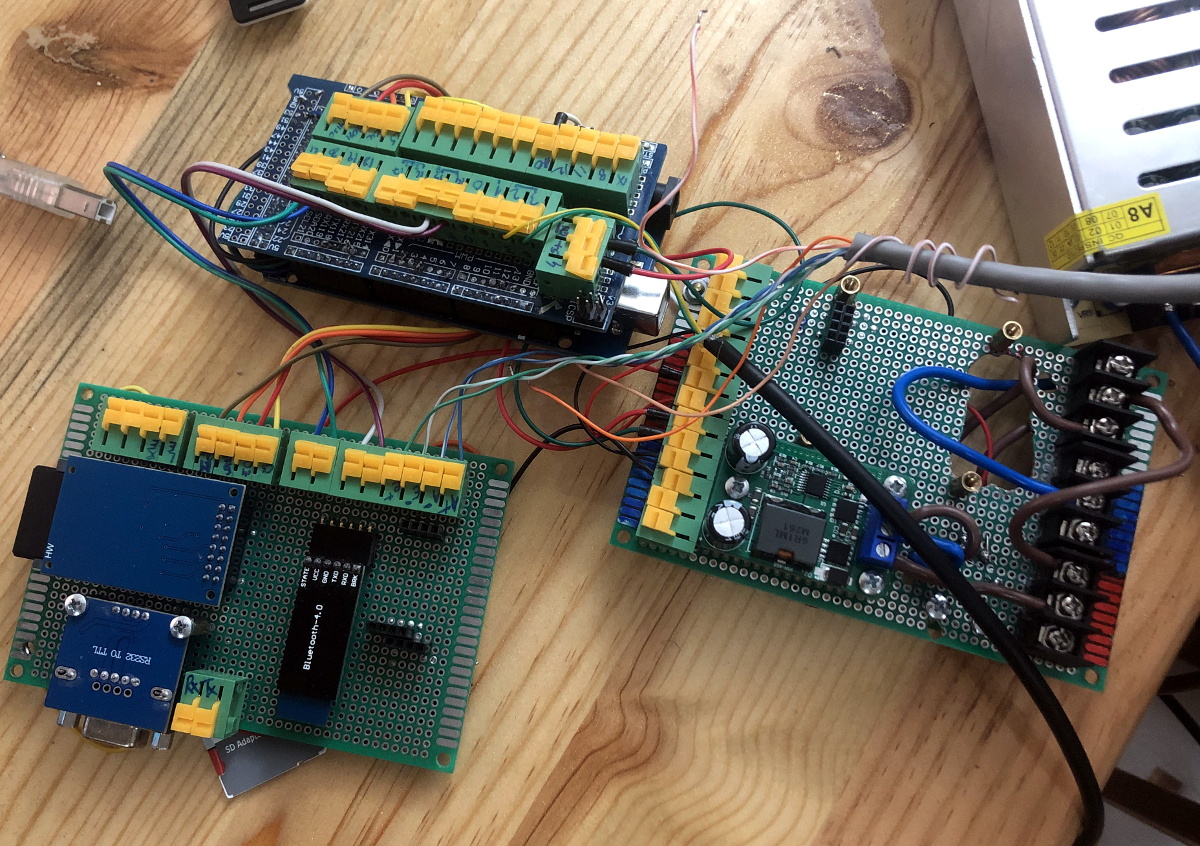
[Ozz] is controlling the beefy 400 watt motor with an IBT-2 H-bridge module connected to an Arduino Mega. The electronics can communicate with the user’s smartphone over a HM-10 Bluetooth module, which allows for more advanced features such as gesture controls that utilize the accelerometer in the phone. Long term, it sounds like he hopes to use the microcontroller in conjunction with the load cell to pull off more advanced tricks like weighing the fish and sending the data off to the user’s fishing buddies to show off.

In the past we’ve seen a drone used to get a lure out where the fish are, but catching one and reeling it back in is a very different challenge. It looks like [Ozz] still has some work to do on this project, but so far it seems things are going well. Being able to return a simple pleasure like this to those who thought their fishing days were behind them will surely prove worthy of the effort.

Continue reading “FISHBOT Reels Them In So You Don’t Have To”

“Hey, You Left The Peanut Out Of My Peanut M&Ms!”

Candy-sorting robots are in plentiful supplies on these pages, and with good reason — they’re a great test of the complete suite of hacker tools, from electronics to machine vision to mechatronics. So we see lots of sorters for Skittles, jelly beans, and occasionally even Reese’s Pieces, but it always seems that the M&M sorters are the most popular.

This M&M sorter has a twist, though — it finds the elusive and coveted peanutless candies lurking in most bags of Peanut M&Ms. To be honest, we’d never run into this manufacturing defect before; being chiefly devoted to the plain old original M&Ms, perhaps our sample size has just been too small. Regardless, [Harrison McIntyre] knows they’re there and wants them all to himself, hence his impressive build.

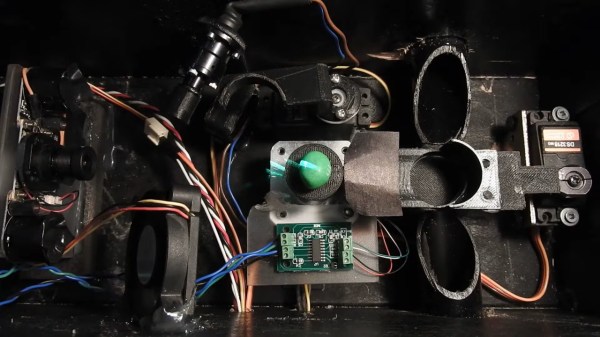
To detect the squib confections, he built a tiny 3D-scanner from a line laser, a turntable, and a Raspberry Pi camera. After scanning the surface to yields its volume, a servo sweeps the candy onto a scale, allowing the density to be calculated. Peanut-free candies will be somewhat denser than their leguminous counterparts, allowing another servo to move the candy to the proper exit chute. The video below shows you all the details, and more than you ever wanted to know about the population statistics of Peanut M&Ms.

We think this is pretty slick, and a nice departure from the sorters that primarily rely on color to sort candies. Of course, we still love those too — take your pick of quick and easy, compact and sleek, or a model of industrial design.

Continue reading ““Hey, You Left The Peanut Out Of My Peanut M&Ms!””

Tensile Testing Machine Takes 3D Printed Parts To The Breaking Point

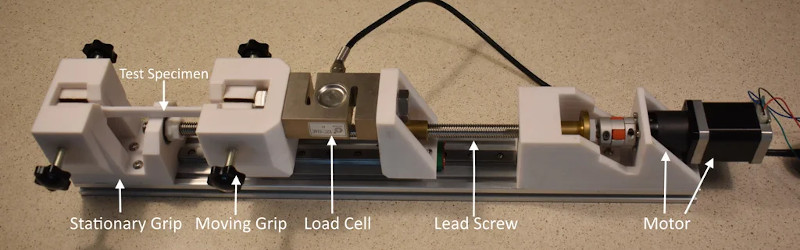
If you’re serious about engineering the things you build, you need to know the limits of the materials you’re working with. One important way to characterize materials is to test the tensile strength — how much force it takes to pull a sample to the breaking point. Thankfully, with the right hardware, this is easy to measure and  [CrazyBlackStone] has built a rig to do just that.

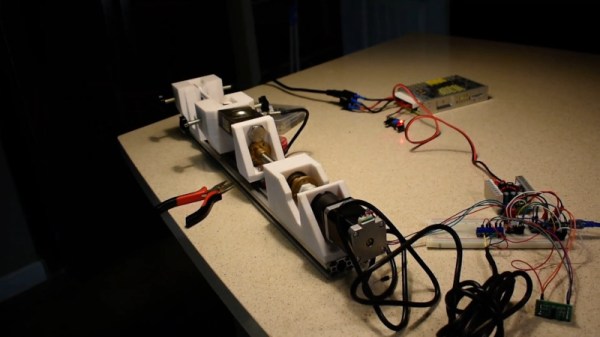
Built on a frame of aluminium extrusion, a set of 3D printed parts to hold everything in place. To apply the load, a stepper motor is used to slowly turn a leadscrew, pulling on the article under test. Tensile forces are measured with a load cell hooked up to an Arduino, which reports the data back to a PC over its USB serial connection.

It’s a straightforward way to build your first tensile tester, and would be perfect for testing 3D printed parts for strength. The STEP files (13.4 MB direct download) for this project are available, but [CrazyBlackStone] recommends waiting for version two which will be published this fall on Thingiverse although we didn’t find a link to that user profile.

Now we’ll be able to measure tensile strength, but the stiffness of parts is also important. You might consider building a rig to test that as well. Video after the break.

Continue reading “Tensile Testing Machine Takes 3D Printed Parts To The Breaking Point”

Cheap Lab Balance Needs Upgrades, Gets Gutted Instead

What is this world coming to when you spend seven bucks on a digital scale and you have to completely rebuild it to get the functionality you need? Is nothing sacred anymore?

Such were the straits [Jana Marie] found herself in with his AliExpress special, a portable digital scale that certainly looks like it’s capable of its basic task. Sadly, though, [Jana] was looking for a few more digits of resolution and a lot more in the way of hackability. And so literally almost every original component was ripped out of the scale, replaced by a custom PCB carrying an STM32 microcontroller and OLED display. The PCB has a complicated shape that allows the original lid to attach to it, as well as the stainless steel pan and load cell. [Jana] developed new firmware that fixes some annoying traits, for example powering down after 30 seconds, and adds new functionality, such as piece-counting by weight. The video below shows some of the new features in action.

Alas, [Jana] reports that even the original load cell must go, as it lacks the accuracy her application requires. So she’ll essentially end up building the scale from scratch, which we respect, of course. At this rate, she might even try to build her own load cell from SMD resistors too.

Continue reading “Cheap Lab Balance Needs Upgrades, Gets Gutted Instead”