A Tin Can Phone, But With Magnets

The tin can phone is a staple of longitudinal wave demonstrations wherein a human voice vibrates the bottom of a soup can, and compression waves travel along a string to reproduce the speaker in another can at the other end. All the parts in this electrical demonstration are different, but the concept is the same.

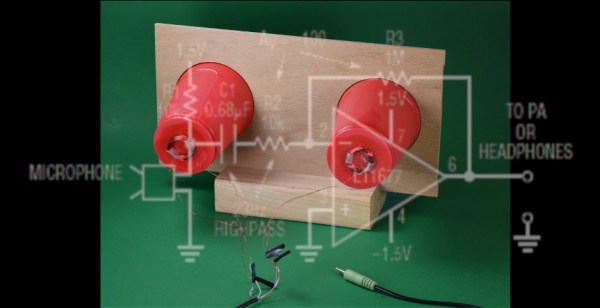
Speakers are sound transducers that turn electrical impulses into air vibrations, but they generate electricity when their coil vibrates. Copper wires carry those impulses from one cup to another. We haven’t heard of anyone making a tin can phone amplifier, but the strictly passive route wasn’t working, so an op-amp does some messy boosting. The link and video demonstrate the parts and purposes inside these sound transducers in an approachable way. Each component is constructed in sequence so you can understand what is happening and make sense of the results.

Can someone make a tin can amplifier transformer? We’d like to see that. In another twist of dual-purpose electronics, did you know that LEDs can sense light?

Continue reading “A Tin Can Phone, But With Magnets”

Wire Loop And Amplifier Solve Audio Problem For The Hearing Impaired

Imagine being asked to provide sound reinforcement for a meeting that occurs in a large room, where anyone can be the speaker, and in a situation where microphones would hinder the flow of the meeting. Throw in a couple of attendees who have hearing disabilities, and you’ve got quite a challenge to make sure everyone gets heard.

Such a situation faced [David Schneider] at his Quaker meetinghouse, which he ended up solving with this home-brew audio induction loop system. The worship style of conservative sects of the Religious Society of Friends, as the Quakers are formally known, is “silent worship”, where congregants sit together in silence until someone feels moved to share something. Anyone can speak at any time from anywhere in the room, leading to the audio problem.

Rooms mics and a low power FM transmitter didn’t work because those using radio as aids to hearing the service felt awkward, so [David] decided to take advantage of a feature in the hearing aids worn by some members: telecoils. These are inductive receivers built into some hearing aids to send sound directly to them using magnetic fields generated by a loop in the listening area. [David]’s loop ended up being 240 meters of 20-gauge copper wire in the attic above the meeting room. The impedance ended up close to 8 ohms, perfect for feeding directly from the speaker terminals of an old stereo amplifier. Pumping 160 Watts into the coil allows the hearing-aid wearers below hear the service now.

There’s still work to be done on the input side to improve audio quality, but [David]’s solution is elegant in that it helps those who need it most using technology they already have. And perhaps those who need but don’t yet have hearing aids can roll their own.

THAT Preamp

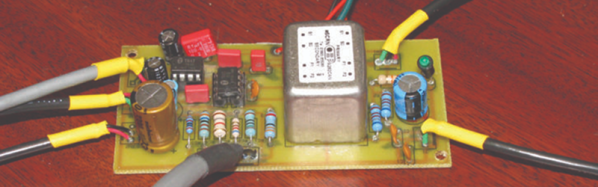
It is easy to cobble together projects these days. ICs make it simple and microcontrollers even easier. However, we always respect a project that really goes from concept to finished product and that’s what we liked about [Curt Yengst’s] “THAT” Thing microphone preamp.

In part 1 of his post about it, he talks about the basic ideas including the chips from THAT — a small but high-end audio chipmaker — he uses. The first chip is a low-noise audio preamp and the other is a balanced line driver.

In part 2, we get to see [Curt] go from breadboard testing to PCB fabrication all the way to the finished rack-mounted device with a good looking front panel. It worked, but like all designers, [Curt] was already thinking about the next version.

Continue reading “THAT Preamp”

Ted The Talking Toaster

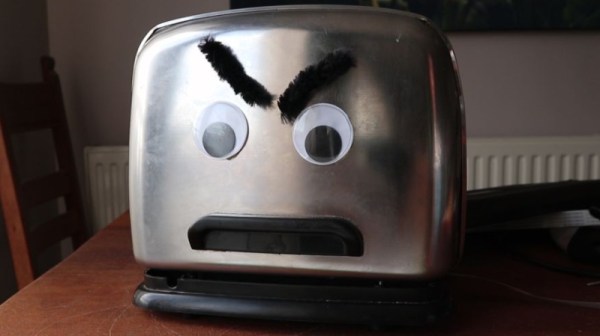
The team behind [8 Bits and a Byte] have built a talking toaster. More accurately, they retrofitted their existing toaster with some hardware components to make it appear to talk and get angry at its users. While the actual toaster functionality isn’t necessary for the build, it certainly allows the project to have a more whimsical vibe.

The project uses a Raspberry Pi 3 and a Google AIY kit, consisting of a HAT, microphone, and speaker. Servos control the movement of the toaster’s eyebrows with the help of the HAT. Some decorative materials in the form of googly eyes and pipe cleaners help bring other features of the talking toaster to life.

The control flow for the chatbot makes use of Google’s speech-to-text for picking up text from audio input, the Dialogflow API to match intent, and Text-to-Speech to pipeline possible answer back to the Raspberry Pi to play over a speaker. They also used Remo.tv to broadcast live updates from the toaster to anyone on an online feed, allowing users in a chatroom to talk directly to Ted.

While Ted’s communications may be quite limited, there’s certainly no limit to the number of interactions he’ll be having online now!

Continue reading “Ted The Talking Toaster”

Paper Cup Mic Is Fun And Functional

Any studio operator worth their Protools subscription will have a wide array of microphones to cover any conceivable situation. SM57s to cover guitar cabs, fancy gilded ribbon mics for vocal takes, and a variety of condensers to round out the selection. That’s all well and good for high-fidelity recording, but what if you want to go the other way? [LeoMakes] has just the thing, with his sub-$10 paper cup mic.

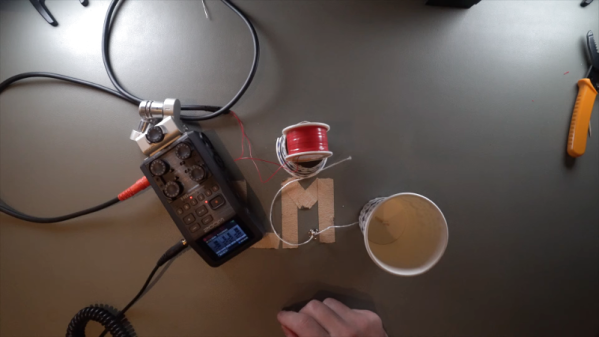
The basic concept is that of a dynamic microphone. A paper cup is attached to a taut string, upon which a magnet is affixed. Sound waves hitting the paper cup cause the string, and thus the magnet, to vibrate. The magnet is located within a coil, created from thin insulated wire wrapped around an old solder spool. This induces a current, creating the audio signal.

Results are as lo-fi as you’d expect, with the exact character of the sound changing depending on the tension of the string and the exact materials used. It’s a fun project that can be tackled with cheap materials, and there’s scope to create all manner of wacky mics by varying the parameters of the build. If you’re doing this more than once, however, you might want some help winding the coils — let this project be an inspiration. Video after the break.

Continue reading “Paper Cup Mic Is Fun And Functional”

Love Songs To The Microphone

A biographer of Frank Sinatra once commented that for singers like Sinatra, their instrument is the microphone. We tend to think of microphones as ideal transducers, picking up sound faithfully. But like most electronic components, microphones are imperfect. They have a varying frequency response. They pick up popping noises when we say words like “popcorn” that are normally lost to someone listening live.

[Cheddar] has an interesting video (see below) that covers how performers like Sinatra, Bing Crosby, and Billie Holiday learned to use the microphone to their advantage. They suggest that the microphone changed the way humans sing, and they are right.

Continue reading “Love Songs To The Microphone”

Build Your Own Anechoic Chamber

For professional-level sound recording, you’ll need professional-level equipment. Microphones and mixing gear are the obvious necessities, as well as a good computer with the right software on it. But once you have those things covered, you’ll also need a place to record. Without a good acoustic space, you’ll have all kinds of reflections and artefacts in your sound recordings, and if you can’t rent a studio you can always build your anechoic chamber.

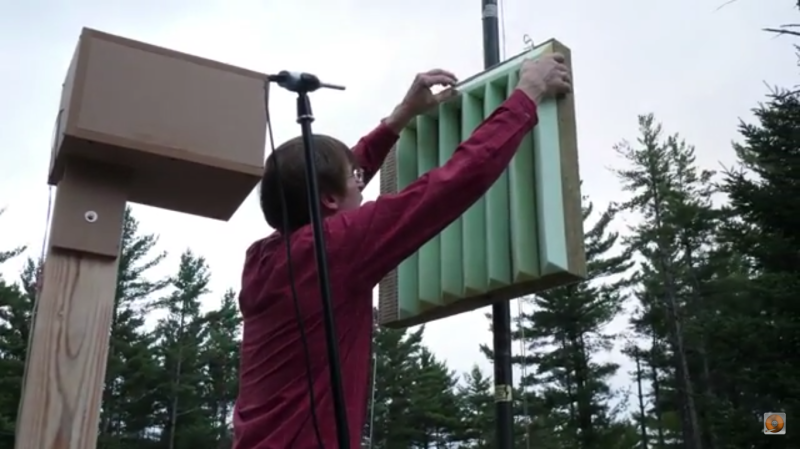
While it is possible to carpet the walls of a room or randomly glue egg crate foam to your walls, [Tech Ingredients] tests some homemade panels of various shapes, sizes, and materials against commercially available solutions. To do this he uses a special enclosed speaker pointed at the material, and a microphone to measure the sound reflections. The tests show promising results for the homemade acoustic-absorbing panels, at a fraction of the cost of ready-made panels.

From there, we are shown how to make and assemble these panels in order to get the best performance from them. When dealing with acoustics, even the glue used to hold everything together can change the properties of the materials. We also see a few other cost saving methods in construction that can help when building the panels themselves as well. And, while this build focuses on acoustic anechoic chambers, don’t forget that there are anechoic chambers for electromagnetic radiation that use the same principles as well.

Thanks to [jafinch78] for the tip!

Continue reading “Build Your Own Anechoic Chamber”