Whole House Current Monitoring

[youtube=http://www.youtube.com/watch?v=HlRBrTTLQFU]

[Debraj Deb] put together a current monitoring device that interfaces with the circuit box at his house. The system is controlled by a PIC 18F4520 and uses an LM358 Op-Amp to rectify the AC signal, as well as an MCP6S21 for range adjustments for detecting both high or low current loads. The data displayed on a character LCD includes average, RMS, and peak current. For now the data is saved to an EEPROM and can be dumped using a serial connection but [Debraj] plans to add a GSM modem so he can send energy use data to his cell phone.

[Thanks Ganesh]

SPRIME Controlled AC Outlets

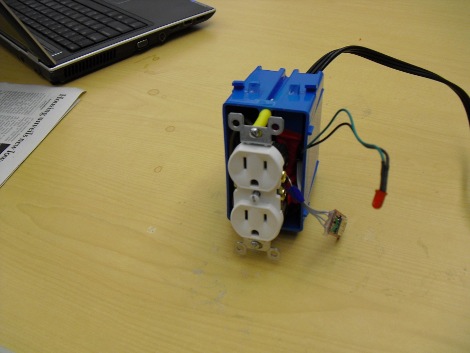
Reader [Tim Upthegrove] sent in a novel take on powering and monitoring AC outlets and devices called SPRIME, or Simple Powerline Remote Interactive Monitor and Enforcer. Compared to previous hacks, such as 120v switching or Quick cheap remote outlets, that only turned an outlet on or off; SPRIME allows not only control over outlets via the internet, but also power usage of devices currently plugged in.

We really liked their idea of giving power companies access to SPRIME outlets to reduce power consumption during peak hours, but sadly we don’t see it being implemented in homes any time soon. Catch a video of SPRIME after the rift.

[Thanks Chris McClanahan and Jeff Starker for the project, and deyjavont for pointing out our silly mistakes]

Continue reading “SPRIME Controlled AC Outlets”

PC Fan Failure Alarm

[youtube=http://www.youtube.com/watch?v=Jznl8U9zzKM]

Need to monitor not only if a fan is running, but if it is running fast enough? Check out this PC fan failure alarm circuit. After several failed attempts using various circuits, they settled on a Schmitt trigger. They even show a couple variations including a manual reset and a relay instead of a buzzer.

[via HackedGadgets]

CATaLOG: RFID Cat Tracking

rfidcats

Like many pet owners, [Pete] was curious about his little furry friend’s habits while he was gone. He decided to build an RFID tracking system to monitor their positions. This data would then be available on the web.  An Arduino handles the communication of the data, both to twitter and his personal cat tracking site. We were a bit surprised to see that the only data transmitted on the final project was whether the cat was inside or out. We’d like to see a heat map of the cat’s activity in the house.

Apple Logo Secondary Monitor

macbook

MacMod member [EdsJunk] has modified the Apple logo on his MacBook to act as a second video display (cache). There’s a video embedded below showing it playing Quicktime videos and the iTunes visualizer. Unfortunately there aren’t any details of the hardware used. From the display settings, it looks to have a resolution of at least 640×480. We hope to see more details soon.

Continue reading “Apple Logo Secondary Monitor”

LCD Repair

lcd

[Andrew] sent us this great breakdown of an LCD monitor repair. After his wife’s monitor developed an issue with rippling in the picture, he was forced to decide between trashing it, or fixing it. He decided for the latter, possibly to his wife’s disappointment. The rippling image could easily be attributed to a failed filter in the power supply. Knowing that capacitors are a prime suspect in these cases, he tore in, looking for failures. He found that there were, in fact, 2 bad capacitors on the back light circuit. After replacing them with newer, higher quality ones, the monitor was as good as new.

Deogen, Tiny Monitor Tester


Deogen is a small, self contained device for testing monitors. It was designed back in 2000 to reduce the amount of space and effort required to test monitors in a computer shop. The initial design used an AT90S1200 microcontroller to generate test patterns for the monitors. Being about the size of a portable CD player, it was much easier to take to any monitor and plug in for testing.

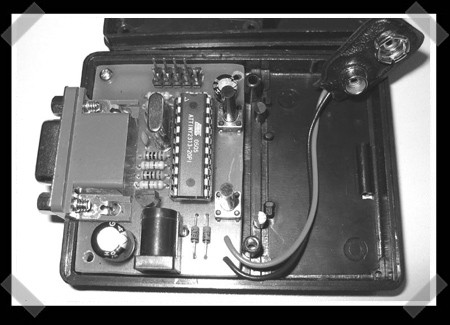
Version two of the device, pictured above, is much smaller, being about the width and height of a credit card. The depth is slightly larger than a 9 volt battery. Compared to the last vga test project we ran, this one is tiny. The unit boasts a decent set of features, such as; eight test patterns at four different resolutions, battery or DC power, and small form factor.

The processor of version two is an ATtiny2313 at 20MHz, and controls the H sync and V sync signals directly. The RGB is converted to analog using a resister network. The power circuit is custom made for low power consumption, though they note that a 78L05 equivalent unit could be used in its place.

The plans for the PCB and the software are available from their site. Head on over and check out some pictures of it in action.

[Thanks, Philip Fitzgerald]