Giant Oscilloscope Music Display

oscilloscope_wall

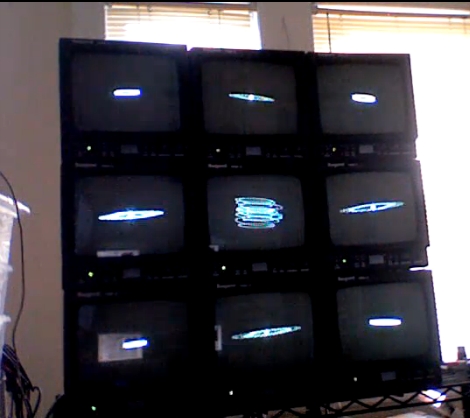
[Andrew] sent us a video of his home made oscilloscope wall, which he uses to visualize different audio tracks he has created. The wall is made up of nine old broadcast monitors he wired together in his studio. At first it appears that the monitors are split into two sets of four, with the center monitor running separately, but upon further inspection it looks as if he can control the display of each monitor independently.

We’re pretty sure he is not using an actual oscilloscope to generate the visuals, but rather visualization software that can approximate the output of an O-scope set in X-Y display mode. Though the screens run independently, it would be great to see all nine screens working in concert to display one large visualization. [Andrew] mentions that an high-def version is in the works, so perhaps we’ll see more features added in that iteration.

Stick around to watch a video of his oscilloscope wall in motion.

Continue reading “Giant Oscilloscope Music Display”

IR-controlled Musical Alarm Clock

Music-Playing-Alarm-Clock

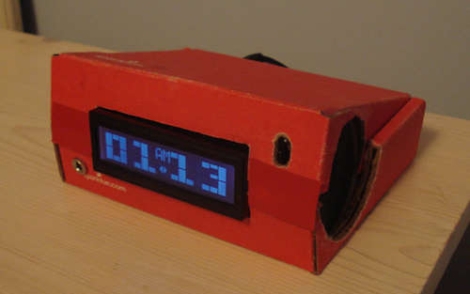
Forum user [Frank] shared with us his recent project, a musical alarm clock. More than just a simple alarm clock, his creation allows the user to load music onto a micro SD card, has alarm settings for each day of the week, and best of all, can be controlled using an IR remote. He uses a Teensy++ to control most of the clock’s functions including the display, delegating the time keeping to a DS1307 real-time clock. All of the audio playback is handled by a separate music decoder mounted on a breakout board.

His Instructables writeup is extremely detailed, with tons of annotations, pictures, diagrams, and source code available. He walks through each step in detail, making this a great learning guide for others looking to start in on AVR programming.

His final presentation is a great lesson in recycling, though unfortunately a bit lackluster, as the clock is packaged in an old SparkFun cardboard box. He does mention that there were some time constraints towards the end, which may explain this choice – it would be nice to see a revised version of this clock packaged in a nice plexi case.


Valentine’s Day Love Song Machine

tellart_bell_ensemble

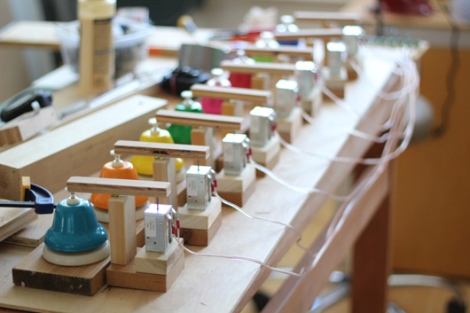
Just in time for Valentine’s day, [Adam Meyer] and the folks over at tellart.com have put together a little project they call the “Love Song Machine“. Using a web-based form, anyone can submit a song, which will then be played on a system of bells that they have set up in their office. You can choose from several pre-defined love songs, or you can create your own unique arrangement with which to serenade them. Once you are ready to go, your song will be queued up, and you can watch a video of your creation as it is being played.

The system is comprised of 8 solenoid-actuated bells which are all controlled by the Arduino they have hooked up to their web server. It’s a pretty fun idea, and there are sure to be plenty of people submitting songs, so get yours in before things get too busy!

Keep reading to see a video preview of their system in action.

Continue reading “Valentine’s Day Love Song Machine”

Range Finder Musical Toy

parallax_arduino_ping_organ

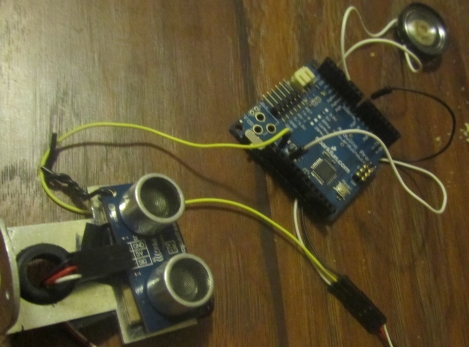
Instructables user [sketchsk3tch] was looking to make a fun toy for his kids using things he had around the house and came up with the Ping Organ. The organ is played by standing in front of the Parallax Ping range sensor, and moving around any which way you please. He interfaced the range sensor with an Arduino, scavenging a small speaker from an old toy for audio output.

The code for the project is fairly straightforward, borrowing most of it from the demo software that shipped with the Ping and the Arduino. He made a few small tweaks in order to get the organ to play frequencies of actual notes, as well as to allow for some flexibility when calculating the specific note to play.

While not the most complex project we have ever featured, [sketchsk3tch] reports that his kids love to spend time flailing around wildly in front of the organ, which is exactly what he intended.
Video of the organ being tested after the break.

Continue reading “Range Finder Musical Toy”

More 555 Projects To Enjoy

We love all of the projects that are coming out for the 555 design contest, so we thought we would share a couple more that have caught our collective eye.  Have a 555 project of your own? Be sure to share it with us, and keep an eye out for the contest submission dates. Read on for a few of our project picks.

Continue reading “More 555 Projects To Enjoy”

Solderless Drawdio Terminally Implemented

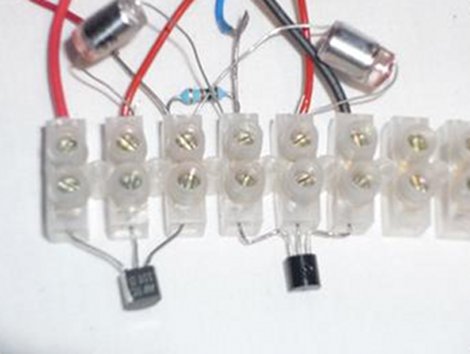
So you’re stuck in a boring class and you can’t fight off the urge to hack something, even your pencil, to pass the time. Maybe you are performing a live electronics show and you drop your synth down a flight of stairs and all that you are left with is a handful of components, a screw terminal block and a pencil. There are thousands, perhaps millions of these kinds of situations and for each one the answer is the solderless drawdio clone by [Martin].

You may have seen the original Drawdio here before, a fun piece of technology that is simple enough to recreate. This latest approach would make an excellent introductory project for a hacking workshop seeing as the guide is straightforward and the lack of soldering would make logistics so much easier. The results are very similar to the original–check the video after the break. Continue reading “Solderless Drawdio Terminally Implemented”

IM-ME Plays Music In Preparation For Gaming

[Emmanuel Roussel] is coding a version of Tetris for the IM-ME. Before you get too excited, he hasn’t actually written the game yet, but instead started with the familiar theme music. The IM-ME has a piezo speak on board so it’s just a question of frequency and duration. [Emmanuel] developed an Open Office spread sheet that calculates each note’s frequency and the timer value needed to produce it. He then created a data type that stores a note and its duration and used an array of those structures to store the song. If you’ve ever wondered how to cleanly code music this is a wonderful example to learn from because right now the code doesn’t have anything other than that code to get in the way.

The ground work for this was established in the other hacks we’ve seen. Now we’re left wondering who will finish coding their game first. Will it be [Emmanuel’s] Tetris or [Travis’] Zombie Gotcha?