EL Wire: Make It, Connect It, Power It

[Jeri’s] back with a series of videos that outlines the step-by-step electroluminescent wire manufacturing, making EL panels from PCBs, and assembling power supplies for EL hardware. These concepts are actually quite approachable, something we don’t expect from someone who makes their own integrated circuits at home.

The concept here is that an alternating current traveling through phosphors will excite them and produce light. You need two conductors separated by a dielectric to get the job done. For wire, [Jeri] uses one strand of enameled magnet wire and one strand of bare wire. The enamel insulates them, protecting against a short circuit.

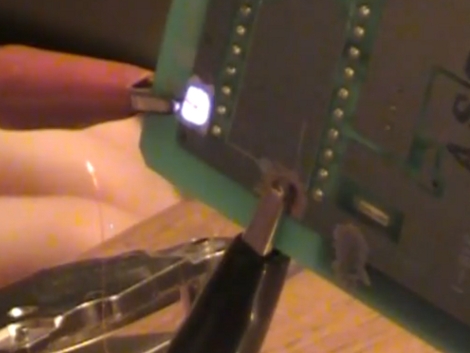
But that’s not all, she also tests using a circuit board as an EL panel. By repurposing the ground plane as one of the conductors, and using the solder mask as the dielectric she is able to paint on a phosphor product resulting in the glowing panel.

Finally, you’ve got to get juice to the circuit and that’s where her power supply video comes into the picture. We’ve embedded all three after the break. It’s possible that this is cooler than blinking LEDs and it’s fairly inexpensive to get started. The circuitry is forgiving, as long as you don’t zap yourself with that alternating current.

Continue reading “EL Wire: Make It, Connect It, Power It”

A Different Take On Electric Motor Cars

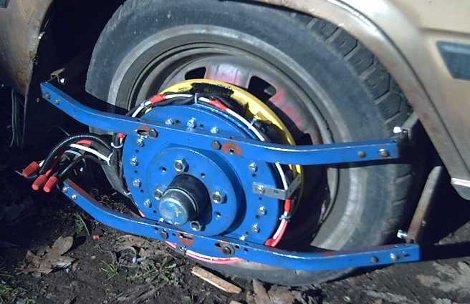
[Craig Carmichael] has been hard at work on his electric hub motor for cars. Unlike typical electrical vehicles the plan is to bypass the transmission, differential, and everything else all together by connecting directly to the hub of the wheel. The goal of giving greater thrust and still allowing the use of a gas engine if need be.

There’s really too much detail for us to even begin to try to explain the entire project in a short recap, but [Craig] builds the entire motor (from magnets to coil windings) and wires his own controller (from schematic to finished PCB), all while documenting the process thoroughly for those wishing to make their own.

Negative Laser Etching

[James] has been refining a method of negatively etching metal with a laser. He had been using a product called Thermark which is designed for this process, but it’s quite expensive. He found that paint designed for wood stoves works just as well. To prepare the surface he bead blasted it and then cleaned of the residue and finger prints off with acetone. The board was preheated in an oven before covering it with the spray paint. He ran the laser at 98/100 power and 90/400 speed at a step size of 0.1mm to achieve the results above. This should immediately make you think about making circuit boards. We’d love to ditch the toner transfer and we’re always looking for one more reason to get a laser cutter.

PCB Trace Antenna

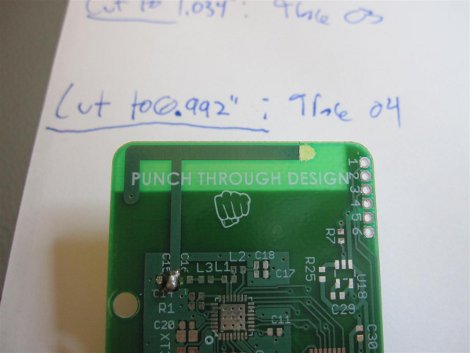
If you’re working on a device that includes RF wireless, [Colin’s] Guide to PCB Trace Antenna Design might clear some headaches when sending off for PCBs. While it is directed at devices transmitting at 2.4GHz, the techniques and recommended equipment (read: espresso smith charts and network analyzers) should work for almost any frequency. While trace antennas aren’t as easy to implement as a measured wire, the space benefits make up for the difficulty. Unless you don’t mind how larger your project is, did someone say cantenna?

Hackaday Links: August 1, 2010

PCB Group Orders

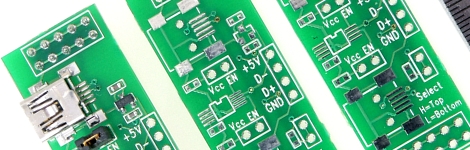
[Phil] wrote in to let us know about the DorkbotPDX group orders. The site makes group PCB orders until a cutoff date or the panel is full. You get three copies of your design with no setup fee for just $5/square inch including domestic postage. Not a bad price. We aren’t affiliated with them, but we’re always looking for board production options for hobbyists. BatchPCB is another popular one, and if you need help getting your design ready we’ve got your covered.

Aspire One MAME cabinet

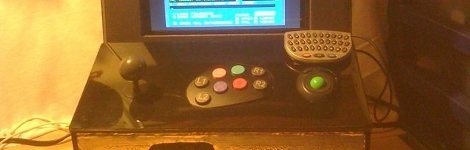
[Tim] built a MAME cabinet using foam board and some USB peripherals. Inside you’ll find an Acer Aspire One netbook. This build is quick, cheap, and if you get tired of it you won’t feel you’re stuck with it in the way owners of other MAME cabinet builds might.

Embedded Cake

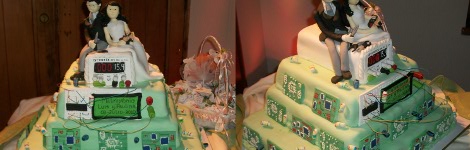
If you are an embedded programmer who happens to be marrying another embedded programmer take note. This wedding cake is perfect for you; decorated with character LCD screens, solderless breadboards, and development boards along with the wires that connect them all together. [Francirius], a read from Chile, says this cake was the handy work of [Paulina Verdejo].

Scoreboard From Scratch

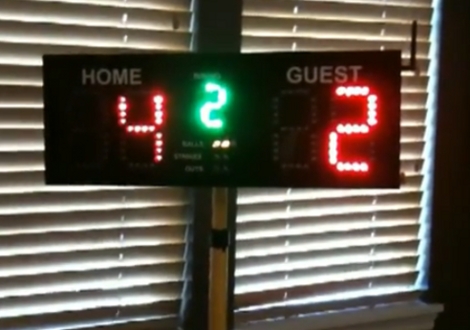
[Kenneth] built this scoreboard for use at a ballpark that lacks such luxuries. We think this a phenomenal application for his skill and his pocketbook. He laid out PCBs for each digit in Eagle and etched them himself, then installed the indicators for home score, visitor score, inning, balls, strikes, and outs in a laser cut case. A pretty beefy battery along with the folding stand make this quite portable.

In the demo video after the break he’s connected to the scoreboard via telnet to update the score. This trick is accomplished using SparkFun’s WiFly GSX breakout board to set up an adhoc wireless network. The goal is to write an iPhone app that will be used to control the board in the field (or the outfield as it were).

This could definitely be used for different types of scoring during the off season.

Continue reading “Scoreboard From Scratch”

Nixie Sudoku: A Look At The Hardware

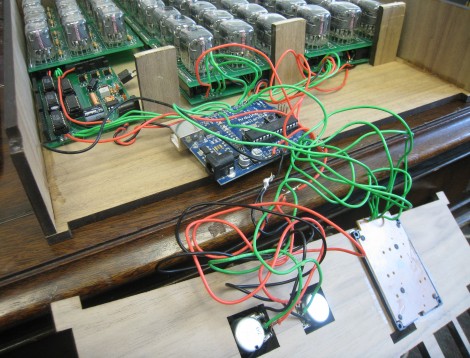
We’re always happy to receive a tour of the guts that make things work. [John Sarik] posted several pictures and descriptions of the hardware that makes up his Nixie Sudoku build. The modular design uses professionally made circuit boards which greatly improve the durability of a large set of circuits such as this.

The design draws on good ideas from similar hardware. The Nixie Duo kit from Ogi Lumen allows tubes to be mounted on top of driver boards with cascading shift registers for control of up to 8 tubes. The ArduiNIX shield makes the high voltages needed for Nixies easy to control with an Arduino. No, [John] didn’t just order these kits and plug them into each other. He designed his own boards to suit his needs. Each driver board can control 9 tubes in a 3×3 grid, all on one PCB. His high voltage board can supply enough juice for the whole system which is tied together with a single Arduino board.

His writeup is quite interesting so do take a look. He also filmed a walk through video which we’ve embedded after the break. It clears up some questions, such as showing the use of a blinking decimal point to indicate the current cursor position.

Continue reading “Nixie Sudoku: A Look At The Hardware”