Fiber Optic Flash Ring

ring

For those who enjoy photography, a ring light is a nice tool to have. Being hackers, making your own seems only logical. This writeup will take you through the process of making one from fiber optics for super cheap. They basically gutted some fiber optic toys and strapped them to the lens. Sure there was a little more work involved, but that’s the gist of it. You may recall some more in depth fiber optic ring lights using LEDs or cold cathodes that we covered before.

[via Hacked Gadgets]

Hands Free Point Of View Camera

handsfree

Here’s an odd little footnote we found while perusing the Comic Tools blog. [Matt Bernier]’s blog is dedicated to drawing and inking tutorials for comic artists. He uses a lot of example photographs that involve both hands. This week, at the bottom of his post on cleaning brushes, he included a photo to illustrate how he takes all of these point of view shots. The camera is strapped securely to his head using an old lanyard. He can see the display and access the controls on the back. After composing his shot, he just sets the timer, and you get a picture of what the process looks like from his perspective. Sure, it looks silly from this angle, but it really helps out the posts.

Macro Photography With An IPhone


The camera lens on the iPhone is much like any other cameraphone lens in the fact that the lens has a fixed minimum and maximum focus length. If you want to get a little closer to your subject, you just might want to give [eastrain’s] macro camera mod a try.

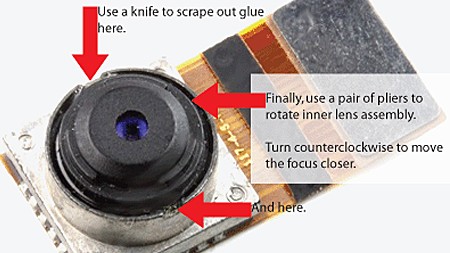
According to [eastrain] both first and second generation iPhone cameras have a screw type focus ring that has been glued to infinity from the factory. This was probably set so that 99% of your photos were roughly in focus.

Gaining access to the camera lens requires the disassembly of your phone and will undoubtedly void any type of warranty you may have had. Once the lens is in view you will need to break the 2 glue points that hold the lens at its current position.

Using needle nose pliers you can then rotate the lens counter clockwise to increase the zoom or clockwise to decrease it. Enabling the built in camera app allows you to see in real time your changes. When you’re satisfied, just put everything back together. Of course the next step should be an externally mounted ring to allow manual zooming on the fly.

Guide To Creating Small Planets


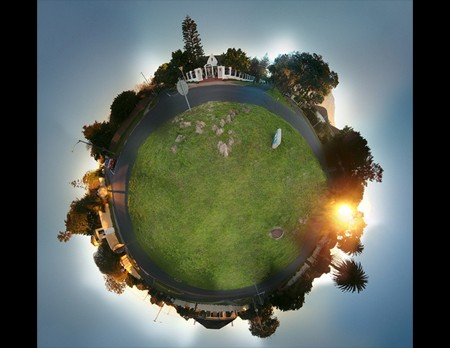
We at Hackaday often dream of having our own personal planets where we wouldn’t have to deal with other people, but our spaceships aren’t quite ready. While we figure that out, you can do the next best thing: render small planets using Photoshop or GIMP with a few other graphics apps and this guide to making small planets like the one pictured above.

Continue reading “Guide To Creating Small Planets”

StereoData Maker


So you got CHDK working on your camera, and the histograms, raw image files, variable shutter speeds and other added functions are amazing, but stereo imaging is what you really want. If you have two or more CHDK-ready cameras, it’s cheap and easy to run StereoData Maker, a system that synchronizes the shutter and flash of multiple cameras.

The first step in getting SDM to work is installing the software on your SD card. You’ll need to find the correct version for you camera; a list is available on the main SDM page. If you are running Windows XP or Vista, run the installer in the zip file. Otherwise, load the files on the SD card and run the installer directly from the camera. Then decide whether this will be the right or left camera and repeat the steps for your second camera.

Next, you’ll need to prepare a switch unit, essentially a set of synchronized USB remotes. There are many ready made commercial units available, but building one on your own shouldn’t be much trouble, and a few ideas are provided on the SDM instruction page.

You’re basically ready to start shooting stereo images, just take a few test shots to get used to it and to customize the configuration on the cameras.

Arduino PhotoLab


Droplet photography (link translated from French) often produces simple and beautiful images, but timing the exposure can be tricky. Snapping the photo too early or too late can cause you to miss the action, which only lasts a fraction of a second. EquinoxeFR (the people behind the Asus WL500GP audio hack) came up with a solution to this problem using a circuit with an ATmega168 running an Arduino environment. The circuit controls a syringe that contains a liquid and is triggered remotely to release a drop into a darkened chamber. A camera with the shutter open is attached to the chamber, and before the droplet hits, it crosses an IR sensor that triggers the flash to go off a few milliseconds later, capturing the unique crown shape of the impact. No schematic is available as yet, but comments at the bottom of the post suggest one will be coming soon.