
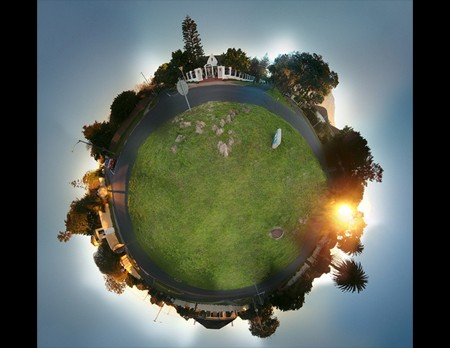
We at Hackaday often dream of having our own personal planets where we wouldn’t have to deal with other people, but our spaceships aren’t quite ready. While we figure that out, you can do the next best thing: render small planets using Photoshop or GIMP with a few other graphics apps and this guide to making small planets like the one pictured above.
photography213 Articles
StereoData Maker

So you got CHDK working on your camera, and the histograms, raw image files, variable shutter speeds and other added functions are amazing, but stereo imaging is what you really want. If you have two or more CHDK-ready cameras, it’s cheap and easy to run StereoData Maker, a system that synchronizes the shutter and flash of multiple cameras.
The first step in getting SDM to work is installing the software on your SD card. You’ll need to find the correct version for you camera; a list is available on the main SDM page. If you are running Windows XP or Vista, run the installer in the zip file. Otherwise, load the files on the SD card and run the installer directly from the camera. Then decide whether this will be the right or left camera and repeat the steps for your second camera.
Next, you’ll need to prepare a switch unit, essentially a set of synchronized USB remotes. There are many ready made commercial units available, but building one on your own shouldn’t be much trouble, and a few ideas are provided on the SDM instruction page.
You’re basically ready to start shooting stereo images, just take a few test shots to get used to it and to customize the configuration on the cameras.
Arduino PhotoLab
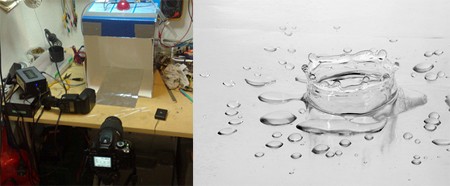
Droplet photography (link translated from French) often produces simple and beautiful images, but timing the exposure can be tricky. Snapping the photo too early or too late can cause you to miss the action, which only lasts a fraction of a second. EquinoxeFR (the people behind the Asus WL500GP audio hack) came up with a solution to this problem using a circuit with an ATmega168 running an Arduino environment. The circuit controls a syringe that contains a liquid and is triggered remotely to release a drop into a darkened chamber. A camera with the shutter open is attached to the chamber, and before the droplet hits, it crosses an IR sensor that triggers the flash to go off a few milliseconds later, capturing the unique crown shape of the impact. No schematic is available as yet, but comments at the bottom of the post suggest one will be coming soon.
Hack Cameras With The Image Fulgurator
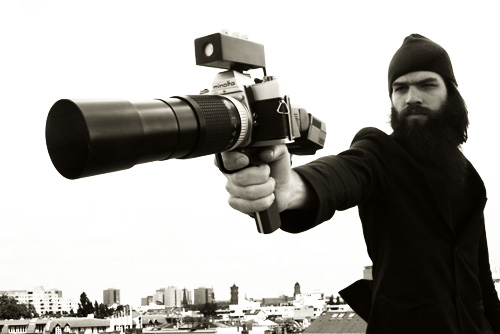
[Wallace] sent in this awesome project built by [Julius Von Bismarck]. The “Image Fulgurator” is the result of mating an optical slave flash with a camera body turned projector. The result is the ability to project ghost images onto a picture being taken by anyone using a camera with their flash. Check out the demo video after the break or hit the project site for more.
Eye-Fi Explore Review
[flickr video=http://www.flickr.com/photos/pauls/2611298593/]
The WiFi uploading Eye-Fi SD card made a big splash when it was first introduced, but now Eye-Fi has a whole line of different products. The top of the line is the Eye-Fi Explore, which supports geotagging without using a GPS. Instead of GPS hardware, it uses the Skyhook Wireless Wi-Fi Postitioning System, which correlates the position of the Eye-Fi’s access point to GPS locations, creating virtual GPS functionality. This allows photos taken with the Eye-Fi to be be geotagged. Of course, the accuracy of the system is noticeably lower than true GPS and seems to be affected by a number of external factors, but it is still accurate enough to tag the photo within the immediate vicinity of where it was taken.
WiFi positioning is great feature, but certainly not limited to photography. Since the Eye-Fi is at its core SD storage media, you could probably have it geotag data saved to the card, even if it wasn’t created by a digital camera..
Consumer Reports Releases Vintage Photos
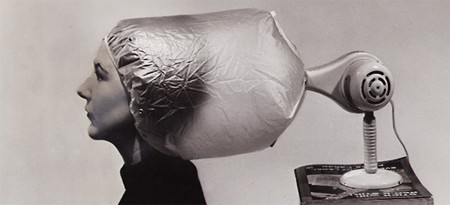
Consumer Reports has just released this photoset of vintage photos of consumer product tests. It includes photos of conventional products like the one above (a portable hair dryer), but also some interesting tech that never took off, like a motorized scour pad and a record player for cars. The products depicted in the set are all from before the 1970s (and remember, a few machines from back then were able to do some pretty impressive things), so whether you’re into old tech for its own sake or you’re just looking for photography of really old tv consoles, get a look.
[via Laughing Squid]
Laser Insect Photography Rig
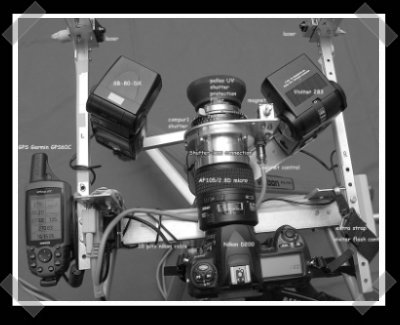
[Marc] sent in this awesome insect photography rig. The camera is manually pre-focused and set for a 30 second exposure at ISO100. The aluminum cylinder in front of the lens is an external shutter mounted with a custom turned lens adapter. It’s used because the built in shutter is too slow for insect capture. The camera/shutter is triggered by a pair of lasers with photo detectors. When both beams are broken, the insect should be in front of the lens. A Garmin GPS provides position information that’s tagged on the image by the Nikon D200. A large photo of the rig is here, while a more detailed writeup on building it is here.
Update: It looks like we covered a previous version of this rig, but the old links are down and we didn’t have a shot of the setup. Oh, and I forgot to mention [Marc] new control box for running this rig.









