Telepresence Robot Lets You Play A Hand Of Cards

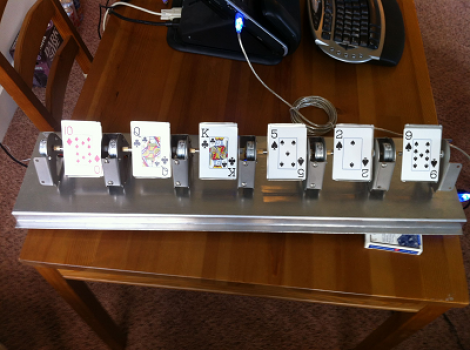
Virtual card games proliferate the interwebs, but this card-playing telepresence device is unique. [Patrick] calls the project Vanna, and we’d bet that’s an homage to the tile-flipping TV star [Vanna White]. Much like she flips the blank tiles to reveal letters, this device can flip the hand of cards either face up or face down.

Each of the six card trays is connected to a stepper motor. The local player deals the hands, placing each card in a tray so that it faces the webcam for the remote player. That remote player has an on-screen interface that can discard by tilting the tray forward and dropping the card on its face, or play a card by tilting toward to the local player so they can see its face value. All becomes clear in the clip after the break.

The hardware is USB controlled from a Windows machine thanks to the PIC 18F4585 which controls it. But it should be quite simple to get it talking to the OS of your choice.

Continue reading “Telepresence Robot Lets You Play A Hand Of Cards”
Player Guitar Sounds Wonderful; Makes Us Drool Because Of The Complexity

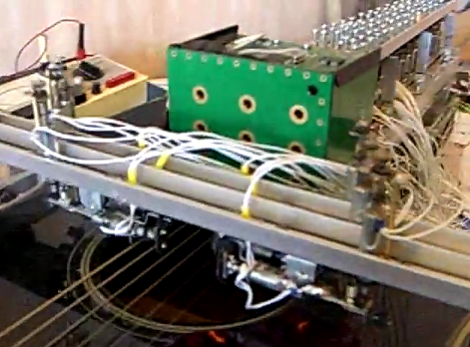
It becomes obvious when you listen to this player guitar that it’s not a human being playing. But the only reason for that is the unrelenting precision with which the songs are played. In addition to that accuracy, it’s interesting to note that this tune is normally played by a group of guitarists but here the machine manages to do it on one instrument. And we think it sounds fantastic!

This comes from [Vladimir Demin], a maker who previously built an automatic Bayan (like an accordion but with buttons where the keyboard is normally found). This time around it’s the six strings and many frets of a guitar that have been outfitted with one solenoid each. In the image above you can see the strumming mechanism mounted near the tone hole. Six picks are held in place, and it appears that each has two solenoids. From what we can observe in the video, one of the solenoids is used to strum the sting, the other tilts the pick mount so that there won’t be a second strumming when the pick is returned to its starting position.

Continue reading “Player Guitar Sounds Wonderful; Makes Us Drool Because Of The Complexity”

Standalone USB Temperature Logger

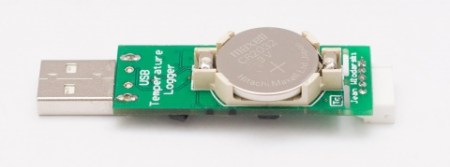
[Jean] wrote in eager to share his latest project, a standalone temperature logger with USB connectivity. Back in November, [Jean] found himself wanting a temperature logger that was roughly the size of a USB memory stick. What he found on the market was not quite adequate in terms of price or size, so he decided to design his own. His would be the size he wanted and wouldn’t require any software or drivers to run. You simply plug it in, edit the configuration text file to set your intervals, and off you go!

You can follow along through the entire design and fabrication on his site. He’s really great about discussing why he made each decision and how he resolved any errors he ran into. You can download the schematics and source code on his site.

Continue reading “Standalone USB Temperature Logger”

Metal Detection Using An Inductor Instead Of A Clock Crystal.

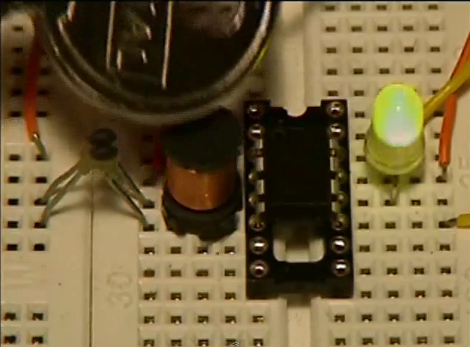
This project from a few years back is an interesting take on a metal detector. Instead of building a detection circuit, [Bruno Gavand] replaced the external clock crystal with an inductor. Here you can see the inductor coil next to the PIC 12F683. You can see two components jumping from one breadboard to the other. These are smoothing capacitors on the inductor lines.

The watchdog timer for the chip is run by the internal RC oscillator. When the external crystal receives a pulse due to metal inducing a current in the coil, the value of the watchdog timer is compared to it. This data is filtered and if the proper parameters are present the green LED blinks. This is bicolor LED. If the inductor circuit is functioning properly it will blink red at power up. [Bruno] says that results will vary based on that inductor so you may need to try a few to get the calibration light to blink.

We’re thinking this would make a simple stud finder (by detecting where the nails/screws are in the wall). Check out the demo after the break, then let us know what you would use this for by leaving a comment.

Continue reading “Metal Detection Using An Inductor Instead Of A Clock Crystal.”

16FUSB — It’s Like V-USB For The PIC 16F628

If you have an idea for a fairly simple USB device but don’t want to invest in the more expensive microcontrollers, this library will be of interest to you. It’s a software implementation of the low-speed USB protocol for PIC 16F628. You can pick these up for around $2, and it just takes a few other components to complete the circuit. And hey, you don’t even need a proper PIC programmer to flash the code. This is the same chip for which we just saw an Arduino act as the programmer.

The circuit design looks exactly the same as the V-USB stack, which provides USB functionality to lower-end AVR microcontrollers. In addition to the chip you need a crystal oscillator, a couple of 3.6V zener diodes, and a handful of passive components. There are a couple of LEDs in the design, but we assume these are for feedback and are not crucial to the functionality of the circuit.

There’s no shortage of data included in the project post so you may want to bookmark this one for later reference.

Arduino PIC Programmer Writes To 18F Family

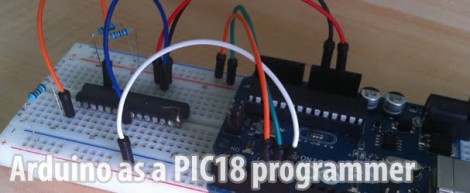
[Kirill] wrote in to share his Arduino-based PIC programmer. It is capable of writing to the 18F family of chips, including 18F2XXX and 18F4XXX. We think that’s pretty exciting because this line of chips has USB functionality and there are bootloaders out there that let you program them via USB. So if you wanted to build your own PIC dev-board (like this one) you can use your Arduino to flash the bootloader.

This post comes hot on the heels of the Arduino being used as a PIC 16F programmer. That hack has a rudimentary programming GUI, something that [Kirill] admits his lacks but has no plans to implement himself. Perhaps someone will do a little porting work to merge the projects, adding to the range of chips supported by this programming technique.

Arduino Can Program PIC Too!

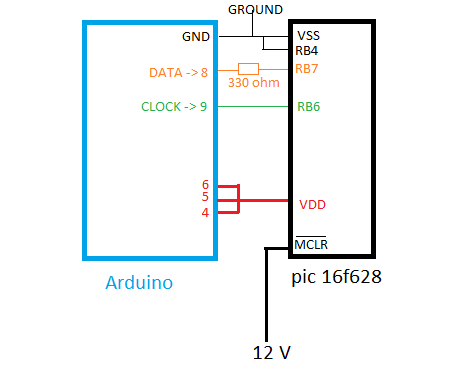
This is a wiring diagram that [Soranne] put together when developing a method of programming PIC microcontrollers using an Arduino board. You can see that he takes care of the 12V issue by connecting the Master Clear (MCLR) pin to an external source. This comes with one warning that the Arduino should always be reset just before making that connection.

He’s tested this with a 16F628 and is happy to report that he can successfully flash the program memory, but hasn’t implemented a way to write to the EEPROM as of yet. This should work for any of the 16F family of chips, but we’d bet this will be extended if some knowledgeable folks decide to lend a hand.

On the PC side of things [Soraane] has been working on a program to push code to the Arduino via the USB connection. He’s developing it in C# and even has a GUI worked up for the project. You can get your hands on the software in the second post of the thread linked above but you’ll have to be logged into the Arduino forum to see the download link.

We think the 12V issue is why we don’t see more roll-your-own programmers for PIC. But there are a few solutions out there like this ATmega8 version.