PIC Based USB Input Devices

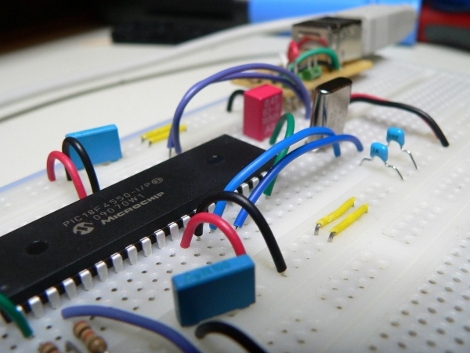
USB is convenient and that makes it desirable in many many projects. [Simon Inns] has the process down and is sharing it with his recent PIC based USB tutorial. Prompted by requests for help on the matter after having published a post about his Commodore 64 interface, he set out to detail the particulars when it comes to using the PIC 18F family as USB input devices. This example uses a PIC 18F4550 with the circuit built on a breadboard. There’s not much required here, an oscillator, a few passives, and a USB B connector. The magic really happens in the code. Take a look at this well-written guide and give it a try with your next project.

Don’t need USB? [Simon’s] game hack, the Ultimate Simon is always worth another look too.
Storage For Your Hacking Needs

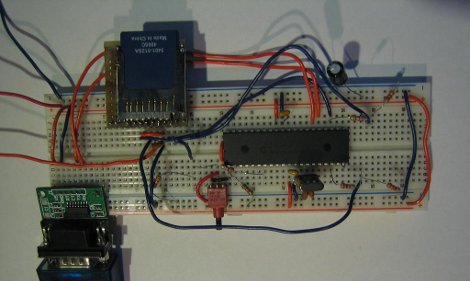
Sometimes your project needs a lot of non-volatile ROM, right on cue [Matthew] let us know how to not only connect, interface, read, and write to SD cards with a PIC over serial, but also how to do the above mentioned with an old PATA HDD. For those without a PIC/serial connection don’t fret, [nada] let us know about his Bus Pirate SD card hack, of which our personal favorite part is the creative use of an old 5.25″ floppy connector as the SD card socket.

Looping Foot Pedal

This guitar pedal can record, playback, and modify samples. [Colin Merkel], also know for his work on electronic door locks, built this to replicate some guitar effects he heard in recordings. By tapping the button at the bottom with your foot the device begins recording. Another tap stops the recording and starts the loop. That’s where the rest of the controls take over, with settings to adjust the speed of playback, volume, and the type of playback looping. The video after the break gives a great demonstration of these features.

[Colin] built this around a PIC 18F877A with a 256k RAM chip to store the sample. There’s a bunch of other components that go into this and we’re dumbfounded that he built it on protoboard. This would be a multi-breadboard prototype for us and we wouldn’t think twice about laying out and etching our own PCB. He admits that the point-to-point soldering stretched his skills to the limit but he doesn’t say how many hours it took to get the circuit up and running. This is a great addition to the cool guitar pedals we’ve seen here.

Continue reading “Looping Foot Pedal”

PIC Pong Clock

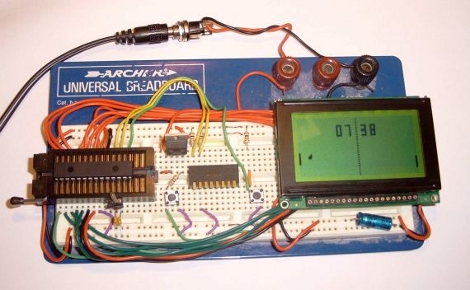
[Andrew] built this pong clock over the span of a couple of days. The PIC 18f2520 he used can serve as a real time clock with the addition of an external clock crystal. His project proves the usefulness of an oscilloscope as poor board layout caused interference in the crystal connections, something difficult to troubleshoot without this handy lab tool.

Pong clocks have been quite popular. This one is nice because it’s easy to throw together now that [Andrew’s] done the coding work for you. Written in assembly, reading and understanding his code might be a good exercise if your low-level language skills are lacking.

Use An Analog Oscilloscope To Display Digital Logic

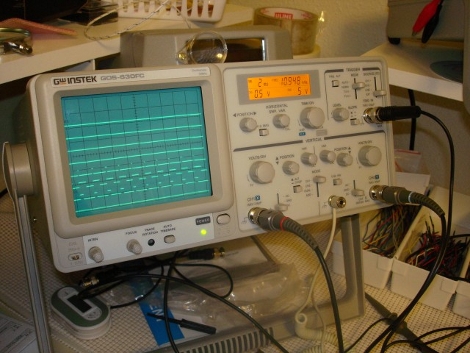
[Mike Bradley] wanted to use his oscilloscope to display 8 channels of digital signals. Alas, the analog unit didn’t have this capability. Not to worry, he threw together an adapter module that does the trick. Using a PIC 18F26K20 microcontroller he inputs four or eight channel digital logic (at 5V) and filters the output to an analog signal that the oscilloscope can interpret. What you see in the photo above is the result.

The UltimateSIMON

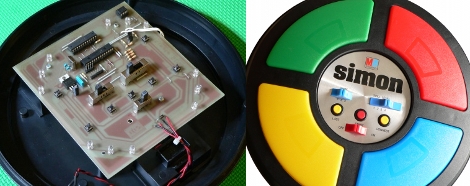
[Simon Inns] designed a circuit board to retrofit an original Simon electronic game. This hack is immediately a win because he made sure that his design required no modification of the original case. The new PCB has many improvements. It moves the device from using 2 D-cells over to a 9 volt battery, the incandescent bulbs were out swapped out for three LEDs per button, and the use of tactile switches makes the buttons a lot more responsive (but does require a bit of modification to the colored button covers). Under the hood there’s a PIC18F2550 controlling a serial LED chip and handling input monitoring and sound generation. The video after the break is safe to watch at work, there’s no swearing involved this time. Continue reading “The UltimateSIMON”

Billy Bass With Selectable Clips

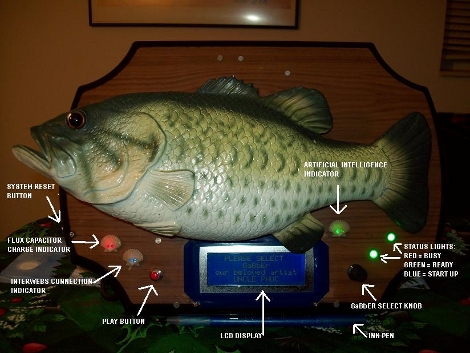
[Will] enjoys giving hacked items as Secret Santa gifts and this year he decided to augment a Billy Bass. These gag items have become a popular hack to use as a prop or to read your Twitter updates to you. Right of the bat he scrapped the original PCB and sent it to the gift’s future recipient as if he were a kidnapper extorting a family. He then set to work replacing the guts with a pair of PIC 18F452 microcontrollers. One uses power transistors to control the movement, the other controls an MP3 that handles the sound clips. The interface has some LEDs for added effect and uses a dial to select each sound clip which is displayed on a 4×20 character LCD.

The project has several voltage headaches as the motors operate at 6v and 4v, the microcontrollers and LCD display at 5v, and the MP3 is looking for 1.5v. That’s for voltages supplying this Frankenstein’d schematic. But he pulled it off, as you can see in the video after the break.

Continue reading “Billy Bass With Selectable Clips”