Volt Meter Clock

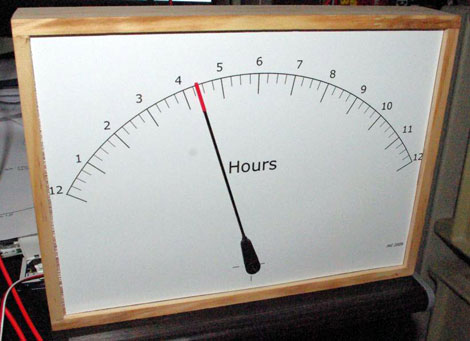
The Volt meter clock continues our recent slew of interesting clock projects. Though considerably easier to read than the resistor clock, it is in the same frame of mind. Set up to look like the face of an analog volt meter, it almost looks like something official or scientific. Since [Jon] couldn’t simply drop a clock mechanism in, he used a PIC microcontroller. The circuit is pretty simple, but he deserves some credit just for the unique layout.

Step-a-sketch

[Chris] is getting his feet wet with Computer Numerical Control starting with an Etch-a-Sketch interface. This is a great way to start out because the really tough parts of the project are already inside of the toy. He’s replaced the two white knobs with stepper motors and connected them through a mosfet network to a PIC 16f84a. The PIC then gets its commands from a computer via the parallel port.

A video of the CNC machine can be seen after the break. He needs to add a frame to increase the precision of the images drawn but this first attempt is pretty good. We prefer to have the computer in charge of the design because controlling an Etch-a-Sketch with a mouse doesn’t make our drawings any better. Continue reading “Step-a-sketch”

BT Phone Is Much More Than Retrofit

[Santiago] turned his Ericfon into a Bluetooth phone. This is completely different from the handset retrofits we looked at last month. This is because he didn’t simply crack open a BT headset and cram it into his phone. He developed his own hardware for full functionality.

This is an open source project with available hardware details that he intends to turn into a kit. [Santiago] has purposed a PIC microcontroller to connect with a WT32 bluetooth module. The PIC allows for a dial tone, dialing with the original rotary dial, and produces the original sound when the phone rings. What he now has is a way to have a home phone without a landline. As seen the video after the break, the Ericfon works the same as it did when it was new, except the connection is made through Bluetooth and not via a copper phone line. Continue reading “BT Phone Is Much More Than Retrofit”

Qube, Not An Arduino Clone

What allows the everyday user to tinker with microcontrollers, IO, interrupts, serial communication, and even analog readings? How about individual modules that add the ability to communicate over bluetooth or add LCD support? If you were thinking Arduino, you would be wrong. It’s actually [Nilok’s] Qube, which at first seems like another Arduino clone however the Qube is based on PIC – not AVR. Another difference is the sweet black anodized case the Qube is planned to be put in.

While all this seems amazing at first, there is of course a catch – it looks like the first models are pre-order only for staunching price of $70! Sorry, but Arduino wins at half the cost.

Regardless, [Nilok] has documented the entire process and it’s amazing to read through; he even includes some guides on solder paste and bootloading USB. And who knows, maybe he’ll release open source. His site seems a little slow, we recommend the Google Cache.

BobLight Night Light Networking

It turns out that more than just pictures of women and flashing animations can be found on the X10 website. [Jonathan] based his BobLight project around the MS14A X10 module.

The idea for the devices started off as a Christmas gift for his parents in-law. A boblight turns on when motion is detected. It then communicates (through radio) with the other boblights to turn them all on. If motion is not detected by any of the boblights for a length of time, they all turn off. Rather than having the user shut all of them off every morning, a light sensor is used to automate the task.

Each boblight is a common LED utility light combined with the board of an MS14A and added a 310MHz RF receiver. He even hacked the board by replacing the onboard PIC with a higher spec model. We think [Jonathan] did a great job at implementing an innovative concept.

2600 Game Jukebox

[Yuppicide] sent us a link to a photo album of an Atari 2600 modified to play ROMs stored inside. We did some digging around and have an idea of what’s going on. It seems that the creator, [Victor] has taken his Atari 2600 cartridge emulator one step further.

Previously, he had replaced the chip in an Atari cartridge with an EEPROM that he could reprogram via a ribbon cable. This new iteration places that EEPROM inside the case of the gaming console along with a PIC development board. The PIC board interfaces an SD card with somewhere around 1200 ROMs on it. Three switches added to the front of the Atari allow the user to cycle through available games and flash the desired title to the EEPROM. As you can see, a 2×16 LCD display now resides in the cartridge opening.

This seems a little more eloquent (and less legal) than the Super Genintari.

Embedded Games: Rogue

Here’s a handheld version of Rogue. Rogue is one of the first graphical computer games and takes the player through a dungeon-exploring adventure. [Manuel] built this around a PIC 16F876 microcontroller and a KS0108 graphic LCD screen.

Hot on the heels of the pixellated Mario game, these embedded handhelds make for fun projects and great gifts. There are few parts used and [Manuel] etched his own PCB. Take a look at the schematic, this is a great platform to start with but the sky’s the limit on writing your own games.