It’s always unfortunate to find a FedEx tag on your door saying you missed a delivery; especially when you were home the whole time. After having this problem a few times [Lee] decided to rig up a doorbell notifier for his Android phone.
[Lee]’s doorbell uses a 10 VAC supply to ring a chime. To reduce modifications to the doorbell, he added an integrated rectifier and a PNP transistor. The rectifier drives the transistor when the bell rings, and pulls a line to ground.
An old Netgear router running OpenWRT senses this on a GPIO pin. Hotplugd is used to run a script when the button push is detected.
The software is discussed in a separate post. The router runs a simple UDP server written in C. The phone polls this server periodically using SL4A: a Python scripting layer for the Android platform. To put it all together, hotplugd sends a UNIX signal to the UDP server when the doorbell is pushed. Once the phone polls the server a notification will appear, and [Lee] can pick up his package without delay.
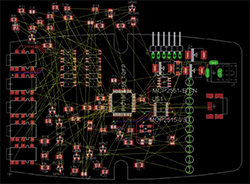 Although it’s derided for not being open source, EagleCAD is an extremely popular piece of schematic and PCB layout software. Most of the popularity is probably due to the incredible amount of part libraries – it’s certainly not the features Eagle has to offer or its horrible scripting capabilities. [Rob] had enough of the lack of good scripting support in Eagle, so he’s been spending his time