Python Library For Emotiv EEG

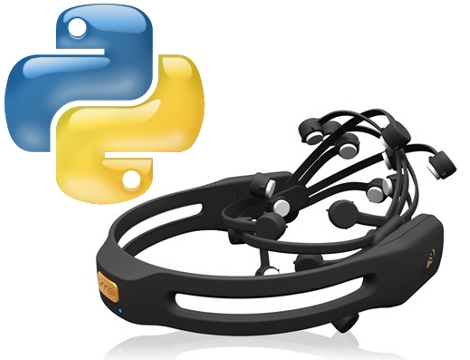
Want to control things with your mind? The Emotiv EPOCH EEG is one of the best pieces of hardware you can get that is ready to be hacked into your project. Too bad the entry-level SDK will set you back $500. Or you can take advantage of [Cody Brocious’] work by using his Emotiv Python Library. He sniffed around the data coming in over the USB connection and discovered that it’s encrypted. With a bit of trickery he extracted the key and built the 128-aes decryption routine into his package. So far this just pulls raw data from the unit so it’s up to you to figure out how to properly filter the signals and differentiate which sensor corresponds to each data stream. But it’s a start, and hopefully it’ll lead to more mind controlled doo-dads.
SOAP Compatibility For SQLmap

[_coreDump] was doing some database vulnerability testing using SQLmap to automate the process. To his dismay, the package was unable to test using the Simple Object Access Protocol. Faced with having to manually test all of the SOAP vulnerabilities he decided to work some Python magic and add support. His solution allows SQLmap 0.8 to parses XML data from the SOAP protocol by modifying three files from the package. He’s made the diff filesĀ availableĀ if you need this functionality for your own security testing.

Tweet-a-Watt Now Speaks To Google Power Meter

Hackaday’s own [Devlin Thyne] has been working with Adafruit to come up with a way to use the Tweet-a-Watt along with Google Power Meter. Back in March we put out the word that Google had unveiled the API for Power Meter and [Devlin] is the first we’ve heard of to come up with a way to use your own equipment with the service. You can build your own or use Adafruit’s kit and the data pulled from your energy use will be nicely displayed using the big G’s tools. Right now there’s only support for one Tweet-a-Watt but we’d image this will evolve fairly quickly into a much larger house solution. Head over to the Tweet-a-Watt code page to get the source files for this project.

[Thanks PT]

Robotic Chess Opponent

[youtube=http://www.youtube.com/watch?v=CkGqn5rNzK8]

[Dennis] is using a robotic arm as a chess opponent. Rather than using an under-board movement system, a Lynxmotion AL5A robotic arm plucks each piece and moves it to the next space. He tells us that he’s using a Python script that he created to process the moves and decide what’s next. That must mean he’s using a webcam to capture the location of the pieces on the board. About half way through you can see the robot run into one of the pawns. We’d like to know if he has problems with picking up the pieces as the game progresses and they get further away from the center of each square. From what we can see, looks like a great job!

Teletype Twitter Frontend

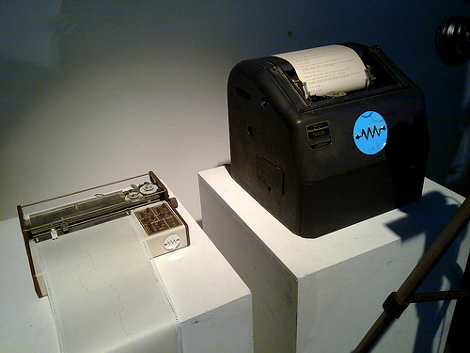
The folks from NYC Resistor got their hands on a teletype machine and hacked it to monitor Twitter. This eighty-year-old beast bangs out messages that it receives at 45.45 baud. This isn’t a project that turns something into a teletype, but rather finds a different way to feed the machine data. In this case, a python script parses Twitter and sends the data it finds to an Arduino board. The Arduino in turn formats the message into the serial format necessary to communicate with the device. To the left you can see a trend plotter, learn more about both in the video after the break.

Continue reading “Teletype Twitter Frontend”

Ditch The LPs And Build Your Own 3D Scanner

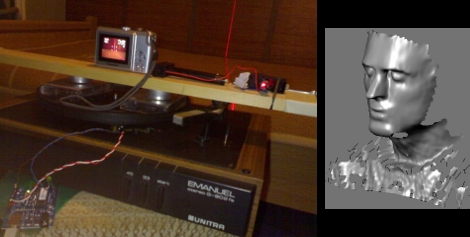
Find yourself an old record player, a laser level, and a digital scanner and you can build a 3D scanner. That’s what [Rob] did. The camera and laser level are mounted on the turntable for steady rotation. The camera captures the vertical laser line traveling around the room by recording 30 fps at a resolution of 640×480. This data is then translated into a Blender 3D file via a Python script and the Python Image Library. You can scan a whole room or just a small object. The face above is the result of this image capture after a bit of processing. [Rob] found this worked best in the dark and when scanning surfaces that are not reflective.

Make sure you also check out the camera-and-projector scanning method.

Is That Some Type Of New Kindle?

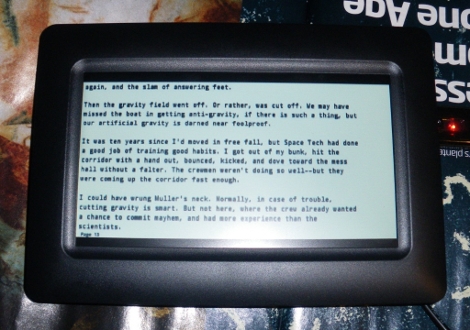
[Mr C Camacho] picked up an inexpensive digital picture frame hoping to hack into it. He hasn’t had the time to crack open the hardware so that it will do his bidding but he did find a creative way to make it an ebook reader. Using a python script he processes books, creating images of the pages.

The python script, available after the break, takes free books from Project Gutenburg and spits out JPG images. Page turning and bookmarking are not what they ought to be but the process does work. The thought of someone staring at a picture frame on the subway is a bit amusing but we’re sure that sooner or later someone will ask if it’s a new version of the Kindle.

Continue reading “Is That Some Type Of New Kindle?”