Controlling A Quadcopter With A Homebrew Remote

When [Matt] started building his multirotor helicopter, he was far too involved with building his craft than worrying about small details like how to actually control his helicopter. Everything worked out in the end, though, thanks to his homebrew RC setup built out of a USB joystick and a few XBees.

After a few initial revisions and a lot of chatting on a multirotor IRC room, [Matt] stumbled across the idea of using pulse-position modulation for his radio control setup.

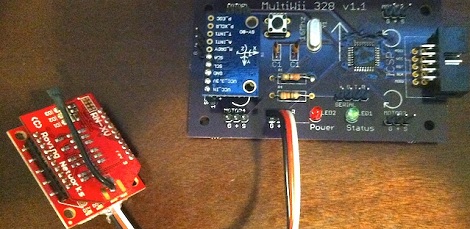
After a few more revisions, [Matt] settled on using an Arduino Pro Mini for his flight computer, paired with a WiFly module. By putting his multicopter into Ad-hoc mode, he can connect to the copter with his laptop via WiFi and send commands without the need for a second XBee.

Now, whenever [Matt] wants to fly his multicopter, he plugs the WiFly module into his MultiWii board, connects his laptop to the copter, and runs a small Python script. It may not be easier than buying a nice Futaba transmitter, but [Matt] can easily expand his setup as the capabilities of his copter fleet grows.

Video of [Matt]’s copter in flight after the break.

Continue reading “Controlling A Quadcopter With A Homebrew Remote”

Eradicating Invasive Species With Quadcopters

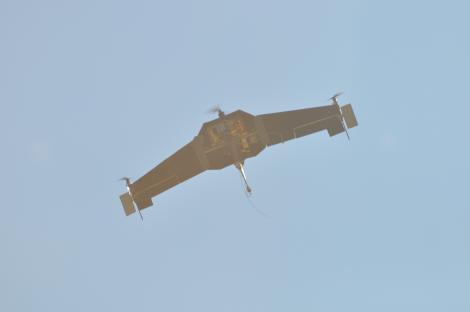
That right there is Sydney Golden Wattle, a fast-growing invasive species native to Eastern Australia that has the possibility of covering 20 percent of the bushland in Western Australia by the year 2020. [John Moore], a researcher at the Department of Food and Agriculture, wants to put an end to this infestation by destroying large swaths of wattle with a quadcopter armed with weed killer.

The plan for the robotic plant assassins is simple; take aerial photographs of the bushland in Western Austraila and identify stands of individual weeds. [Moore]’s robots are then dispatched to these stands of weeds to spray them down with weed killer.

The quadcopters are armed with a camera, allowing the operator to make sure the robot is hovering directly over the invasive weeds. Considering these weeds are found in somewhat inaccessible places – and the fact that just about everything in Australia is poisonous – these robotic weeders will kill more wattle than what could be done on foot.

We couldn’t find a video of the robot in action, or a demo of the herbicide spay system of [John]’s copter. If you can find one of those, send it in and we’ll put it up.

Thanks to [Michal] for sending this in.

Toorcamp: Quadcopter Controlled By A TI-84+

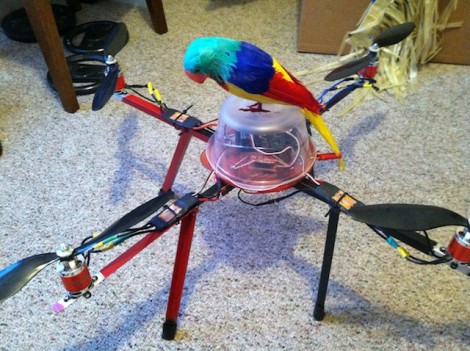
What happens when you combine a TI-84+ graphing calculator with an added bluetooth module, a 1 Watt Alfa wifi dongle, and a Parrot Wifi Quadcopter? You get a long range quadcopter that’s controlled from the TI-84+ directional pad.

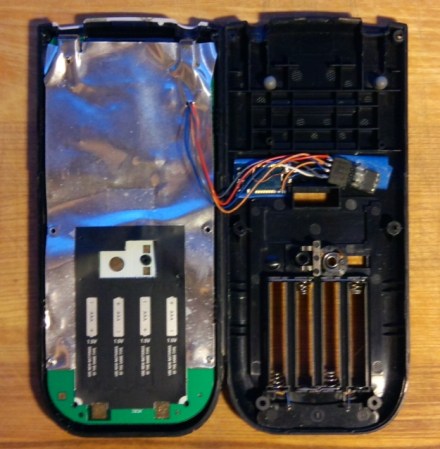
This TI-84+ looks like a standard issue school calculator, but [Owen] added an ATTiny13 microcontroller and a bluetooth module which sniffs the I/O port of the calculator. This allows for bi-directional communication with a laptop. He wrote a few Python scripts on the laptop to receive data from the calculator and send commands to the Parrot Quadcopter. The high-powered wifi module allowed for pretty good range with the Quadcopter, which was flown across the Toorcamp grounds.

Of course, having an innocent looking calculator with wireless communications has some other uses. Data could be displayed on the calculator from a phone over bluetooth. How about accessing Wikipedia or WolframAlpha from your calculator? Despite the possibilities, [Owen] did say that he’s never used it to cheat on tests.

Electromagnetic Field Camp

Emf Electromagnetic Field Camp is a three-day camping festival for people with an inquisitive mind or an interest in making things: hackers, geeks, scientists, engineers, artists, and crafters.

There will be people talking about everything from genetic modification to electronics, blacksmithing to high-energy physics, reverse engineering to lock picking, crocheting to carpentry, and quadcopters to beer brewing. If you want to talk, there’ll be space for you to do so, and plenty of people who will want to listen.

EMF is a volunteer effort by a non-profit group, inspired by European and US hacker camps like CCC, HAR, and toorcamp.  This year on Friday 31st August – Sunday 2nd September 2012 Will hold the first Uk meeting of its kind.

Events and activities will run throughout the day and into the evening, everything else (chats, debates, impromptu circus performances, orbital laser launches) will run as long as your collective energy lasts.

The Event is to be held at Pineham Park, Milton Keynes, UK.

As a Hackaday viewer you can get discounted tickets.

[thanks Jonty]

Designing A Quadcopter Brain PCB

When working on his quadcopter project [Matt] decided it would be best to build a robust controller for the device. He had never sent off a PCB design for fabrication, but took the plunge and ended up with a compact and reliable PCB on the first try.

One of the first things that comes to mind when we hear about quadcopter controllers are the feedback sensors. The accelerometers which are used for these projects generally come in a DFN or QFN package. This means there are no legs. Instead the chip has pads on the bottom of the package making it a lot more difficult to solder. [Matt] side-stepped this issue by using an IMU board which already has the sensors in place and offered a 0.1″ SIL pin header to use as an interface. This is simple to roll into the design, along with all of the other connectors for motor control, power, etc. He grabbed a copy of Eagle Lite to do the layout, and used OSH Park to get the boards fabricated. He was surprised that everything worked on the first try. Thanks to his planning it fits inside of a plastic food container where it should be able to ride out most minor crashes with ease.

Lift Beer With Quadcopters, Win Prizes

If you have a quadcopter and are looking for a beer delivery device, HobbyKing is putting on a beerlift competition The rules for the HobbyKing beer lift are pretty simple: lift the most beer with a quad/hex/octo copter and win a HobbyKing gift card.

There are 3 classes: Unlimited, which means a vehicle of any size goes, a 700 class for copters with a motor-to-motor diameter of 700 mm or less, and a Disaster class for the coolest crash.

So far the largest lift is a monsterous 2 meter octocopter by [Muresan Alexandru Camil] capable of lifting just over 47kg. In the 700 class, a bizarre looking 9-rotor copter built by the Whac-A-Mole flying team was able to lift 28kg.

The disaster category, a smaller quad built by [Gabriel Devault] was barely able to lift four cans of Coors Light water, while the current disaster class leader made a few valiant efforts to lift a keg. Protip: if you’re doing a blooper reel, Yakety Sax is definitely the way to go.

Adding A Bomb Bay To A Quadcopter

The Fourth of July is fast approaching, and what better way to celebrate the independence of your country than by blowing up a small piece of it? [Anzel360] decided to take that line of thought to a whole new level by adding a bomb bay to his quadrocopter.

[Anzel360] recently upgraded his transmitter to a Spektrum DX8, giving him two extra channels on his four-channel quadrotor. After adding a small servo to the quad, it was a simple matter of taping a box to the undercarriage and filling it full of fireworks.

The ammo [Anzel] is using is just a handful of Snappin’ Pops – otherwise known as the lamest firework ever created. We won’t hold that against him, though; a remote ignition system for a few Black Cats mounted on a fancy quadrocopter is just asking for trouble. We do recall a throwable cap gun bomb from our youth, though, that would allow for year-round ammo replenishment…