Human-powered Quadcopter Flies Live Tomorrow

A team from the University of Maryland will be taking their human-powered helicopter to the air tomorrow. The current flight record for this type of vehicle is just over 19 seconds of flight at a height of about 8 feet. What surprises us about this attempt is that they’re not pedaling just one main rotor. It seems that the most success in man-powered helicopter flight has come from helicopters with a total of four rotors.

The image seen above is a 2009 test of just one of the four rotor arms that will go into UMD’s finished chopper. Fully assembled it will be about 1/3 the size of a football field, dwarfing the autonomous quadcopters we usually see around here. Get the details about the design from the video after the break. It’s interesting to hear [Dr. Antonio Filipone] talk about the need to generate both the lift and the thrust, where human-powered fixed-wing aircraft only need the thrust. He predicts that human-powered helicopter flight is possible, but that it will only lift the aircraft, with little possibility of moving it in one direction or the other.

The team is attempting to grab the $250,000 Sikorsky Prize with their creation. We wish them the best of luck.

Continue reading “Human-powered Quadcopter Flies Live Tomorrow”
Tri-rotor Helicopter With Full Autopilot

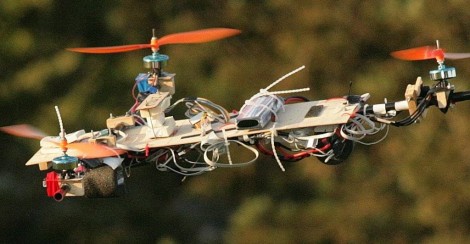
Quadcopters stand aside, here’s a three-rotor helicopter we think you’re going to love. The body is made out of plywood and carbon fiber rods, keeping it light enough to be easily lifted by just 3 motors while making sure the force doesn’t tear the aircraft apart. Three gyroscopes, two accelerometers, three magnetometers, and a GPS module are all used in conjunction for an autopilot system. There’s a lot of great pictures and videos but our favorite, embedded after the break, shows the tricopter writing messages in the sky using light and camera exposure tricks similar to this ground-based trike.

Continue reading “Tri-rotor Helicopter With Full Autopilot”

Thanksgiving Turkey Quadcopter Shenanigans

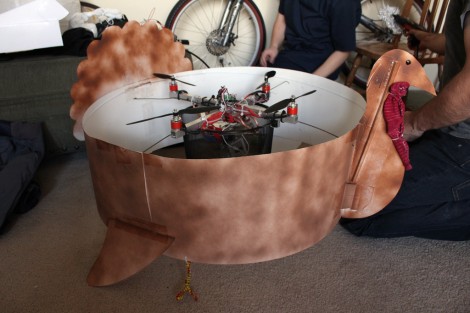
The challenge: can you build a flying turkey that drops pumpkin pie bombs? That’s the question that Utah Aerials asked themselves and they did manage to make it happen. Of course they’re not starting from scratch, but adding a little holiday cheer to an existing quadcopter in the form of a spray painted turkey fuselage. The cheapest pumpkin pie they could find was hung from the copter with care, and dumped thanks to a servo motor. Check the video after the break to see if they were able to hit their balding-bullseye or not.

Seems like the wicked witch music should have been the background for that video.

Continue reading “Thanksgiving Turkey Quadcopter Shenanigans”

Wooden Quadcopter Body

brings back memories of balsa wood gliders

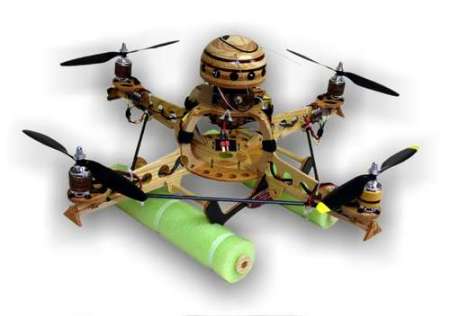
[Greasetattoo] shares the process of building his wooden quadcopter body that won 2nd place in the Minnesota state fair.  His plans were purchased as a kit back in 1999, but he never got around to actually building them. The original plans called for a foam board body, but he felt that a wooden piece of art would be much nicer. This build isn’t focusing on the electronics, they’re just a kit from Mikrokopter. Instead, it is a log of the entire process of making the beautiful wooden body. He really put some nice detail in there from the layered and nicely finished dome to the little oak sleeves for his motors. Great job [Greasetattoo].

Easy Quadrotor Helicopter Instructions

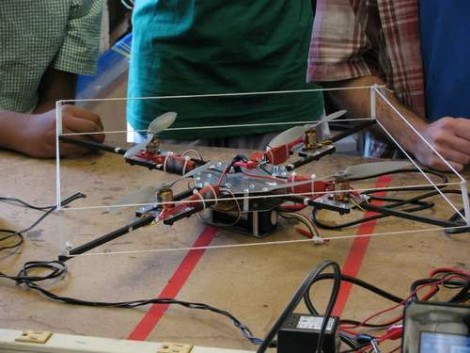
Here’s a great tutorial on building your own quadrotor helicopter. This build isn’t necessarily less expensive than others we’ve seen since quality motors, propellers, and control circuitry aren’t cheap. But the design and assembly is well documented and presents a well-planned building procedure. The carbon-fiber tubes that make up the frame have extensions to protect the motors and propellers in the event of a crash. The Arduino, IMU, and transceiver are all tucked away between two aluminum body plates as well. They only thing missing is a solid methodology for tuning the four motors, a critical procedure that is just touched up at the end of the article.

Update: Acrobatic Quadcopters Team Up

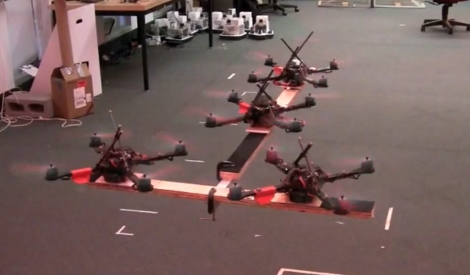
We usually envision small wheeled robots when we thing about swarm robotics but these cooperative quadcopters make us think again. This is an extension of the same project that produced those impressive aerial acrobatics. It may not be as flashy, but watching groups of the four-rotored flyers grab onto and lift loads is quite impressive. There is also a shot of one dropping a 2×4 and immediately compensating for the loss of weight. We’re not certain, but it looks like team lifting doesn’t require the 20 high-speed camera rig that the acrobatics did. We’ve embedded the demonstration video after the break.

Continue reading “Update: Acrobatic Quadcopters Team Up”

Cameras Perch On Power Lines, Steal Electricity

[Tim] let us know about a video outlining some covert camera devices the Air Force is developing (dead link, try the Internet Archive version). The video takes a lot of time to explain induction to those who’ve never heard of it but we liked to see the bird-like concept animations. They’ve already developed cameras that will clamp on to power lines in order to use induction as a power source. Shown in the video is an eight-rotor quadcopter they’re hoping to use to deliver the camera covertly. But the animations show a winged robot similar to a hawk that has a camera for a head. Having seen some of the other flying devices in development this may not actually be that far off.