Playing SNES With An R/C Controller

Normally when we see an R/C transmitter used in a build we’re prepared for robots, quadcopters, or UAVs. [Alex] found a new use for his Futaba radio – hooking it up to his Super Nintendo.

We’ve seen a lot of builds using game controllers as interfaces to other hardware. The N64 media remote comes to mind, as does the NES iPod dock. Outside of a few builds to automatically win in-game currency for you, we haven’t seen much of anything to control a video game with additional electronics. [Alex]’s build happily bucks that trend, and technically gives the SNES an analog controller.

The build uses an mBed microcontroller to capture the radio’s button and stick positions. This is sent through a two shift registers to produce the 16-bit packet required of the SNES controller protocol. [Alex] posted all the software for his build, and from the looks of it the code seems pretty portable. [Alex] says he’s working on getting his Sega Saturn running with his Futaba, so we can’t wait to see some Panzer Dragoon action. Check out [Alex] demoing his controller with Gradius III after the break.

Continue reading “Playing SNES With An R/C Controller”

AM Singer: A Tiny AM Transmitter


[Simon Orr] wrote in to tell us about his AM transmitter prototype that he plans to put into production in a few months. The build is based on an “Easy AM Transmitter” featured in this Instructables article.

Interestingly enough, this device is capable of transmitting in the 100KHz to 480KHz frequencies. The AM band goes from 520 KHz to 1610KHz, so in order to hear this signal, one must actually tune the radio to twice the emitted frequency. This allows one to tune into the harmonic frequency and receive a signal in this range.

Using the harmonic frequency to transmit is an interesting concept by itself. Additionally, the idea that one could build this device with or without the kit in the future should appeal to experienced hackers and those just starting out alike. Check out the “AM Singer” prototype video after the break. Continue reading “AM Singer: A Tiny AM Transmitter”

RC Transmitter Does Everything

[Demetris] sent in a tip about a project he’s working on: an Open Source Remote Control transmitter. This is one of the most impressive looking RC transmitters we’ve ever seen. The OSRC could be great for a small UAV – just get the GPS position from the aircraft and map it with the transmitter’s screen. There’s also support for a video downlink so flying around New York City is possible with a single device.

Continue reading “RC Transmitter Does Everything”

[Jeri Ellsworth] Builds A Software Radio

[Jeri Ellsworth] has been working on a direct conversion receiver using an FPGA as an oscillator and a PC sound card DSP. Being the excellent presenter she is, she first goes through the history and theory of radio reception (fast forward to 1:30), before digging into the meat of the build (parts 2 and 3 are also available).

Continue reading “[Jeri Ellsworth] Builds A Software Radio”

Retro-radio: Building On Another WiFi Radio Hack

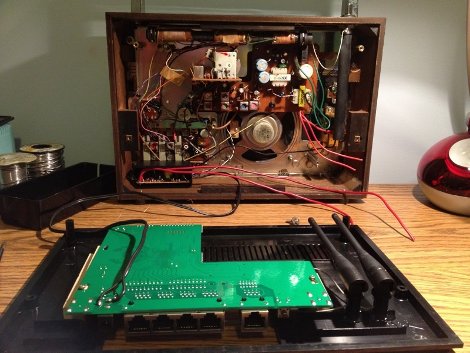
[Jay Collett] likes listening to Internet radio stations and decided to build his own standalone hardware that lets him listen without being at his computer. But he wasn’t starting from square one on this project. [Jay] built on the epic instruction set that [Mighty Ohm] published when he first built his own WiFi radio.

Both of these radios used the same method of getting onto the internet; a hacked router. We kind of like this because it means you should be able to use the radio as a bridge for wired Ethernet devices. But we digress. [Jay] departs from the instructions by using an Arduino and its IDE to interface an LCD screen with a different line/column orientation than the original, and to implement a different control scheme. This makes the project a bit more approachable if you prefer not to roll your own electronics.

Take a look at the video after the break. The router takes quite a while to boot, but once it does it seems that the controls are both intuitive and responsive.

Continue reading “Retro-radio: Building On Another WiFi Radio Hack”

Radio Packets…from Spaaaace!

space_radio

[Bill Meara] was watching the International Space Station and the Shuttle Discovery pass overhead a few weeks ago, which rekindled an interest he gave up long ago – sending and receiving radio packets from space.

Years ago, he used to send APRS packets into space with a small rig powered by a 286 computer and HandiTalkie. These packets would drift off into space most of the time, but occasionally they would bounce back to Earth whenever the space station or PC Sat would fly by. The packets were often captured by other ham operators across the globe, who happened to be tuned to 145.825 MHz.

His interest renewed, he dug out his old HandieTalkie and Kantronics Terminal Node, aiming them towards the sky via an antenna situated in his back yard. When he returned 10 hours later, he found that he had collected all sorts of “space packets” from across the globe.

While not exactly a hack, it is definitely a neat exercise in ham radio operation. We can imagine slinging data packets off the space station would be an exciting experience for any budding operator (and OMs as well!)

ChronoTune: Listen To Radio By Year, Not By Frequency

The ChronoTune is a radio that plays sounds from different eras. This project was developed as an entry for the Redbull Creation Challenge by some members of i3Detroit, a hackerspace in the motor city. It allows a user to turn the dial to tune in a new moment in history, but they can also listen in on the present day. They’ll be greeted with the sounds of a tuning radio, followed by music or audio clips common to the period displayed on the dial.

As you know from the last contest entry, each project must use an Arduino to qualify. It reads a rotary encoder attached to one of the knobs on the front of the case. This doesn’t directly move the tuning needle. Instead, it’s attached to the guts of an inkjet printer to move it back and forth. This lets the radio tune itself if need be.

The audio is played from several sources. There is an MP3 module that allows for longer clips, but there are also some ISD voice recorder chip modules that play back shorter clips. If the dial is tuned to present day, an FM radio module tunes in a station over the air.

Having trouble reading that dial? Don’t worry, there’s a simulated Nixie tube display sticking out the top of the case to provide a digital readout of the currently selected time period. Check out the video after the break to see the team walk us through each part of the ChronoTune.

Continue reading “ChronoTune: Listen To Radio By Year, Not By Frequency”