Hackaday Links: November 6th, 2011

Build details for Raspberry Pi prototype

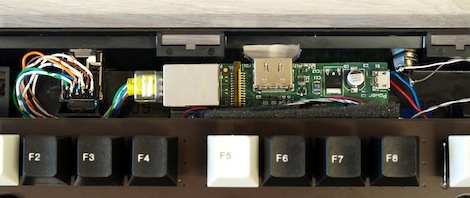
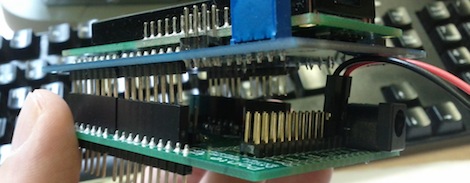
With the launch of Raspberry Pi approaching the development team released the details about the prototypes from about five years ago. The board was originally based on an ATmega644 and built on some perfboard.

‘Zero Energy Device’ challenge

We call BS on the title of this one, but the goal of finding devices that don’t use disposable energy sources is a good thing in our book. For instance, can we get more stuff that uses long-life capacitors instead of batteries?

Command adhesive for mounting bulletin boards, etc.

This seems like a no-brainer, but we’ve been using nails to mount bulletin boards and white boards for year. The problem is, when you stick a push-pin in one side, the other side pops off of the nail. [Zhanx] is using adhesive from 3M Command Hooks to keep his stuck to the wall.

Servo-driven gripping hand

[Navic] has been hard at work on this robot hand. There’s few details but he shows it can grip objects under one pound and he’s been taking amperage measurement during testing.

Emergency cellphone charging

It might not have been an emergency this time, but [Chris] did figure out a way to charge his cellphone after the snow storm in New England knocked out his power. He connected to lantern batteries to a 7805 regulator, then patched that into a USB hub to get his phone connected. Not bad in a pinch!

Raspberry Pi Might Not Be Vaporware

When we first covered the Raspberry Pi, we secretly wondered if the project might become vaporware. It looks like the tiny, full-fledged computer might actually be produced with the announcement of alpha boards in the Raspberry Pi HQ.

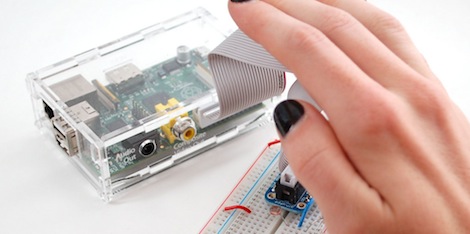
In the announcement of the Raspberry Pi last May, the board was about the size of a USB thumb drive and would cost $25. It looks like the board will be a little larger in the final revision – about the size of a business card – and production of the alpha boards were a bit over cost. That being said, these boards seem a lot more capable than what we’ve seen before. The Raspberry Pi now has 10/100 ethernet, and analog audio and video while keeping the HDMI, USB, and SD card support we saw in the original.

The Raspberry Pi team already has Debian running on these boards, so right now we’re wondering when gumstix boards will come down in price. Of course, this project is intended for use in education, but we can’t wait to see what can be done with this hardware. If you already know what you would do with this, tell us in the comments.

raspberry_pi

Miniature PC Packs A Big Punch

We are always looking out for smaller yet capable computers for our projects, and this newest offering by [David Braben] is looking mighty nice. [David] is the head of a UK-based games studio, but has recently been focusing on bringing small, affordable PCs to classrooms around the world.

The computer, called Raspberry Pi,  is about the size of your standard USB thumb drive and contains a 700 MHz ARM 11 processor as well as 128 MB of memory. It has an HDMI port which can display 1080p video on any compatible screen, along with a USB port for input peripherals. Mass storage is provided courtesy of an on-board SD card slot, and it looks like the ability to utilize add-on modules will be available as well.

There is sure to be no shortage of willing buyers if [David] is able to bring these computers to market within a reasonable timeframe. With a projected cost of about $25, this will certainly give the OLPC and others a run for their money.

Thanks to everyone who sent this story in… all of you. You can stop now… please. (don’t stop sending us tips, we’re just joking around)