A Sail And Oar Skiff Built From Common Lumber

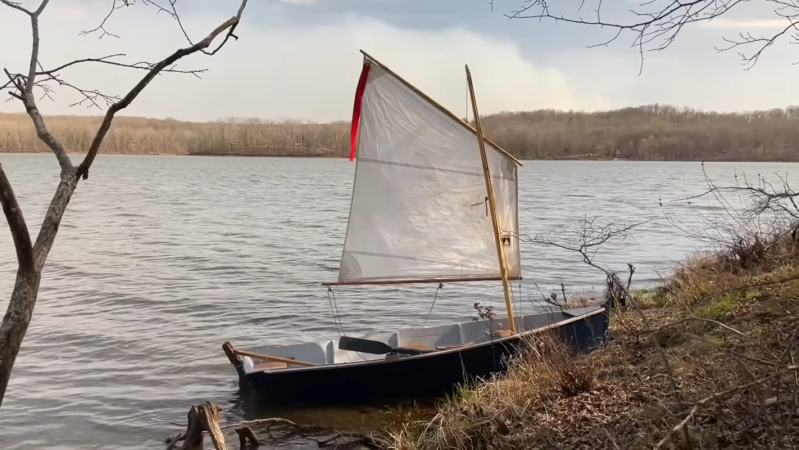
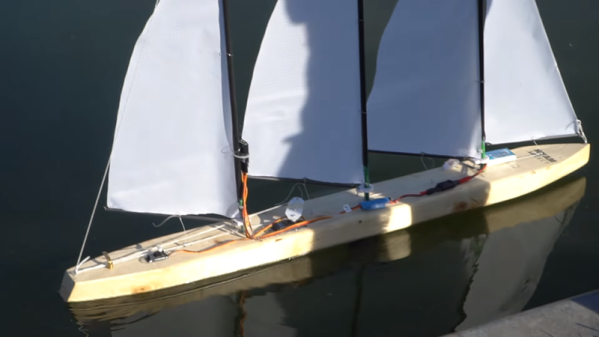
For those first venturing into sailing, it can be overwhelming since the experience is thick with jargon and skills that don’t often show up in life ashore. With endless choices, including monohulls versus catamarans, fiberglass versus wood, fractional versus masthead rigs, and sloops versus ketches, a new sailor risks doing something like single-handing a staysail schooner when they should have started on a Bermuda-rigged dinghy without a spinnaker. Luckily, there are some shortcuts to picking up the hobby, like the venerable Sunfish or Hobie ships. It’s also possible to build a simple sailing vessel completely out of materials from a local hardware store, as [Cumberland Rover] has been demonstrating.

Continue reading “A Sail And Oar Skiff Built From Common Lumber”

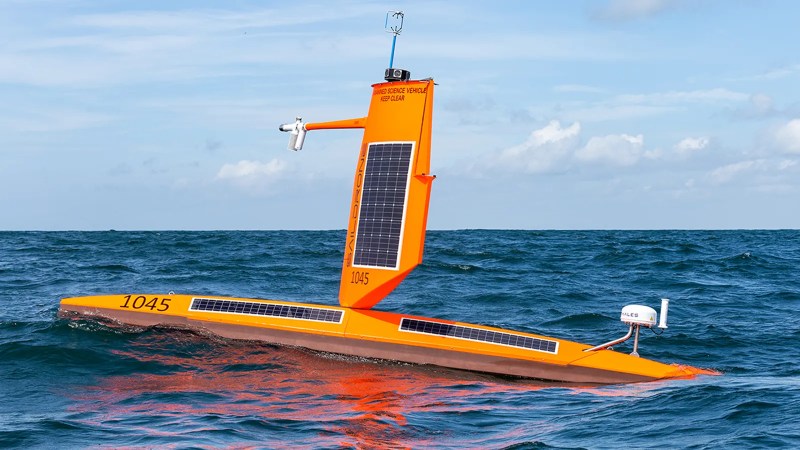
A bright orange sailboat with solar panels on the wing sail and the hull of the craft. A number of protuberances from the wing are visible containing instruments and radio equipment.

Saildrones Searching The Sea For Clues To Hurricane Behavior

Hurricanes can cause widespread destruction, so early forecasting of their strength is important to protect people and their homes. The US National Oceanic and Atmospheric Administration (NOAA) is using saildrones to get better data from inside these monster storms.

Rising ocean temperatures due to climate change are causing hurricanes to intensify more rapidly than in the past, although modeling these changes is still a difficult task. People on shore need to know if they’re in store for a tropical storm or a high strength hurricane to know what precautions to take. Evacuating an area is expensive and disruptive, so it’s understandable that people want to know if it’s necessary.

Starting with five units in 2021, the fleet has gradually increased in size to twelve last summer. These 23ft (7m), 33ft (10m), or 65ft (20m) long vessels are propelled by wing sails and power their radio and telemetry systems with a combination of solar and battery power. No fossil fueled vessel can match the up to 370 days at sea without refueling that these drones can achieve, and the ability to withstand hurricane winds and sea conditions allow scientists an up-close-and-personal look at a hurricane without risking human lives.

We’ve covered how the data gets from a saildrone to shore before, and if you want to know how robots learn to sail, there’s a Supercon talk for that.

Thanks to [CrLz] for the tip!

An image of a man in glasses in a circle placed on a black background. The title "Pierce Nichols: Teaching Robots to Sail" is on white lettering in the bottom left corner.

Supercon 2023: [Pierce Nichols] Is Teaching Robots To Sail

Sailing the high seas with the wind conjures a romantic notion of grizzled sailors fending off pirates and sea monsters, but until the 1920s, wind-powered vessels were the primary way goods traveled the sea. The meager weather-prediction capabilities of the early 20th Century spelled the end of the sailing ship for most cargo, but cargo ships currently spend half of their operating budget on fuel. Between the costs and growing environmental concerns, [Pierce Nichols] thinks the time may be right for a return to sails.

[Nichols] grew up on a sailing vessel with his parents, and later worked in the aerospace industry designing rockets and aircraft control surfaces. Since sailing is predominantly an exercise in balancing the aerodynamic forces of the sails with the hydrodynamic forces acting on the keel, rudder, and hull of the boat, he’s the perfect man for the job.

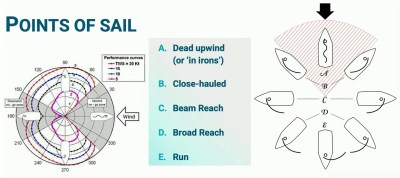
WhileAn image of a sailing polar diagram on the left next to the words "A) Dead upwind (“in irons”) B) Close-hauled C) Beam reach (90˚ to the wind - fastest for sailing vessels D) Broad reach E) Run" The letters correspond to another diagram of a sailboat from the top showing it going directly into the wind (A), slightly into (B), perpendicular to (C), slightly away (D), and directly away from the wind / downwind (E). the first sails developed by humans were simple drag devices, sailors eventually developed airfoil sails that allow sailing in directions other than downwind. A polar diagram for a vessel gives you a useful chart of how fast it can go at a given angle to the wind. Sailing directly into the wind is also known as being “in irons” as it doesn’t get you anywhere, but most other angles are viable.
After a late night hackerspace conversation of how it would be cool to circumnavigate the globe with a robotic sailboat, [Nichols] assembled a team to move the project from “wouldn’t it be cool” to reality with the Pathfinder Prototype. Present at the talk, this small catamaran uses two wing sails to provide its primary propulsion. Wing sails, being a solid piece, are easier for computers to control since soft sails often exhibit strange boundary conditions where they stop responding to inputs as expected. Continue reading “Supercon 2023: [Pierce Nichols] Is Teaching Robots To Sail”

Sailing (Directly) Into The Wind

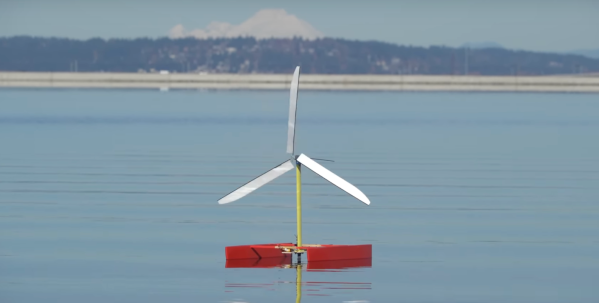
Humans have been sailing various seas and oceans for thousands of years, and using boats for potentially even longer than that. But as a species we wouldn’t have made it very far if it was only possible to sail in the same direction the wind is blowing. There are a number of methods for sailing upwind, but generally only up to a certain angle. [rctestflight] wondered if there was some way of sailing straight upwind instead and built this rotary sail craft to test the idea.

Normally a boat sailing upwind will sail approximately 45° into it, then “tack” 90° across the wind until they’re at another 45° angle from the wind, this time facing the opposite direction. This back-and-forth nature is not the most efficient path, so this vessel uses a few propellers to bypass the traditional sail. The first iteration, built on a sleek catamaran hull, uses a large propeller to catch the wind’s energy, then transfers it mechanically through a set of shafts to an underwater prop.

It took a few tries to get the size and pitch of both propellers narrowed down to where the boat would move forward into the wind, but move it does. A second major iteration of the build uses a single shaft with no gears, with the trade-off that neither propeller is facing an ideal direction, but this has the added benefit of the boat naturally pointing itself upwind.

While none of the designs are speed demons, the concept is sound enough. It’s just that, in most cases, performing multiple tacks to get upwind is acceptable compared to the extreme efficiency losses and drag from propeller-driven sailing crafts like these. A more effective way of propelling a boat upwind, at least using modern technology, might be to trade sails for solar panels.

Continue reading “Sailing (Directly) Into The Wind”

Solar Boat Makes Waves

The two best days in a boat owner’s life are the day they buy it, and the day they sell it. At least, that’s the common saying among people who actually spend money to buy a boat. [saveitforparts], on the other hand, looks like he’s going to have many more great days on this boat than that since he cobbled it together nearly for free, and he won’t even need to purchase any fuel for it since it runs on solar power.

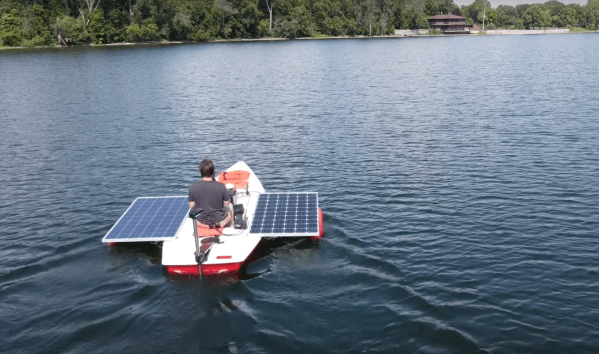
The build starts with [saveitforparts] heading out to a literal pile of boats in his yard, unearthing an old single-person sailboat, and then fixing the major problems with its hull. With a new coat of red paint, the focus turns to the drivetrain. Propulsion is handled by an electric trolling motor found at an auction for $8 and is powered by an off-the-shelf battery bank provided by a sponsor of his channel. A pair of solar panels (which were traded for) fitted to outriggers keep the battery bank topped off, and there’s plenty of energy left over with this setup to charge drone batteries and other electronics while out on the lake.

[saveitforparts] reports that the single-passenger solar boat is remarkably stable on the water and fairly quick at full speed thanks to its light weight. He even hypothesizes that it could be fished from. The only thing not particularly stable was towing it to the lake, as the rough roads and permanently-attached solar panel outriggers weren’t particularly congruent with each other. If you’re looking for something similar to carry a few passengers, though, have a look at this much larger version.

Continue reading “Solar Boat Makes Waves”

This Radio Control Sailboat Uses 2X4s

When [PeterSripol] was a kid, he made a simple sailboat from a scrap piece of 2×4 and some napkin sails. He’s not 8 years old anymore, but he decided he wanted to make another 2X4 sailboat using the skills he’s learned since he was a kid.

You’ll have to get past storytime and mice, but the build skill is evident. There’s a RC rudder, a keel with lead shot and overall it is a good looking boat for such a simple build.

Continue reading “This Radio Control Sailboat Uses 2X4s”

Hacker Challenge: Sail The Atlantic

We found it incredible that — apparently — no one has sailed an autonomous sailboat across the Atlantic successfully. Compared to an electric craft, sail-powered platforms ought to reduce having to carry batteries or other fuel and enable long-duration missions. The problem, of course, is the sailing conditions in the Atlantic.

The challenge is the focus of the Microtranssat challenge which started in 2010. You can think of the challenge as a race, but not in the conventional sense. Participants can launch their 8 foot (or less) craft any time between July and December, and it doesn’t matter which direction they go. They simply have to cross the Atlantic. If more than one boat makes it, the fastest is the winner.

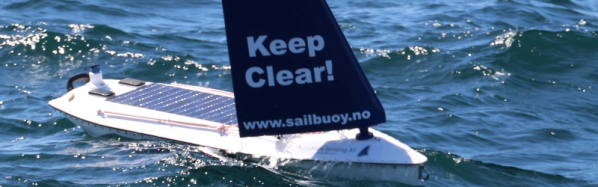
The current leader is the SailBuoy. This Norwegian entry has made it halfway, but no further. However, it has sailed quite a distance in other places, so perhaps it will make it soon. You can see SailBuoy afloat in the video below.

Continue reading “Hacker Challenge: Sail The Atlantic”