Arduino Rig Does Spectrophotometry

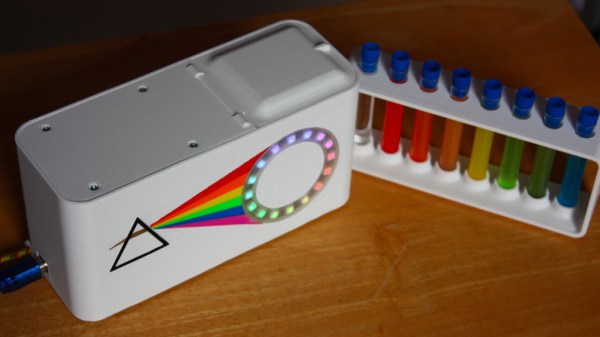
Spectrophotometry is an important scientific tool, most commonly used in biology and chemistry. It’s a method to measure the amount of light absorbed by a chemical solution at various different wavelengths. While it’s typically the preserve of expensive lab equipment, [Daniel Hingston] built a rig to do the job at home.

The heart of the rig is a normal filament-based flashlight bulb, which produces good-quality white light containing all colors. A prism is then used to split the light into its component wavelengths, so that the sample can be tested across the whole light spectrum. The prism is rotated by a servo motor, which exposes the sample to the full rainbow, while an Arduino uses a light-dependent resistor to measure how much light makes it through the sample. Thus, the amount of light absorbed by the sample can be calculated, relative to calibrations made with no sample present.

It’s a simple build that can be achieved with fairly common materials, barring the prism which may need to be specially ordered. It would be a great way to teach highschool students about advanced scientific concepts, as well as showing them behind the curtain of how lab equipment works.

We see all kinds of DIY science gear around here; this lantern-based bioreactor is a great example. Video after the break.

Continue reading “Arduino Rig Does Spectrophotometry”

Video: Bil Herds Looks At Mitosis

I loved my science courses when I was in Junior High School; we leaned to make batteries, how molecules combine to form the world we see around us, and basically I got a picture of where we stood in the  scheme of things, though Quarks had yet to be discovered at the time.

In talking with my son I found out that there wasn’t much budget for Science learning materials in his school system like we had back in my day, he had done very little practical hands-on experiments that I remember so fondly. One of those experiments was to look and draw the stages of mitosis as seen under a Microscope. This was amazing to me back in the day, and cemented the wonder of seeing cell division into my memory to this day, much like when I saw the shadow of one of Jupiter’s moons with my own eyes!

Now I have to stop and tell you that I am not normal, or at least was not considered to be a typical young’un growing up near a river in rural Indiana in the 60’s. I had my own microscope; it quite simply was my pride and joy. I had gotten it while I was in the first or second grade as a present and I loved the thing. It was just horrible to use in its later years as lens displaced, the focus rack became looser if that was possible, and dirt accumulated on the internal lens; and yet I loved it and still have it to this day! As I write this, I realize that it’s the oldest thing that I own. (that and the book that came with it).

Today we have better tools and they’re pretty easy to come by. I want to encourage you to do some science with them. (Don’t just look at your solder joints!) Check out the video about seeing mitosis of onion cells through the microscope, then join me below for more on the topic!

Continue reading “Video: Bil Herds Looks At Mitosis”

Searching For Alien Life With The Sun As Gravitational Telescope

Astronomy is undoubtedly one of the most exciting subjects in physics. Especially the search for exoplanets has been a thriving field in the last decades. While the first exoplanet was only discovered in 1992, there are now 4,144 confirmed exoplanets (as of 2nd April 2020). Naturally, we Sci-Fi lovers are most interested in the 55 potentially habitable exoplanets. Unfortunately, taking an image of an Earth 2.0 with enough detail to identify potential features of life is impossible with conventional telescopes.

The solar gravitational lens mission, which has recently been selected for phase III funding by the NASA Innovative Advanced Concepts (NIAC) program, is aiming to change that by taking advantage of the Sun’s gravitational lensing effect. Continue reading “Searching For Alien Life With The Sun As Gravitational Telescope”

Three Years Of HardwareX: Where Are They Now?

After three years of online publications, HardwareX may have solidified itself as an academic journal for open-source hardware. We originally wrote about HardwareX back in 2016. At the time, HardwareX hadn’t even published its first issue and only begun soliciting manuscripts. Now after three years of publishing, six issues as of October 2019 (with the seventh scheduled for April 2020), and an impact factor of 4.33, it’s fair to say that Elsevier’s push into open-access publications is on a path to success.

To give you a bit of background, HardwareX aims to promote the reproducibility of scientific work by giving researchers an avenue to publish all the hardware and software hacks that often get buried in traditional manuscripts. The format of HardwareX articles is a bit different than most academic journals. HardwareX articles look more like project pages similar to Hackaday.io. (Maybe we inspired them a bit? Who knows.)

It’s a bold attempt on Elsevier’s part because although open-access is held as an ideal scenario for scientific work, such efforts often come under quite a bit of scrutiny in the academic community. Don’t ask us. We can’t relate.

Either way, we genuinely wish Elsevier all the best and will keep our eyes on HardwareX. Maybe some of our readers should consider publishing their projects in HardwareX.

Growing Human Neurons Hooked Up To Electrodes

Philosophers have long mused about the concept of a “brain in a jar”, but thus far, it’s remained the preserve of science fiction rather than reality. However, after reading some scientific papers, [Justin] wanted to attempt the feat himself, so set out to grow some human neurons on an electrode array. 

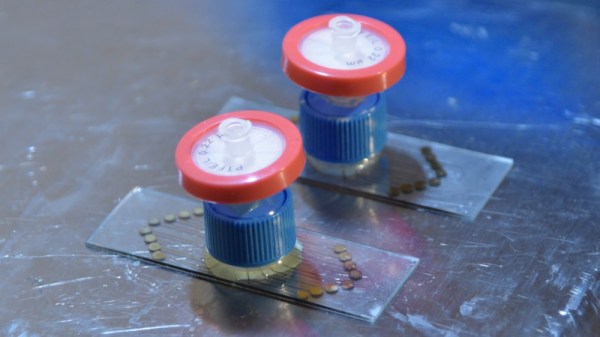
The project builds on [Justin]’s earlier work, using his DC sputtering rig to coat a glass microscope slide with electrodes. The first layer is silver for high conductivity, with an added gold layer for biocompatibility. The screw cap from a Falcon tube is then epoxied on to act as a reservoir for culture media for the neurons. Finally, an air filter is added to allow the biological mixture to breathe.

This was [Justin]’s first attempt at culturing neurons, and there were plenty of hurdles along the way. The custom culture assemblies had issues with the epoxy bonds leaking or failing entirely, leading to only one slide making it through the sterilization process. Additionally, the neurons were accidentally added in too high a quantity. While some growth was observed under the microscope, [Justin] was unable to detect any real signal from the system.

Despite a poor final result, plenty was learned along the way. [Justin] has already put plans into place to fix some of the pitfalls of the original experiment, and we look forward to seeing future updates from the project. Video after the break.

Continue reading “Growing Human Neurons Hooked Up To Electrodes”

See You On The Dark Side Of The Moon: China’s Lunar Radio Observatory

For nearly as long as there has been radio, there have been antennas trained on the sky, looking at the universe in a different light than traditional astronomy. Radio astronomers have used their sensitive equipment to study the Sun, the planets, distant galaxies, and strange objects from the very edge of the universe, like pulsars and quasars. Even the earliest moments of the universe have been explored, a portrait in microwave radiation of the remnants of the Big Bang.

And yet with all these observations, there’s a substantial slice of the radio spectrum that remains largely a mystery to radio astronomers. Thanks to our planet’s ionosphere, most of the signals below 30 MHz aren’t observable by ground-based radio telescopes. But now, thanks to an opportunity afforded by China’s ambitious lunar exploration program, humanity is now listening to more of what the universe is saying, and it’s doing so from a new vantage point: the far side of the moon.

Continue reading “See You On The Dark Side Of The Moon: China’s Lunar Radio Observatory”

Hiring From A Makerspace Pays Off

A makerspace is a great place to use specialty tools that may be too expensive or large to own by oneself, but there are other perks that come with participation in that particular community. For example, all of the skills you’ve gained by using all that fancy equipment may make you employable in some very niche situations. [lukeiamyourfather] from the Dallas Makerspace recently found himself in just that situation, and was asked to image a two-million-year-old fossil.

The fossil was being placed into a CT machine for imaging, but was too thick to properly view. These things tend to be fragile, so he spent some time laser cutting an acrylic stand in order to image the fossil vertically instead of horizontally. Everything that wasn’t fossil had to be non-conductive for the CT machine, so lots of fishing line and foam was used as well. After the imaging was done, he was also asked to 3D print a model for a display in the museum.

This is all going on at the Perot Museum of Nature and Science if you happen to be in the Dallas area. It’s interesting to see these skills put to use out in the wild as well, especially for something as rare and fragile as studying an old fossil. Also, if you’d like to see if your local makerspace measures up to the Dallas makerspace, we featured a tour of it back in 2014, although they have probably made some updates since then.