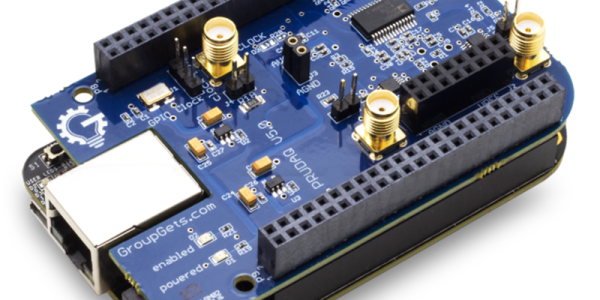
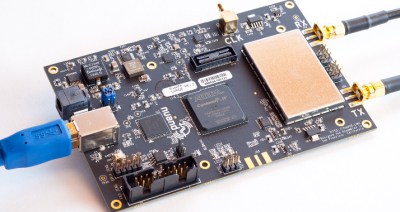
[Jason Holt] wrote in to tell about of the release of his PRUDAQ project. It’s a dual-channel 10-bit ADC cape that ties into the BeagleBone’s Programmable Realtime Units (PRUs) to shuttle through up to as much as 20 megasamples per second for each channel. That’s a lot of bandwidth!
The trick is reading the ADC out with the PRUs, which are essentially a little bit of programmable logic that’s built on to the board. With a bit of PRU code, the data can be shuttled out of the ADC and into the BeagleBone’s memory about as fast as you could wish. Indeed, it’s too fast for the demo code that [Jason] wrote, which can’t even access the RAM that fast. Instead, you’ll want to use custom kernel drivers from the BeagleLogic project (that we’ve covered here before).
But even then, if you don’t want to process the data onboard, you’ve got to get it out somehow. 100 mbit Ethernet gets you 11.2 megabytes per second, and a cherry-picked flash drive can save something like 14-18 megabytes per second. But the two 10-bit ADCs, running full-bore at 20 megasamples per second each, produces something like 50-80 megabytes per second. Point is, PRUDAQ is producing a ton of data.
So what is this cape useful for? It’s limited to the two-volt input range of the ADCs — you’ll need to precondition signals for use as a general-purpose oscilloscope. You can also multiplex the ADCs, allowing for eight inputs, but of course not at exactly the same time. But two channels at high bandwidth would make a great backend for a custom SDR setup, for instance. Getting this much ADC bandwidth into a single-board computer is an awesome trick that used to cost thousands of dollars.
We asked [Jason] why he built it, and he said he can’t tell us. It’s a Google Research project, so let the wild conjecture-fest begin!
There’s a problem with software defined radio. It’s not that everyone needs to re-learn what TEMPEST shielding is, and it’s not that Bluetooth is horribly broken. SDR’s biggest problem is one of bandwidth and processing. With a simple USB TV Tuner, you can listen in on aircraft, grab Landsat images from hundreds of miles up, or sniff the low-power radios used in Internet of Things things. What you can’t do is make your own WiFi adapter, and you can’t create your own LTE wireless network. This is simply a problem of getting bits from the air to a computer for processing.
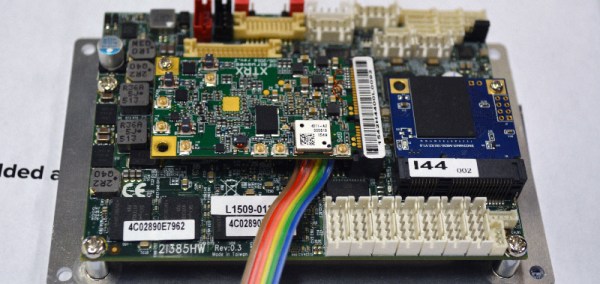
At HOPE last weekend, the folks behind the very capable LimeSDR and a new company working with Lime’s hardware laid out the possibilities of what software defined radio can do if you make a link to a computer very fast, and add some processing on the SDR itself.
[Lukas] started his epic SDR-from-scratch build when he was 16. Projects like this aren’t completed overnight. (He’s now 18. We’re impressed.)
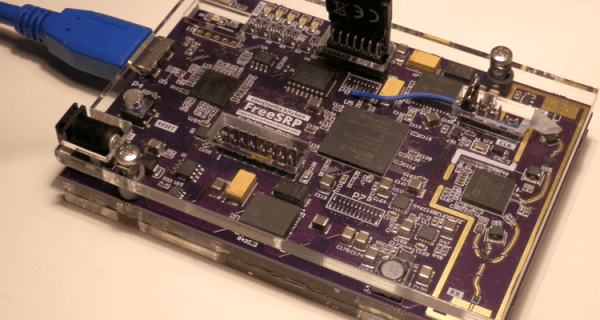
The project itself is a Software-Defined Radio built on top of the 12-bit Analog Devices AD9364 transceiver IC. A big fat FPGA takes the data and runs it off to a USB 3.0 interface, which is necessary for the amount of data this thing will be producing — he’s got it receiving 56 MHz of bandwidth. In short, this is an SDR peripheral that’s in the big leagues.
After two years of work and (only!) three revision, [Lukas] got the thing working. Read his writeup for the blow-by-blow account. In the end, a 6-layer board was necessary for the routing to get the full speed out of the clocking, and he discovered the reason that you use exactly the specified bias resistors — the expensive ADC chip gets very hot. But he didn’t give up, and in the end he pulled off a project of immense complexity. In his own words:
I have discovered that taking on large projects, even when not knowing how to tackle problems that might arise, is a very effective way of learning for me. It’s just important to be persistent, as I’ve seen that almost any problem can be solved on your own — which is incredibly rewarding — even if you get stuck and seem to not make progress for a while.
[Lukas] is now working on the software. He’s already got a hacked osmocom driver working, so it plays nice with GNURadio.
Of course, there are tons of ways to get into SDR without building your own from scratch, but we applaud [Lukas] for going the hard way. If you’re tempted to follow in his footsteps, have a look at [Michael Ossmann]’s great talk on making the RF design process as tractable as possible.
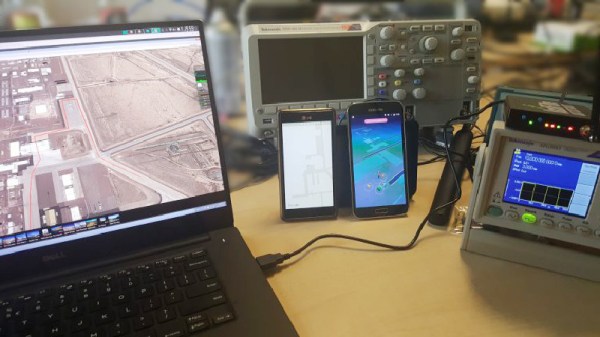
To [Stefan Kiese], this isn’t much more than an exercise. He’s not even playing Pokemon Go. To squeeze a usable GPS signal out of his HackRF One, a $300 Software Defined Radio, [Stefan] uses an external precision clock. This makes up for the insufficient calibration of the HackRF’s internal clock, although he points out that this might also be fixed entirely in software.
GNURadio is the swiss-army-knife of software-defined radio suites: it does everything and anything. It has a great GUI overlayer that makes creating radio flows fairly simple. There are only two areas where we could quibble with the whole system — it’s a gigantic suite of software, and it’s a lot harder to code up in Python than it is to use the GUI.
[Vanya Sergeev] started up his LuaRadio project to deal with these shortcomings. If you’re looking for the full-GUI experience, you’re barking up the wrong tree here. LuaRadio is aimed at keeping things easy to code and keeping the codebase small and tidy.
That doesn’t mean that it departs entirely from GNURadio’s very successful flow-graph programming paradigm, however, and if you’re comfortable with the procedure of hooking up a signal source to a filter block to an output, you’ll be doing fine here as well. Check out the obligatory FM radio demo — the “hello world” of SDR — and you’ll see how it works: instantiate the various blocks in code, and then issue “connect” commands to link them together.
LuaRadio’s main selling points are its size and the ease of programming it by hand. It’s got great documentation to boot. It’s written as a library that’s embeddable in your C code, so that you can write standalone programs that make use of its functionality.
LuaRadio is a new project and it doesn’t have a GUI either. It may not be the ideal introduction to SDR if you’re afraid of typing. (If you are new to SDR, start here.) But if you want to code up your SDR by coding, or run your radio on smaller devices, it’s probably worth a look. It’s at v0.1.1, so we’re looking forward to hearing more from LuaRadio in the future. Any of you out there use it? We’d love to hear in the comments.
Software-defined radio (or SDR) is a relatively new (to average tinkerers, at least) way of sending and receiving radio signals. The interest in SDR exploded recently with the realization that cheap USB TV tuner cards could be used to start exploring the frequency spectrum at an extremely reduced cost. One of the reasons that this is so advantageous is because of all of the options that a general-purpose computer opens up that go beyond transmitting and receiving, as [Chris] shows with his project that ties SDR together with GPS.
The goal of the project was to automatically tune a radio to the local police department’s frequency, regardless of location. To do this, a GPS receiver on a computer reports information about the current location. A JavaScript program feeds the location data to the SDR, which automatically tunes to the local emergency services frequencies. Of course, this relies on good data for what those frequencies are, but this is public information in most cases (at least in the US).
There are a lot of opportunities here for anyone with SDR. Maybe an emergency alert system that can tune to weather broadcasts if there’s a weather alert, or any of a number of other captivating projects. As for this project, [Chris] plans to use Google’s voice recognition software to transcribe the broadcasts as well. The world of SDR is at your fingertips to do anything you can imagine! And, if you’re looking to get started in it, be sure to check out the original post covering those USB TV tuner dongles.
We are entering a new era of radio technology. A new approach to building radios has made devices like multi-band cell phones and the ubiquitous USB TV receivers that seamlessly flit from frequency to frequency possible. That technology is Software Defined Radio, or SDR.
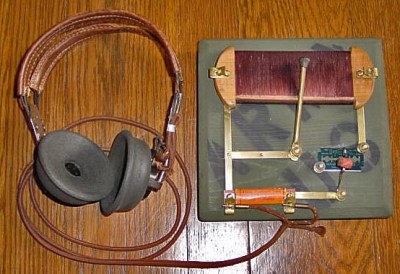
A idealized radio involves a series of stages. Firstly, an antenna receives the radio signal, converting it into an electrical signal. This signal is fed into a tuned resonator which is tuned to a particular frequency. This amplifies the desired signal, which is then sent to a demodulator, a device which extracts the required information from the carrier signal. In a simple radio, this would be the audio signal that was encoded by the transmitter. Finally, this signal is output, usually to a speaker or headphones.
A replica foxhole crystal set. Photo: Bill Jackson
That’s how your basic crystal radio works: more sophisticated radios will add features like filters that remove unwanted frequencies or additional stages that will process the signal to create the output that you want. In an FM radio, for example, you would have a stage after the demodulator that detects if the signal is a stereo one, and separates the two stereo signals if so.
To change the frequency that this radio receives, you have to change the frequency that the resonator is tuned to. That could mean moving a wire on a crystal, or turning a knob that controls a variable capacitor, but there has to be a physical change in the circuit. The same is true of the additional mixing stages that refine the signal. These circuits may be embedded deeply in the guts of the radio, but they are still there. This is the limitation with normal receivers: the radio can’t receive a signal that is outside the range that the resonator circuit can tune to, or change the way it is demodulated and processed. If you want to receive multiple frequency bands or different types of signals, you need to have separate pathways for each band or type of signal, physically switching the signal between them. That’s why you have physical AM/FM switches on radios: they switch the signal from an AM radio processing path to an FM one.
Software Defined Radios remove that requirement. In these, the resonator and demodulator parts of the radio are replaced by computerized circuits, such as analog to digital converters (ADCs) and algorithms that extract the signal from the stream of data that the ADCs capture. They can change frequencies by simply changing the algorithm to look for another frequency: there is no need for a physical change in the circuit itself. So, an SDR radio can be tuned to any frequency that the ADC is capable of sampling: it is not restricted by the range that a resonator can tune to. Similarly, the demodulator that extracts the final signal you want can be updated by changing the algorithm, changing the way the signal is processed before it is output.
This idea was first developed in the 1970s, but it didn’t really become practical until the 1990s, when the development of flexible field-programmable gate array (FPGA) chips meant that there was enough processing power available to create single chip SDR devices. Once programmed, an FPGA has no problem handing the complex tasks of sampling, demodulating and processing in a single device.
Most modern SDRs don’t just use a single chip, though. Rather than directly converting the signal to digital, they use an analog front end that receives the raw signal, filters it and converts it down to a fixed frequency (called the intermediate frequency, or IF) that the ADCs in the FPGA can more easily digitize. This makes it cheaper to build: by converting the frequency of the signal to this intermediate frequency, you can use a simpler FPGA and a cheaper ADC, because they don’t have to directly convert the maximum frequency you want to receive, only the IF. As long as the front end can convert a band of signals down to an intermediate frequency that the FPGA can digitize, the SDR can work with it.
The BladeRF, a modern SDR device that can receive and transmit signals between 300 MHz and 3 GHz
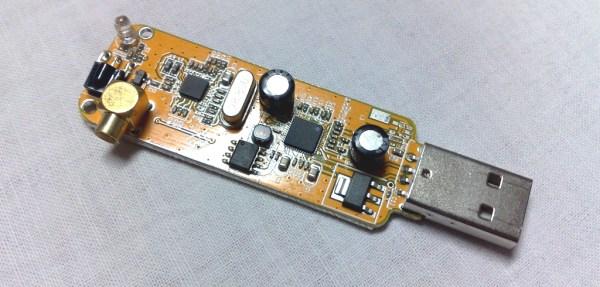
This flexibility means that SDR devices can handle a huge range of signals at relatively low cost. The $420 BladeRF, for instance, can receive and transmit signals from 300 MHz to 3.8 GHz at the same time, while the $300 HackRF One can work with signals from 1 MHz up to an incredible 6 GHz. The ability of the BladeRF to both receive and transmit means that you can use it to build your own GSM phone network, while the low cost of the HackRF One makes it a favorite of radio hackers who want to do things like make portable radio analyzers. Mass produced models are even cheaper: by hacking a $20 USB TV receiver that contains an SDR, you can get a radio that can, with a suitable antenna, do things like track airplanes or receive satellite weather images. And all of this is possible because of the idea of Software Defined Radio.