How The NSA Can Read Your Emails

Since [Snowden]’s release of thousands of classified documents in 2013, one question has tugged at the minds of security researchers: how, exactly, did the NSA apparently intercept VPN traffic, and decrypt SSH and HTTP, allowing the NSA to read millions of personal, private emails from persons around the globe? Every guess is invariably speculation, but a paper presented at the ACM Conference on Computer and Communications Security might shed some light on how the NSA appears to have broken some of the most widespread encryption used on the Internet (PDF).

The relevant encryption discussed in the paper is Diffie–Hellman key exchange (D-H), the encryption used for HTTPS, SSH, and VPN. D-H relies on a shared very large prime number. By performing many, many computations, an attacker could pre-compute a ‘crack’ on an individual prime number, then apply a relatively small computation to decrypt any individual message that uses that prime number. If all applications used a different prime number, this wouldn’t be a problem. This is the difference between cryptography theory and practice; 92% of the top 1 Million Alexa HTTPS domains use the same two prime numbers for D-H. An attacker could pre-compute a crack on those two prime numbers and consequently be able to read nearly all Internet traffic through those servers.

This sort of attack was discussed last spring by the usual security researchers, and in that time the researchers behind the paper have been hard at work. The earlier discussion focused on 512-bit D-H primes and the LogJam exploit. Since then, the researchers have focused on the possibility of cracking longer 768- and 1024-bit D-H primes. They conclude that someone with the resources of cracking a single 1024-bit prime would allow an attacker to decrypt 66% of IPsec VPNs and 26% of SSH servers.

There is a bright side to this revelation: the ability to pre-compute the ‘crack’ on these longer primes is a capability that can only be attained by nation states as it’s on a scale that has been compared to cracking Enigma during WWII. The hardware alone to accomplish this would cost millions of dollars, and although this computation could be done faster with dedicated ASICs or other specialized hardware, this too would require an enormous outlay of cash. The downside to this observation is, of course, the capability to decrypt the most prevalent encryption protocols may be in the hands of our governments. This includes the NSA, China, and anyone else with hundreds of millions of dollars to throw at a black project.

Get Your Internet Out Of My Things

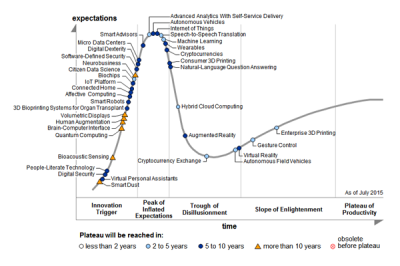
2014 was the year that the Internet of Things (IoT) reached the “Peak of Inflated Expectations” on the Gartner Hype Cycle. By 2015, it had only moved a tiny bit, towards the “Trough of Disillusionment”. We’re going to try to push it over the edge.

emerging-tech-hc.png;wa0131df2b233dcd17Depending on whom you ask, the IoT seems to mean that whatever the thing is, it’s got a tiny computer inside with an Internet connection and is sending or receiving data autonomously. Put a computer in your toaster and hook it up to the Internet! Your thermostat? Hook it up to the Internet!? Yoga mat? Internet! Mattress pad? To the Intertubes!
Snark aside, to get you through the phase of inflated expectations and on down into disillusionment, we’re going to use just one word: “security”. (Are you disillusioned yet? We’re personally bummed out anytime anyone says “security”. It’s a lot like saying “taxes” or “dentist’s appointment”, in that it means that we’re going to have to do something unpleasant but necessary. It’s a reality-laden buzzkill.)

Continue reading “Get Your Internet Out Of My Things”

A White Hat Virus For The Internet Of Things

The Internet of Things is going gangbusters, despite no one knowing exactly what it will be used for. There’s more marketing money being thrown at IoT paraphernalia than a new soda from Pepsi. It’s a new technology, and with that comes a few problems: these devices are incredibly insecure, and you only need to look at a few CCTV camera streams available online for proof of that.

The obvious solution to vulnerable Internet of Things things would be to get people to change the login credentials on their devices, but that has proven to be too difficult for most of the population. A better solution, if questionable in its intentions, would be a virus that would close all those open ports on routers, killing Telnet, and reminding users to change their passwords. Symantec has found such a virus. It’s called Wifatch, and it bends the concept of malware into a force for good.

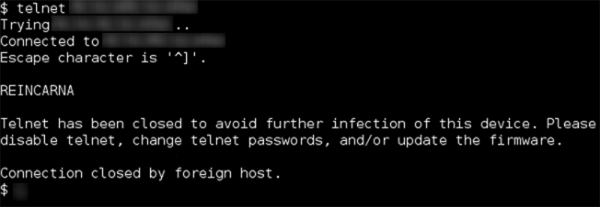
Wifatch is a bit of code that slips through the back door of routers and other IoT devices, closes off Telnet to prevent further infection, and leaves a message telling the owner to change the password and update the device firmware. Wifatch isn’t keeping any secrets, either: most of the code is written in unobfuscated Perl, and there are debug messages that enable easy analysis of the code. This is code that’s meant to be taken apart, and code that includes a comment directed at NSA and FBI agents:

To any NSA and FBI agents reading this: please consider whether defending
the US Constitution against all enemies, foreign or domestic, requires you
to follow Snowden's example.

Although the designer of Wifatch left all the code out in the open, and is arguably doing good, there is a possible dark side to this white hat virus. Wifatch connects to a peer-to-peer network that is used to distribute threat updates. With backdoors in the code, the author of Wifatch could conceivably turn the entire network of Wifatch-infected devices into a personal botnet.

While Wifatch is easily removed from a router with a simple restart, and re-infection can be prevented by changing the default passwords, this is an interesting case of virtual vigilantism. It may not be the best way to tell people they need to change the password on their router, but it’s hard to argue with results.

[Image source: header, thumb]

Getting Biometrics In Hand

It is amazing how quickly you get used to a car that starts as long as you have the key somewhere on your person. When you switch vehicles, it becomes a nuisance to fish the key out and insert it into the ignition. Biometrics aims to make it even easier. Why carry around a key (or an access card), if a computer can uniquely identify you?

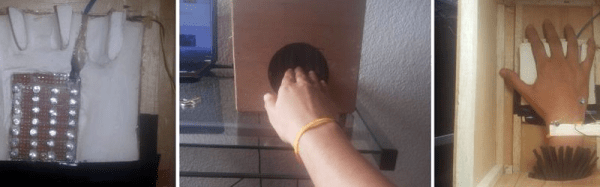
[Alexis Ospitia] wanted to experiment with vein matching biometrics and had good results with a Raspberry Pi, a web cam, and a custom IR illumination system. Apparently, hemoglobin is a good IR reflector and the pattern of veins in your hand is as unique as other biometrics (like fingerprints, ear prints, and retina vein patterns). [Alexis’] post is in Spanish, but Google Translate does a fine job as soon as you realize that it thinks “fingerprint” is “footprint.” The software uses OpenCV, but we’ve seen the same thing done in MATLAB (see the video below).

Continue reading “Getting Biometrics In Hand”

Reverse Engineering An Obsolete Security System

[Veghead] recently went to a surplus warehouse filled with VHS editing studios, IBM keyboards, electronic paraphernalia from 40 years ago, and a lot of useless crap. His haul included a wooden keypad from an old alarm system that exuded 1980s futurism, and he figured it would be cool to hook this up to an alarm system from 2015. How did he do that? With software defined radio.

After pulling apart the alarm panel, [Veghead] found only a single-sided board with a 9V battery connector. There were no screw terminals for an alarm loop, meaning this entire system was wireless – an impressive achievement for the mid-80s hardware. A quick search of the FCC website showed this alarm panel was registered to two bands, 319MHz and 340MHz, well within the range of an RTL-SDR USB TV tuner dongle.

After capturing some of the raw data and playing it back in Audacity, [Veghead] found a simple OOK protocol that sends two identical binary patterns for each key. A simple program takes the raw bit patterns for each key press and codes them into a map for each of the twelve buttons.

Although the radio still works, [Veghead] found the waveforms captured by his RTL-SDR were an abomination to RF. All the components in this security system are more than 30 years old at this point, and surely some of the components must be out of spec by now. Still, [Veghead] was able to get the thing working again, a testament to the usefulness of a $20 USB TV tuner.

Thanks [Jose] for sending this one in

The Year Of The Car Hacks

With the summer’s big security conferences over, now is a good time to take a look back on automotive security. With talks about attacks on Chrysler, GM and Tesla, and a whole new Car Hacking village at DEF CON, it’s becoming clear that autosec is a theme that isn’t going away.

Up until this year, the main theme of autosec has been the in-vehicle network. This is the connection between the controllers that run your engine, pulse your anti-lock brakes, fire your airbags, and play your tunes. In most vehicles, they communicate over a protocol called Controller Area Network (CAN).

An early paper on this research [PDF] was published back in 2010 by The Center for Automotive Embedded Systems Security,a joint research effort between University of California San Diego and the University of Washington. They showed a number of vulnerabilities that could be exploited with physical access to a vehicle’s networks.

A number of talks were given on in-vehicle network security, which revealed a common theme: access to the internal network gives control of the vehicle. We even had a series about it here on Hackaday.

The response from the automotive industry was a collective “yeah, we already knew that.” These networks were never designed to be secure, but focused on providing reliable, real-time data transfer between controllers. With data transfer as the main design goal, it was inevitable there would be a few interesting exploits.

Continue reading “The Year Of The Car Hacks”

Use Your Mouse Pointer To Send Data

[Ido Gendel] was thinking about new and interesting ways to send data between devices, when he realized that the answer was right in his hand. Literally: he decided to try sending data using the mouse pointer. What he came up with was an interesting hack that uses small movements of the mouse pointer to send data at up to 1200bps, or about 150 bytes per second.

The way he did this was very, very clever. He used an Arduino Leonardo that is set to emulate a mouse, working alongside his existing mouse. This setup means that he can use his existing mouse: the system just sees the Arduino as a second mouse, and the pointer just looks a little jerky when you zoom in. That is because the Arduino is just sending tiny movements, each of which is a code that represents a nybble (4 binary bits) of data. By using both a combination of three left-right or up-down movements, he was able to create 16 movements, each of which can encode 4 bits of data. Each of these encoding movements also returns the mouse to its origin point, so the mouse doesn’t mysteriously scroll off the screen when data is being sent.

Continue reading “Use Your Mouse Pointer To Send Data”