Robot Boxing With Wrist Watches

The classic injection molded plastic Rock ‘Em Sock ‘Em Robots has been upgraded to use motion control. The project uses four TI Chronos watches, one on each wrist of both players. In the video after the break we get a good look at the guts of the base unit. We’re quite impressed with the quality craftsmanship that went into retrofitting the plastic bots with four servos each. The electronics include some bells and whistles such as an SD card that records scores and can replay a match via saved inputs. If you’ve got a couple of these watches on hand we’d love to see you port this project and make it a Punchout controller.
Continue reading “Robot Boxing With Wrist Watches”

Mouse Controlled Manipulator Arm

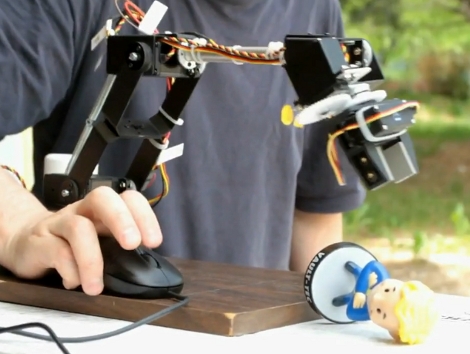
[Oleg] worked out a way to use his USB mouse to control this manipulator arm. Using a Lynxmotion AL5D (we’ve seen the AL5A previously) he drives the six servos with an Arduino servo shield. A USB host shield handles the HID end for connecting the mouse. The video after the break says it all, [Oleg] has no problem picking up that figurine quickly and accurately. Sliding the mouse controls horizontal movement in all directions. The scroll wheel moves the claw up and down. And holding the left or right buttons what using the control wheel closes or rotates the claw. All we can say is: Bigger, BIGGER!

Continue reading “Mouse Controlled Manipulator Arm”

Servo Controller Board

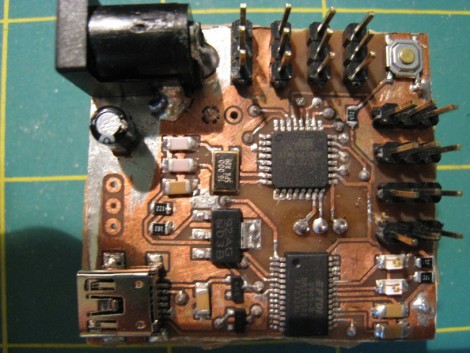
This board is [Eric Seifert’s] venture into working with AVR microcontrollers. He has worked with PIC microcontrollers in the past and used the goal of developing a servo controller board as his motivation to try the grass on the other side of the fence. He found he likes the AVR line for its ease of development under Linux, a feature we also appreciate. What he ended up with is a tiny board that controls up to eight servo motors. If you’ve got a project that is spilling over with servo-controlled limbs, maybe this will save you some development time.

Foam Board Servo Driven Arm

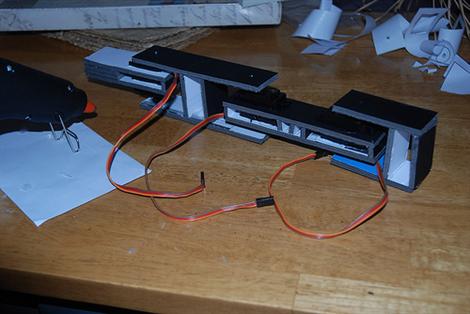
[Lucky Larry] posted some pictures to the Hack a Day flickr pool that caught our eye. He made a quick and cheap servo driven arm. Constructed from foam board and some hobby servos, he’s using an Arduino for the brains. You can download the pattern for the arm pieces as well as the code on his site.

He ultimately finds that he has positioning issues that he blames on the cheap servos. You can see in the video on his site that the circles it is drawing are drifting one direction.

Panoramic And Spheric Tripod Rig

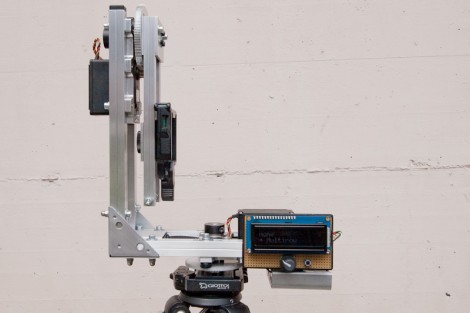
This simple yet precise build takes your camera for a spin in order to take spherical and multi-row panorama photographs. The rig mounts to a tripod, using two servo motors for motion, producing images that can be stitched together perfectly. An Arduino handles the hardware with an LCD interface for dialing in the settings.It’s not the cheapest way to get 360 degree shots but the example images are amazing.

[Thanks Juan]

Power Laces Take Us 5 Years Into The Future

[youtube=http://www.youtube.com/watch?v=ROEZs0HpFQc]

Back to the Future Part 2 provided a glimpse of a future that included hover boards and holographic advertisements. But you don’t have to wait until 2015 to get your hands on at least some of the technology. [Blake Bevin] has produced a pair of shoes with power laces as seen in the film. Of course present day technology doesn’t allow him to make the mechanical parts disappear so you’ll have to deal with two servo motors and an Arduino hanging off of your heels.  But hey, at least you won’t have to tie your own shoes like some 20th century peasant. No word on using these for a little theme music as you walk around but maybe that’s something from the more distant future.

Sound Card Driven Servo Motor

[youtube=http://www.youtube.com/watch?v=1LG2Ecsk13Q]

[Darrell] is using a sound card to drive this servo motor. The motor draws power from a cellphone battery with the control signal coming from one of the audio channels. It’s not too surprising that this works since the motor just needs a PWM signal to operate and that’s what is used to create the different frequencies of sound on electronic speakers. We’re not sure what [Darrell’s] got planned for this system but he mentions that two servos can be used, one on each audio channel. If you’re not using your sound card this would be a way to stop using the Arduino for that mail checker and just use a little flag attached to a servo. When mail comes in the appropriately engineered sound raises the flag.