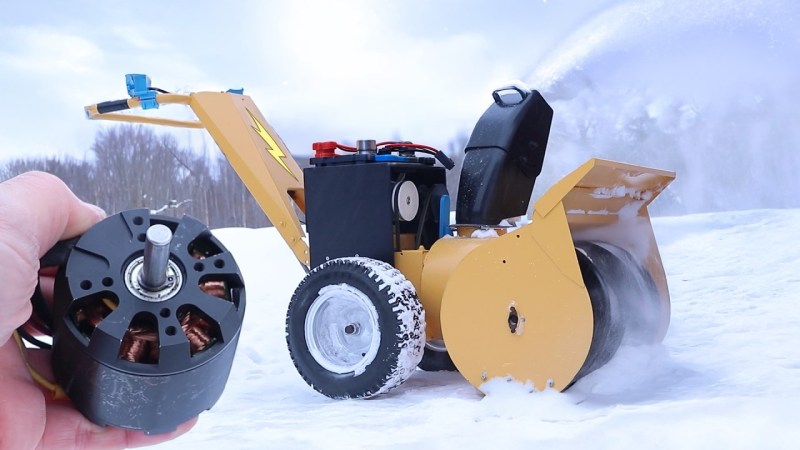
The blower and a smaller motor than what's actually driving it.

Electric Snowblower Clears The Way With Hobby Parts

If you live in snow country and own a home, you either have a snowblower or wish you did. The alternatives are either an expensive and potentially unreliable plow service, or back-breaking (and heart-attack inducing) shoveling. [RCLifeOn] was one of those people in the second category, until he decided to do something about it: electrifying a scrap snowblower with a blown engine. 

The usual brushless DC motors and electronic speed controllers [RCLifeOn] has on hand to get his R/C life on with don’t quite have enough oomph to handle both functions of a snowblower. For those of you cursed to live in warmer climes, the modern snowblower is both self-propelled via its twin wheels, and generally has a two-stage powered snow-removal “blower” consisting of an auger to break up the snow and an impeller to blast it out of the machine and many meters off the driveway. On the traditional gas-powered models, these are both powered via belts off the same motor, but that wasn’t going to work.

He kept the belts, and simply used a pair of motors, each with their own ESCs that are controlled via oversized thumb wheels on the handles. The belts couple to the motors with 3D printed pulleys. Belt tension is achieved in the case of the wheels through a simple and sensible shimming arrangement. In the case of the blower motor, he uses a 3D printed adjustable mount to get the appropriate tension. To help it hold long-term (given the issues with creep in 3D prints) he’s got a bearing on a second mount opposite the motor.  It holds up for his demo, which consists of clearing a driveway of 10cm of snow and then plowing through a pile larger than the mouth of the machine. In other words: it works.

The build, as unfortunately common on YouTube, is shy on specific details– but in this case that’s fine. Even if he’d open-sourced everything and posted STEP or STL files, it wouldn’t save much time since you’d pretty well have to re-engineer the build to fit your own snowblower, if you were so inclined. As with many hacks of this nature, the point of sharing it is to show how easy it is and provide the inspiration. As the cartoons used to say, “knowing is half the battle.”

If one was to re-implement this hack, we could not encourage you strongly enough to put in the standard dead-man’s switch, a feature commercial snowblowers share with things like lawnmowers. As annoying as it is to hang onto with frozen fingers, that safety feature is there for a reason.

If your driveway is short, you can save on gas and fuel costs with an extension cord. Or you could just stay inside and do the job by remote control, but that comes with its own pitfalls.

Continue reading “Electric Snowblower Clears The Way With Hobby Parts”

Backyard Rope Tow From Spare Parts

A few years ago, [Jeremy Makes Things] built a rope tow in his back yard so his son could ski after school. Since the lifts at the local hill closed shortly after schools let out, this was the only practical way for his son to get a few laps in during the week. It’s cobbled together from things that [Jeremy] had around the house, and since the original build it’s sat outside for a few years without much use. There’s been a lot more snow where he lives this year though, so it’s time for a rebuild.

The power source for the rope tow is an old gas-powered snowblower motor, with a set of rollers and pulleys for the rope made out of the back end of a razor scooter. Some polyurethane was poured around the old wheel hub so that the rope would have something to grip onto. The motor needed some sprucing up as well, from carburetor adjustment, fuel tank repairs, and some other pieces of maintenance before it could run again. With that out of the way it could be hoisted back up a tree at the top of the hill and connected to the long rope.

This isn’t the first time [Jeremy] has had to perform major maintenance on this machine either. Three years ago it needed plenty of work especially around the polyurethane wheel where [Jeremy] also had to machine a new wheel bearing in addition to all the other work that had to go into repairing it that time. From the looks of things though it’s a big hit with his son who zips right back up the hill after each ski run. Getting to the tops of ski runs with minimal effort has been a challenge of skiers and snowboarders alike for as long as the sport has been around, and we’ve seen all kinds of unique solutions to that problem over the years.

Fail Of The Week: The Little Remote-Controlled Snowblower That Couldn’t

[Punxatawny Phil]’s prognostications aside, winter isn’t over up here in the Northern Hemisphere, and the snow keeps falling. If you’re sick of shoveling the driveway and the walk and you don’t have a kid handy to rope into the job, relax —  this rapidly assembled junkyard RC snowblower will do just as crappy a job while you stay nice and warm inside.

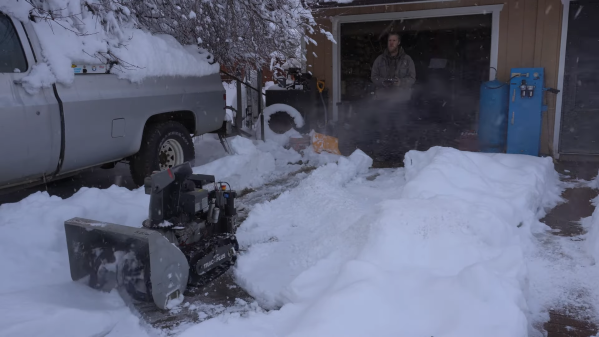
This build seemed to have a lot of potential at the start, based as it was on a second-hand track-drive snowblower, something that was presumably purpose-built for the job at hand. [Lucas] quickly got to work on it; he left the original gasoline engine to power the auger but took most of the transmission off so that each track could be driven separately with a wheelchair motor.  That seemed like a solid idea as far as steering goes, but the fact that he chose to drive the 24 volt motors with a single 12 volt deep-cycle battery worked against him out in the snow.

With a battery upgrade for better traction, the snowblower actually got around in the snow pretty well. [Lucas] also added some nice features, like a linear actuator to remotely engage the auger — a nice safety touch when kids and pets are around — and a motor to control the direction of the chute. Even these improvements weren’t enough, though; it worked insofar as it moved snow from where it was to where it wasn’t, but didn’t really move it very far. To the casual observer, it seems like there’s just not enough weight to the machine, allowing it to ride up over the snow rather than scraping the driveway clean. Check out the video below and see what you think.

Now, we’re not picking on [Lucas] here. Far from it — we enjoyed this build as much as some of his other stuff, like his scratch-built CO2 laser tube and his potty-mouthed approach to Kaizen tool organization. We still think this one has a lot of potential, and we’re glad he vowed to continue working on it for next winter.

Continue reading “Fail Of The Week: The Little Remote-Controlled Snowblower That Couldn’t”

Remote Controlled Electric Snowblower Sports FPV For Safety

As summer scorches the northern hemisphere, here’s something to cool your thoughts: winter is only four months away. And with it will come the general misery and the proclamations that “It’ll never be warm again,” not to mention the white stuff and the shoveling. Or perhaps not, if you’re lucky enough to have a semi-autonomous electric snowblower in the garage.

The device [Dane Kouttron] describes is a strange beast indeed, and one that came to him under somewhat mysterious circumstances. It appears to be a standard Ariens two-stage blower, the kind normally driven by a fairly beefy internal combustion engine so as to have enough power to run the auger, the impeller, and the drive wheels. But a previous owner had removed the gas engine and attached a 4-kW brushless motor to run the auger and impeller. Realizing the potential of this machine and with a winter storm heading his way, [Dane] used the old engine mount to hold giant LiFePO₄ batteries from a cell tower backup battery, slapped a couple of electric wheelchair motors onto the drive wheels, mounted a motor to swivel the exhaust chute, and added control electronics from a retired battlebot. Setting such a machine loose in the wild would be bad, so an FPV system was added just in time for storm cleanup. Upgrades for version 2 include better weight distribution for improved stability and traction, and of course googly eyes. Check out the video below to see it flinging snow and moving around faster than any snowblower we’ve ever seen.

We’ll never get lucky enough to have such wonders gifted on us as [Dane] did, but we applaud him for picking up the torch where someone else obviously left off. And who knows; perhaps the previous maker took inspiration from this remote-controlled snowblower build?

Continue reading “Remote Controlled Electric Snowblower Sports FPV For Safety”

Electric Snowblower Does The Job With 240 Volts

In parts of the world where it snows a lot and there are requirements for homeowners to keep sidewalks clear, a personal snowblower is it seems an essential piece of equipment. They have traditionally used internal combustion engines, but electric models are also available.

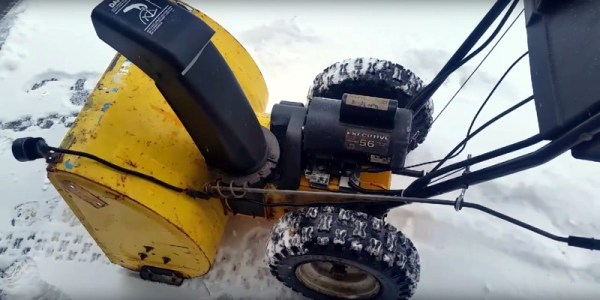
[Joel Clemens] is not impressed by the commercial electric blowers available to him as an American, because their 120 V mains supply just can’t deliver the power to make an effective two-stage design. So he’s built his own using a formerly gasoline-powered blower from a garage sale, and a 240 V industrial motor.

The blower is an impressive piece of equipment even if his running it close to its own cord does look rather hazardous. But the video is also of interest for its examination of the state of access to 240 V outlets for Americans. [Joel] has one for his electric vehicles, and has made a splitter box to give him the required American-style 240 V industrial connector. He makes the point that this is becoming more common as the take-up of electric vehicles gathers pace.

Continue reading “Electric Snowblower Does The Job With 240 Volts”

Just In Time For Summer: A Remote Controlled Snowblower

It’s May, and you know what that means: we’re winding down from a worldwide celebration of the worker, pollen is everywhere, Hackaday readers in the southern hemisphere are somehow offended, and somewhere, someone is finishing up a remote-controlled snow blower build.

In this nine-part, two-hour-long video series, [Dave] covers the planning and fabrication of one of the most coveted of all cold weather yard instruments. It’s a remote-controlled snow blower. Just think: instead of bundling up to go blow the driveway off, [Dave] can get all the snow off his driveway from the comfort of his living room window. Sure, it may not sound like a big deal now that it’s Crocs & Socks weather, but this is going to be a great invention in seven or eight months.

This snow blower robot is built around two motors taken from an electric wheelchair. Most snowblowers already have tracks, so the ever-important traction for this build is already taken care of. A linear actuator takes care of the angle of the ‘scoop’, and a clever confabulation of bicycle sprockets, chain, and a motor allows the ‘chute’ of the snowblower to be pointed in any direction. The electronics are simple enough – a normal, off-the-shelf RC transmitter and receiver handles the wireless communication while an Arduino takes those signals and turns them into something the relays and motors understand.

This is one of the better build vlogs we’ve seen. There are nine parts to this build, we’ve included the final, wrapup video below.

Continue reading “Just In Time For Summer: A Remote Controlled Snowblower”

diy power wagon

Snow Blower Turned Power Wagon

Winter is now gone and it’s time to put away that snowblower. Well, it seems that [SWNH] either didn’t hear the news or thought not using his snowblower for most of the year was a waste of a great resource. No, he’s not using it to blow dirt around, he converted it into a Power Wagon.

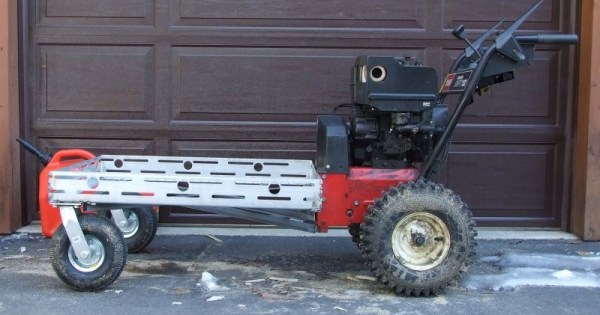
A Power Wagon is just what it sounds like, a wagon that is motorized and it is used for moving stuff around your yard. [SWNH] started by disassembling the 2 stages of the snowblower. They came off as a unit with only 6 bolts. Next up, the wagon bed was made, starting with an angle iron frame with a plywood bottom and sides. Two large casters with rubber wheels supports the front of the wagon.

Using the power wagon is easy, fill up the bin and use the snowblower controls to drive the cargo around. [SWNH] says that it steers like a shopping cart. And since the wagon bed is bolt-on, it can be removed and the blower assembly re-installed next winter to take care of that pesky snow.