Hacking A Code-protected Hard Disk

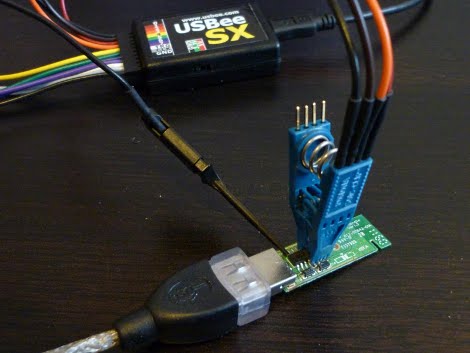
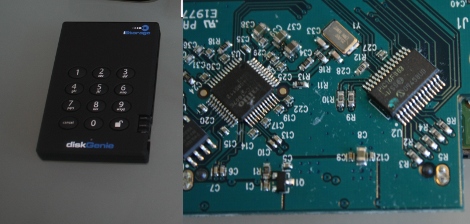
Our friend [Sprite_TM] took a look at the security of a code-protected hard disk. The iStorage diskGenie is an encrypted USB hard drive that has a keypad for passcode entry. After cracking it open he found that the chip handling the keypad is a PIC 16F883 microcontroller. He poked and prodded at the internals and found some interesting stuff. Like the fact that there is an onboard LED that blinks differently based on the code entered; one way for the right code, another for the wrong code of the right number of digits, and a third for a wrong code with the wrong number of digits. This signal could be patched into for a brute force attacking but there’s a faster way. The microcontroller checks for the correct code one digit at a time. So by measuring the response time of the chip an attacker can determine when the leading digit is correct, and reduce the time needed to crack the code. There is brute force protection that watches for multiple incorrect passwords but [Sprite_TM] even found a way around that. He attached an AVR chip to monitor the PIC response time. If it was taking longer than it should for a correct password the AVR resets the PIC before it can write incorrect attempt data to its EEPROM. This can be a slow process, but he concluded it should work. We had fun watching the Flash_Destroyer hammer away and we’d like to see a setup working to acquire the the code from this device.
Modchip Hacks PS3 Via USB Port

[youtube=http://www.youtube.com/watch?v=4jOEbZEkp9A]

It’s been a long time coming, but the video above shows a modchip circumventing the PlayStation 3 security by running a game from a hard drive. The sites Ozmodchips.com which sells the modchip, and psx-scene.com which has confirmed them as working are both unstable right now due to heavy traffic. But here’s what we know. The device is called the PS Jailbreak and can be used to dump PS3 games to the hard drive of a PlayStation3 running the most current firmware (3.41). Dumped games can then be played from the hard drive by selecting them from a menu that the modchip spawns. It’ll cost you though. The current preorder price is $169.99 AUD or $147.47 US dollars with a projected delivery date of August 27th.

[Thanks Charlie via Slashdot]

RGB VU Meter

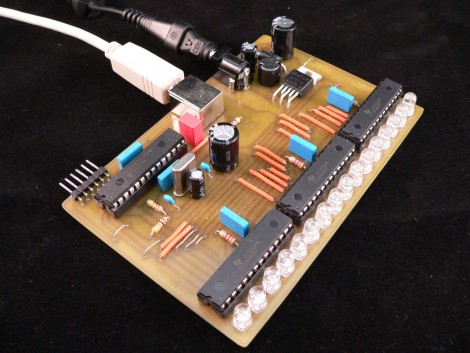
[Simon Inns] turned out this VU meter with a 16 RGB LEDs. He’s using three 16-bit TLC5940NTG LED drivers for the project. They’re not cheap chips but they do a great job. If you were looking to save on parts [Simon] found there’s more than enough brightness and any loss due to multiplexing would not be a problem. The device connects to a computer via USB thanks to the PIC 18F2550 which he’s used in his past VU meter projects. One of the design choices he made was to use a switching power supply. The LM2576 (datasheet) has no problem sourcing 3A at 5V and in addition to two electrolytic capacitors which are commonly used with linear regulators, you just need to add a diode and an inductor.

The meter offers several different configurations which are set on the PC side of things. These include the colors that are used and if the entire bars is used as one meter or split into sections to display both audio channels. Check it out after the break.

Continue reading “RGB VU Meter”

Reverse Engineering Apple’s Recharging Scheme

[vimeo=http://vimeo.com/13835359]

[Ladyada] has been hard at work reverse engineering the charging method used by Apple products. This saga takes us through the years as new devices were released and subsequently broke Minty Boost’s charging capabilities. It seems the data lines were gradually adopted as a means for iPhones and iPods to identify the charger that had been connected. By adding voltage dividers to the D+ and D- lines you can instruct the handheld to pull 1 Amp (with data voltages of 2.8v and 2.0v) for wall chargers or 0.5 Amps (2.0v on both data lines) for portable chargers. In the video above [Ladyada] removes the surface mount resistors from a commercial charger in order to measure the voltage divider and discover the secret.

Tethering The Samsung Vibrant Without Rooting

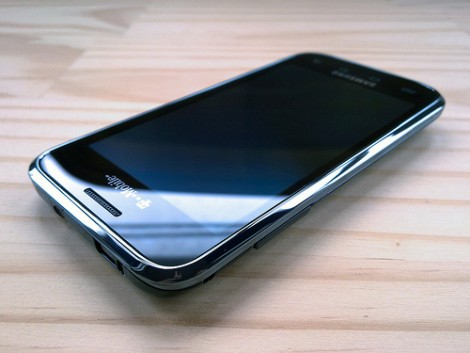
If you’ve got a Samsung Vibrant and want to take advantage of that unlimted 3G account you can tether without rooting the phone. This method uses a USB cable to provide internet access to Windows XP and Windows 7 computers. Samsung’s own Kies software handles the tethering, as long as you have the magic number to get connected on T-Mobile USA networks; ‘epc.tmobile.com’ for the APN name and ‘*99#’ as the phone number. [Zedomax] made the video after the break which takes you through the tethering ritual.

Continue reading “Tethering The Samsung Vibrant Without Rooting”

Mouse Controlled Manipulator Arm

[Oleg] worked out a way to use his USB mouse to control this manipulator arm. Using a Lynxmotion AL5D (we’ve seen the AL5A previously) he drives the six servos with an Arduino servo shield. A USB host shield handles the HID end for connecting the mouse. The video after the break says it all, [Oleg] has no problem picking up that figurine quickly and accurately. Sliding the mouse controls horizontal movement in all directions. The scroll wheel moves the claw up and down. And holding the left or right buttons what using the control wheel closes or rotates the claw. All we can say is: Bigger, BIGGER!

Continue reading “Mouse Controlled Manipulator Arm”

Wireless Presenters Easily Cracked

While hacking a wireless presenter doesn’t sound like something worthwhile or interesting, [Niels Teusink] demonstrates that these little devices often are a lot more powerful than we give them credit.

With an Arduino, plenty of research, and some heavy sniffing of a wireless presenter’s SPI and then wireless interface [Niels] is able to emulate an entire keyboard. Sending commands as harmless as “next slide” to the devastating “[Win+R] Format C:”. Hopefully anyone planning such a project at the next Apple or Microsoft keynote just intends some gentle fun.

Related: Wireless keyboards easily cracked.

[Thanks Dan Ransom]