A Smart Bandage For Monitoring Chronic Wounds

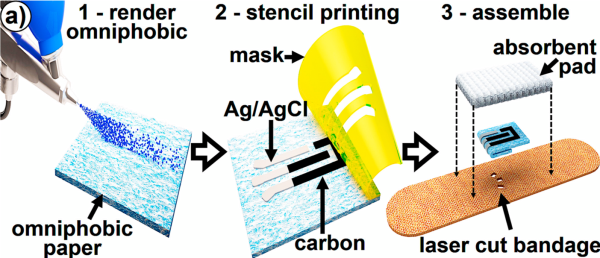
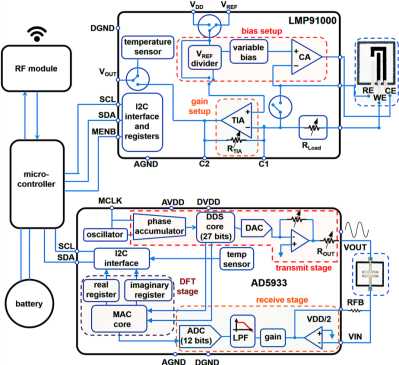
Here at Hackaday, we’re always enthralled by cool biohacks and sensor development that enable us to better study and analyze the human body. We often find ourselves perusing Google Scholar and PubMed to find the coolest projects even if it means going back in time a year or two. It was one of those scholarly excursions that brought us to this nifty smart bandage for monitoring wound healing by the engineers of FlexiLab at Purdue University. The device uses an omniphobic (hydrophobic and oleophobic) paper-based substrate coupled with an onboard impedance analyzer (AD5933), an electrochemical sensor (the same type of sensor in glucometers) for measuring uric acid and pH (LMP91000), and a 2.4 GHz antenna for wirelessly transmitting the data (nRF24L01). All this is programmed with an Arduino Nano. They even released their source code.

To detect uric acid, they used the enzyme uricase, which is very specific to uric acid and exhibits low cross-reactivity with other compounds. They drop cast uric acid onto a silver/silver chloride electrode printed on the omniphobic paper. Similarly, to detect pH, they drop cast a pH-responsive polymer called polyaniline emeraldine salt (PANI-ES) between two separate silver/silver chloride electrodes. All that was left was to attach the electrodes to the LMP91000, do a bit of programming, and there they were with their own electrochemical sensor. The impedance analyzer was a bit simpler to develop, simply attaching un-modified electrodes to the AD5933 and placing the electrodes on the wound.

The authors noted that the device uses a much simpler manufacturing process compared to smart bandages published by other academics, being compatible with large-scale manufacturing techniques such as roll-to-roll printing. Overcoming manufacturing hurdles is a critical step in getting your idea into the hands of consumers. Though they have a long way to go, FlexiLab appears to be on the right track. We’ll check back in every so often to see what they’re up to.

Until then, take a look at some other electric bandage projects on Hackaday or even make your own electrochemical sensor.

Rapid Prototyping System Gives Wheels To Wearables

Wearables are kind of a perplexing frontier for electronics. On the one hand, it’s the best possible platform for showing off a circuit everywhere you go. On the other hand, the whole endeavor is fiddly because the human body has no straight lines and moves around quite a bit. Circuits need to be flexible and comfortable. In other words, a wearable has to be bearable.

[Konstantin], [Raimund], and [Jürgen] have developed an intriguing system for prototyping e-textiles that opens up the wearables world to those who don’t sew and makes the prototyping process way easier for everyone.

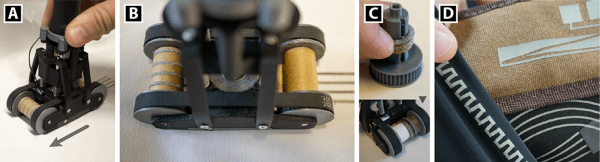
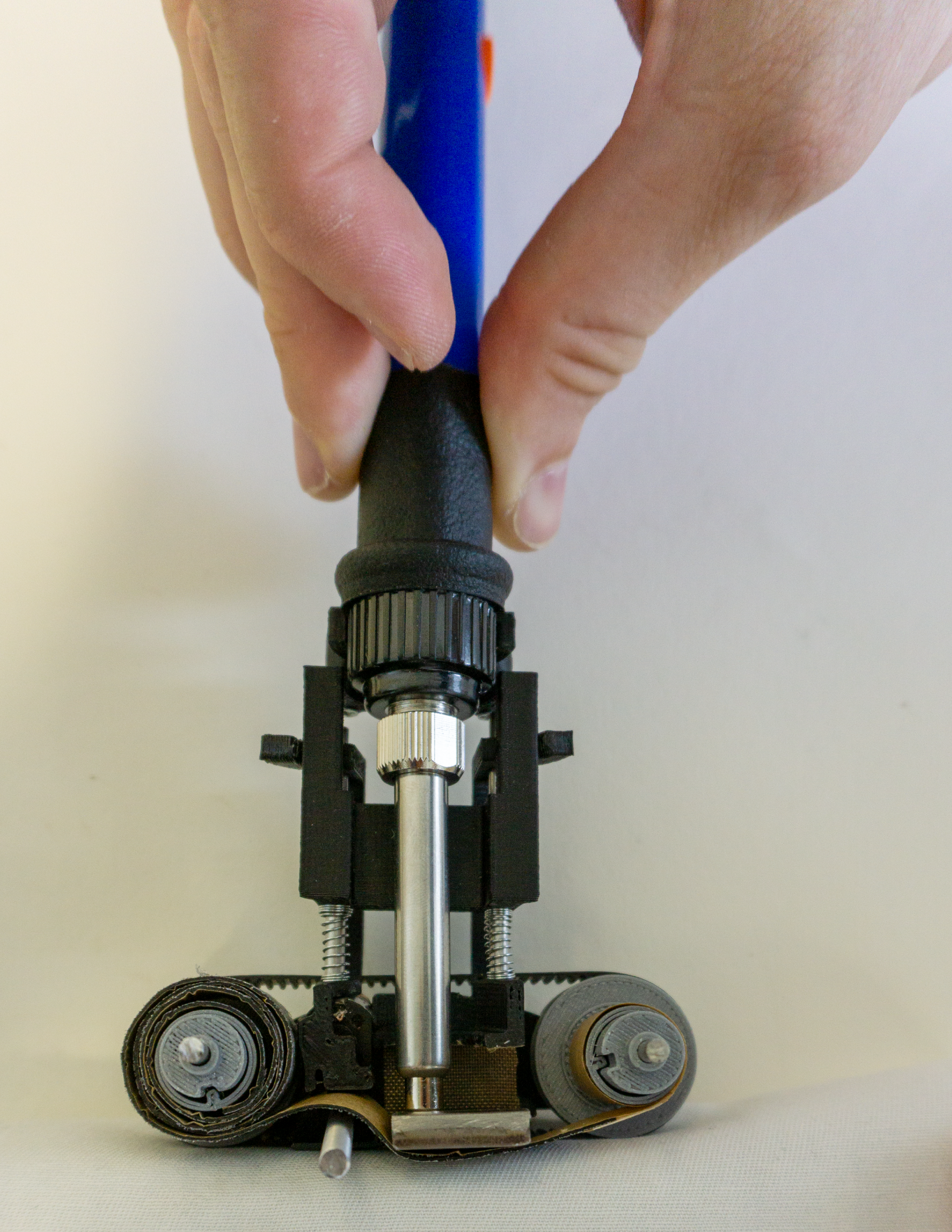
It’s a small and portable roll-on ironing device that lays down different kinds of custom ‘tapes’ on to textiles. The conductive fabric tapes can be used as touchable traces, and can support components such as flexible e-ink screens and solar panels. Some tapes provide single or multiple points of connectivity, and others are helper substrates like polyimide tape that multiply the possibilities for complex circuits.

The device uses a modified soldering iron to transfer the tapes, which are loaded onto 3D-printed spools that double as the wheels. Check it out after the break — there’s a 30-second tour and a 5-minute exploration of the whole process.

Everyone needs to prototype, even the seasoned stitchers. The next time you’re thinking in thread, throw some magnets into the process.

Continue reading “Rapid Prototyping System Gives Wheels To Wearables”

Thunder Pack Is A Bolt Of Lightning For Wearables

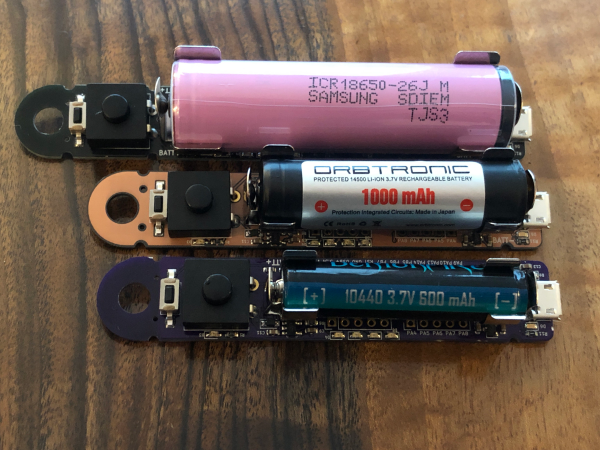
Do you need portable power that packs a punch? Sure you do, especially if you want to light up the night by mummifying yourself with a ton of LED strips. You aren’t limited to that, of course, but it’s what we pictured when we read about [Jeremy]’s Thunder Pack. With four PWM channels at 2.3 A each, why not go nuts? [Jeremy] has already proven the Thunder Pack out by putting it through its paces all week at Burning Man.

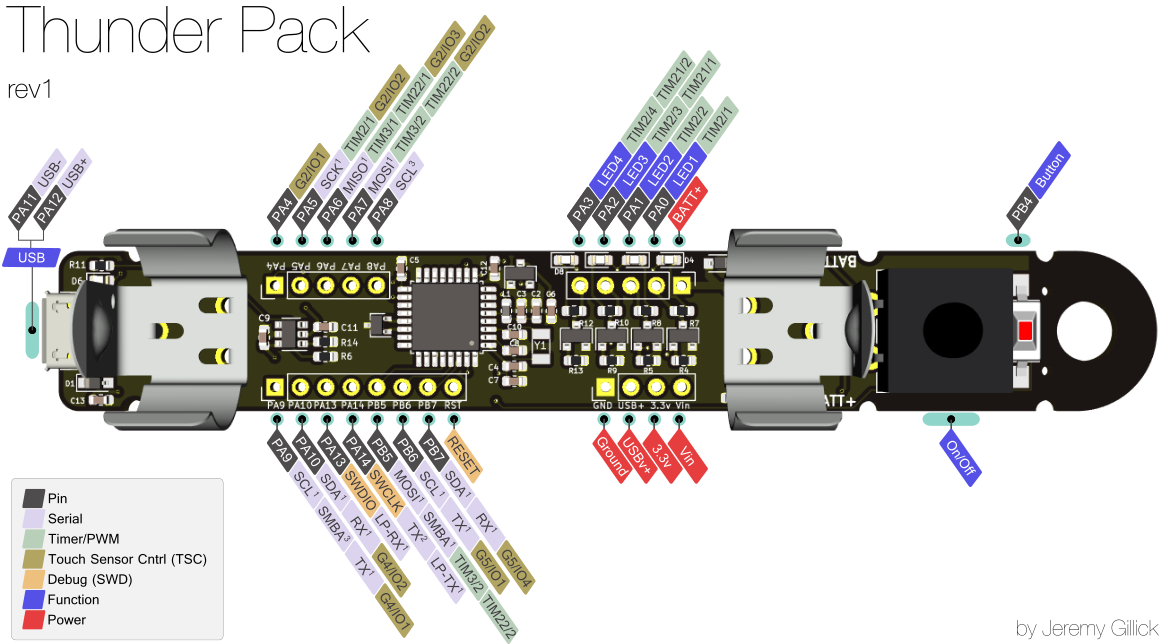
Click to embiggen!

After a few iterations, [Jeremy] has landed on the STM32 microcontroller family and is currently working to upgrade to one with enough flash memory to run CircuitPython.

The original version was designed to run on a single 18650 cell, but [Jeremy] now has three boards that support similar but smaller rechargeable cells for projects that don’t need quite as much power.

We love how small and powerful this is, and the dongle hole is a great touch because it opens up options for building it into a wearable. [Jeremy] made a fantastic pinout diagram and has a ton of code examples in the repo. If you want to wade into the waters of wearables, let whimsical wearables wizard [Angela Sheehan] walk you through the waves.

LED Shirt Does It With Tulle

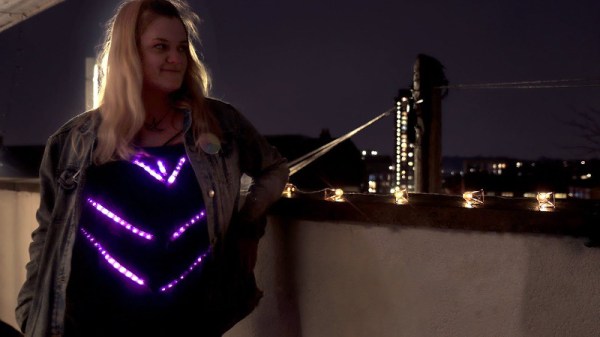
Given that we are living in what most of humanity would now call “the future”, we really ought to start acting like it. We’re doing okay on the electric cars, but sartorially we’ve got some ground to make up. Helping with this effort is [Amy Goodchild], who put together a fancy LED shirt for all occasions.

The basis of the shirt is an ESP8266 running the FastLED library, hooked up to strings of WS2812B LEDs. It’s a great combination for doing quick and simple colorful animations without a lot of fuss. The LED strips are then fastened to the shirt by sewing them on, with heatshrink added to the strips to give the thread something to attach to. Tulle fabric is used as a diffuser, hiding the strips when they’re off and providing a more pleasant glowing effect. Everything is controlled from a small box, fitted with an arcade button and 7-segment display.

It’s a fun piece that’s readily achievable for the novice maker, and a great way to learn about LEDs and sewing. We’ve seen other similar builds before, such as this glowing LED skirt. Video after the break.

Continue reading “LED Shirt Does It With Tulle”

Magnets Make Prototyping E-Textiles A Snap

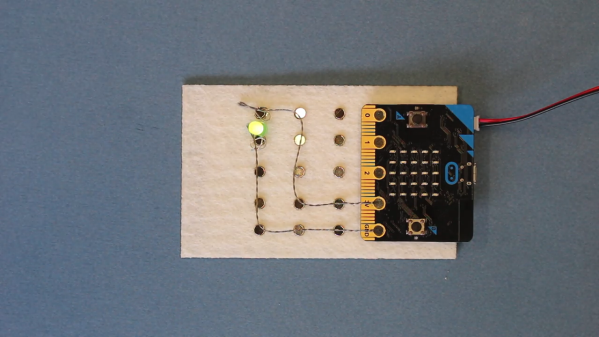
How do you prototype e-textiles? Any way you can that doesn’t drive you insane or waste precious conductive thread. We can’t imagine an easier way to breadboard wearables than this appropriately-named ThreadBoard.

If you’ve never played around with e-textiles, they can be quite fiddly to prototype. Of course, copper wires are floppy too, but at least they will take a shape if you bend them. Conductive thread just wants lay there, limp and unfurled, mocking your frazzled state with its frizzed ends. The magic of ThreadBoard is in the field of magnetic tie points that snap the threads into place wherever you drape them.

The board itself is made of stiff felt, and the holes can be laser-cut or punched to fit your disc magnets. These attractive tie-points are held in place with duct tape on the back side of the felt, though classic double-stick tape would work, too. We would love to see somebody make a much bigger board with power and ground rails, or even make a wearable ThreadBoard on a shirt.

Even though [chrishillcs] is demonstrating with a micro:bit, any big-holed board should work, and he plans to expand in the future. For now, bury the needle and power past the break to watch [chris] build a circuit and light an LED faster than you can say neodymium.

The fiddly fun of e-textiles doesn’t end with prototyping — implementing the final product is arguably much harder. If you need absolutely parallel lines without a lot of hassle, put a cording foot on your sewing machine.

Continue reading “Magnets Make Prototyping E-Textiles A Snap”

Stylish Outfit Packs A Solar Charging Rig

Being out and about with your devices rapidly running out of battery power can rapidly turn into a sticky situation. Suddenly you find yourself unable to hail rideshares and incapable of transferring money around. For the fashion conscious who wish to avoid this, [Kitty Yeung]’s design may be a valuable addition to their summer closet.

The project starts with [Kitty] sewing an elegant bodice and shorts out of a silky silver material. This fabric tends to fray when cut, so fabric glue and iron-on tape was used to protect the edges. This also makes sure the garment doesn’t fall to pieces when washed or worn often. Ribbons, pockets, and other features were designed into the garments to integrate them with hardware to enable the garments to act as a portable charging solution. 3D-printed brackets are affixed to the shoulders, holding a solar panel in an upward-facing angle to catch a good amount of sun. The panel chosen integrates circuitry to output a nice, clean 5V output for charging devices over USB.

It’s a fashionable outfit that also packs useful hardware, and we agree with [Kitty] that it really would be perfect for Burning Man. The cone hat was a nice touch, too. It’s not the first time we’ve heard from [Kitty] either – she appeared as a speaker at 2018’s Hackaday Superconference, too!

Angela Sheehan Is Developing Wearable Tech With Whimsy

As a concept, wearable technology excites many of us, but in practice, it’s been hard to nail down. Up to this point, the most high-tech thing the average person might reasonably wear has been a wrist watch. Devices like Google Glass tried to push the state-of-the-art, but it arguably raised more questions than it answered. It demonstrated in a very public way that developing wearable technology that’s simultaneously visually appealing, useful, and robust enough to handle daily life is exceptionally difficult. If Google couldn’t pull it off, what hope do we lowly hackers have?

But maybe we’ve been going about things the wrong way. Compelling as the end result may seem, the move from wrist watches to head-mounted computers is simply too large of a technical and psychological leap to make. To help develop the skills and techniques necessary to build practical wearable electronics, it might help to take a slightly more fanciful approach.

It seems to be working pretty well for Angela Sheehan, at least. In her talk “Building Whimsical Wearables: Leveling Up Through Playful Prototyping” at the 2019 Hackaday Superconference, she went over some of the things she’s learned while developing her Color Stealing Fairy costume. The product of several years of iterative design, the costume is able to mimic colors seen in the environment through the use of a wireless sensor wand, and features a number of design elements that are critical to any successful wearable project.

Even if a custom RGB Fairy costume isn’t on your short list of projects, there’s information in this talk that will surely be of interest to anyone who’s even contemplated a wearable project. From technical aspects like battery placement to logistical considerations such as making adjustments for multiple wearers, Angela’s make-believe creation has become a testbed for real-world considerations.

Continue reading “Angela Sheehan Is Developing Wearable Tech With Whimsy”