Using Quality Optics With A Webcam

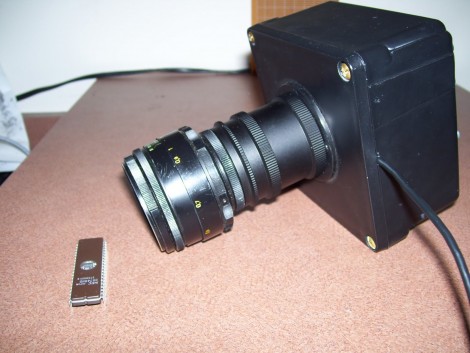
[Devon Croy] built a case to join a webcam sensor with a camera lens. The box is a PVC conduit box you’d find at a home center. He used JB Weld to attach four bolts to the back of the box. These are used to fine-tune the mounting plate for the webcam sensor to ensure it’s at the focal point of the lens. The lens connects through a couple of extension tubes to an adapter mounted in the center of the box’s cover plate. The setup above shows a macro lens that takes pretty good pictures.

If you need images of really tiny things you should look into a microscope adapter for your camera.

Nerf Sentry Turret

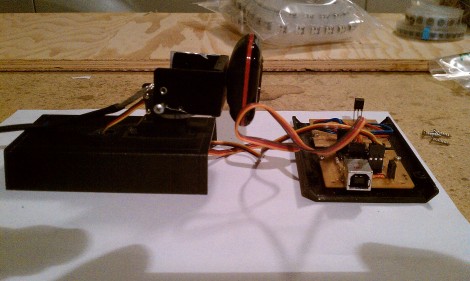
With exams behind him [Adam Greig] had time to make a Nerf sentry gun. It’s actually quite easy to pull everything together. He’s got a netbook running Motion, an open source motion sensing program for use with a webcam. When movement is detected an Arduino, connected via a USB cable, actuates a servo to pull the trigger of the gun. The turret itself has seen a battery upgrade that increases the firing speed. It’s fun to see hardware prototyping done with a few pencils and a fist full of cable ties. Check it out after the break.

This particular toy, the Nerf N-Strike Vulcan, has become quite a popular starting point for turrent projects. We’ve seen one that uses a motorized base, and another that was part of a final project at Cornell.

Continue reading “Nerf Sentry Turret”

Intelligent Ground Vehicle Competition 2010 Day One Report

The Intelligent Ground Vehicle Competition (IGVC) is the precursor to the DARPA Grand Challenge, and in many ways it is just as difficult. We have the pleasure of being at the competition this year with the Tennessee Technological University Autonomous Robotics Team. The teams at the competition pull off some amazing home-brew robotics, so we’ve decided to do a short section on some exemplary robotic hacking each day of the competition.

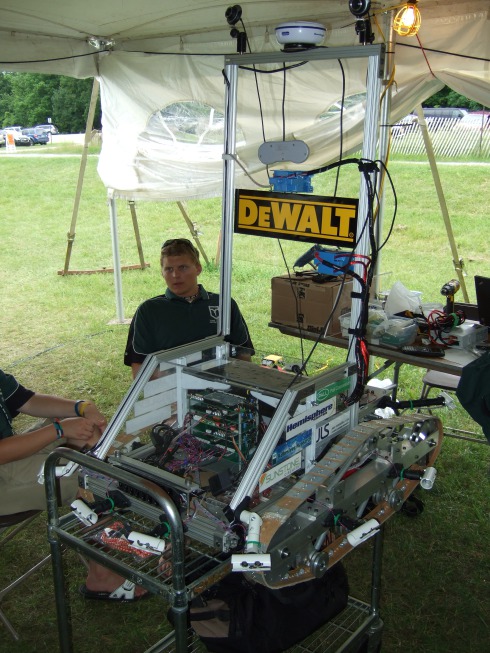
Today’s robot comes from the York College of Pennsylvania. The robot, dubbed “Green Lightning”, features an impressive set of custom made hardware.

We interviewed the team, and got a pretty thorough rundown of their robot with pictures after the jump. Continue reading “Intelligent Ground Vehicle Competition 2010 Day One Report”

Commercial Webcam Multi-touch Coming Soon

[youtube=http://www.youtube.com/watch?v=sBgg33J695I]

It looks like Toshiba has a webcam-based multi-touch display on the way. The video shows an iPod-esque photos album interface where the user stands in front of the display and manipulates it with both hands. The difference between this and some of the other multi-touch displays we’ve seen is that there is no touching necessary (goodbye fingerprints!). The user’s image is superimposed on the screen in a way that reminds us of the original Playstation Eye. Obviously this is much more refined, making us wonder if it’s the better camera, better processing, or both.

[Thanks Risingsun]

Augmented Reality Glasses

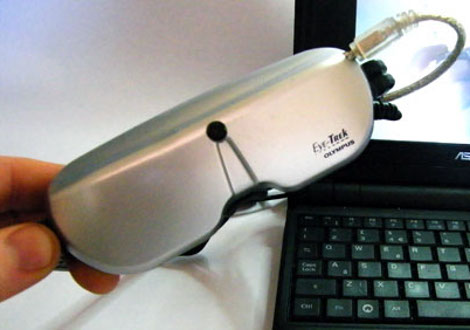
Augmented reality is a pretty neat thing but we don’t want to live our lives staring at a smartphone as we walk around. [F00] didn’t either so he built these augmented reality glasses. You can see a hole in the middle of the glasses where he added a webcam. The camera captures the image in front of you, processes it through augmented reality software, then sends the image to the wearable display that makes up the body of this hack. Integrate this into the head-mounted Linux hack and you’ll be able to ride your bike around the real world with your blast shield down instead of being tethered to your trainer in a virtual universe.

Monocle Fixes Webcam Farsightedness

[Vik Oliver] came up with a webcam focus fix that is so quick and simple we never would have thought of it. He received the webcam as a gift and mounted on an articulated lamp so that it could easily be positioned around his projects. The problem is the camera lacks a focus adjustment so the close-up shots were blurry.

In what we consider a eureka moment, he sourced a pair of dollar store reading glasses to fix the optics. The glasses came with their own mounting bracket. He clipped them in half and wrapped the wire ear support around the camera body. Great hacks don’t have to be complicated, and we need to do a better job of looking at the dollar store for project parts!

Arduino Security With Frickin’ Laser

[over9k] used his Arduino to set up a laser trip wire. The laser is mounted along side the Arduino, reflects off of a mirror, and shines on a photoresistor that interfaces via a voltage divider. The signal from the voltage divider is monitored for a change when the laser beam is broken. [over9k] set things up so that a webcam snaps a picture of the intruder and Twitters the event for easy notification. Video after the break walks through each of these steps.

This build is a bit rough around the edges but unlike other laser trip wires this keeps all the electronics in one place. The laser interface could be a bit more eloquent, and we’re wondering just how much current it is pulling off of the Arduino pins. But if you’re bored and have this stuff on hand it will be fun to play around with it. Continue reading “Arduino Security With Frickin’ Laser”