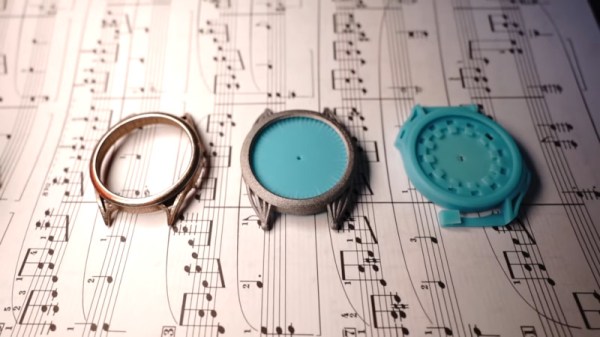
It’s fair to say that among Hackaday readers you will find a very high percentage of 3D printer ownership compared to the general population, but for most of us that means an FDM or perhaps even an SLA printer. These two technologies have both effectively delivered polymer printing at the affordable end of the market, but as readers will also be aware they are only the tip of the 3D printing iceberg. We know the awesomeness of your industrial 3D printer is defined by the size of your wallet, and while our wallets are small, we are offered a chance at the big time through the services of rapid prototyping companies that will print our models on these high-end machines. Thus [Carter]’s project video is as much about using these services as it is about making a wristwatch.
If you’re a clock aficionado and have ever visited Berlin, you’re probably familiar with the Berlin Clock on Budapester Straße: a minimalist design of yellow and orange lights that displays the time in a base-5 number system. This clock has been telling the time to the few that can read it since 1975, and is but one of several unusual clocks that can be found in the city.
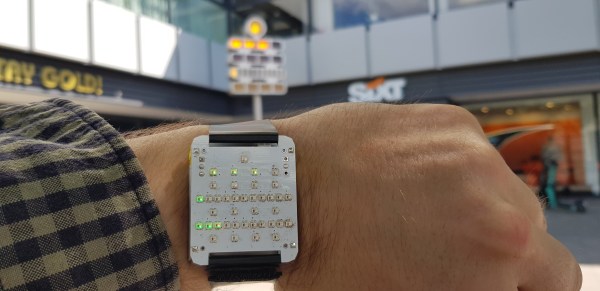
Berlin resident [jjoeff] decided to make a miniature replica, appropriately called the Berlin Uhr Nano, in order to watch the unusual display at any time of day. Built around a Wemos D1 Mini, it connects to WiFi in order to synchronize its internal clock to an NTP time server. It then drives a custom PCB that holds 39 WS2812 LEDs to display the time in its proper format. Unlike the original though, it also includes a full counter to tell the number of seconds; the bigger clock just flashes a single lamp to show the seconds passing.
Are we seeing more wristwatch PCB swapping projects because more people are working on them, or because we saw one and they’re on our mind? The world may never know, but when it comes to design constraints, there’s a pretty fun challenge here both in fitting your electronic wizardry inside the confines of an injection molded case, and in the power budget to make your creation run on a sippy straw of battery power.
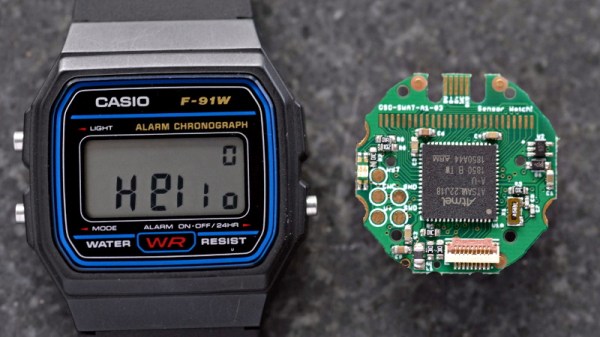
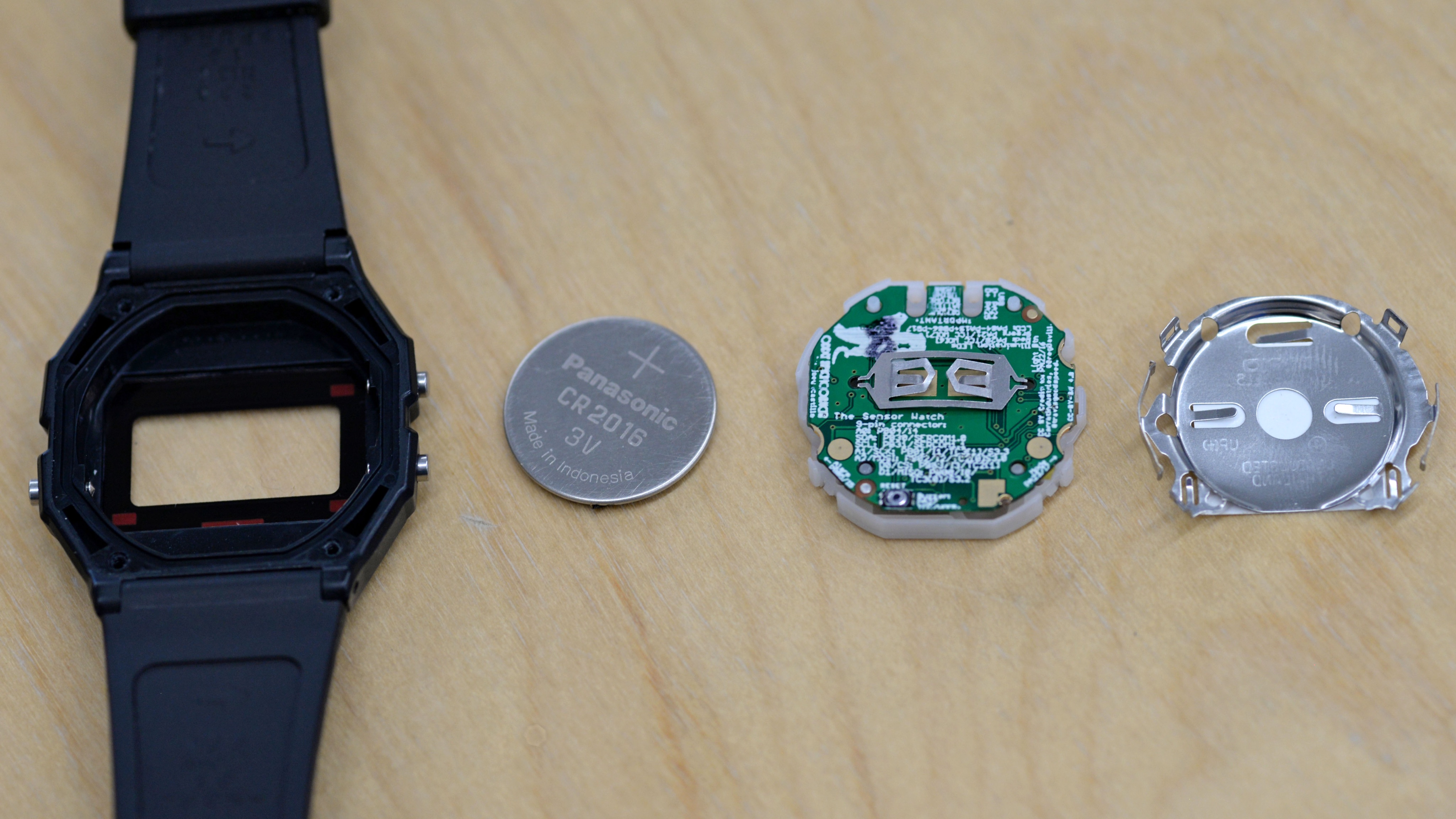
Just this morning we came across [Joey Castillo’s] sensor-watch project. He chose the Casio F-91W as the donor wristwatch. It’s got that classic Casio look of a segment LCD display capable of displaying hours, minutes, and seconds, as well as day and date. But the added bonus is that we know these have decent water resistance while still providing three buttons for user input. Sure, it’s less buttons than the pink calculator watch we saw [Dave Darko] working on earlier in the week, but which would you trust in the pool?
Replacement PCB sized to use the same battery contact and CR2016 for power [via @josecastillo]We see that [Joey] also chose to use the ATSAML22 microcontroller and sheds some light on why: it includes a built-in segment LCD controller! If you’re a peripheral geek like us, you can read about the SLCD controller on page 924 of the datasheet (PDF), it’s a whole datasheet onto itself.
The sensor part of the sensor-watch is a flex PCB breakout that allows you to swap in whatever sensor fits your needs. The first to be reflowed at [Joey’s] bench is a BME280 humidity sensor, which is most obviously useful for the included temperature measurements, but maybe it could also alarm at moisture ingress? [Joey] says you can swap in other parts as long as they’re in the QFN or LGA size range. We think an IMU is in order since there’s a lot of fun interaction there like the watch reacting to being positioned in front of your face, or to take tap-based inputs.
We think beginning with a donor watch is brilliant since pulling off a case, especially one that keeps water out, is 97% of the battle. But when your UI is unique to the watch world, sometimes you need to start from scratch like this wooden word clock wristwatch.
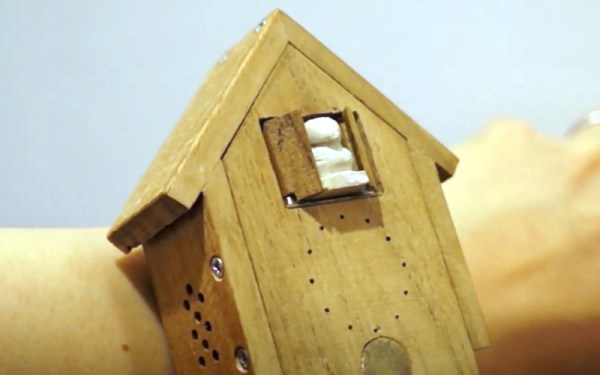
There are few better ways of asserting your independent spirit as a hardware hacker than by creating your own special timepiece. Even more so if the timepiece is a watch, particularly in this era of smartwatches. Few home-made timepieces though have come as near to wristwatch Nirvana as the cuckoo clock wristwatch from [Kiyotaka Akasaka], which we would venture to name as having won wristwatches. Nobody will top this one in the field of home-made clocks!
Superlatives aside, this is an electronic cuckoo clock on the wrist, with an LED ring dial and a motorised cuckoo, all clothed in an authentically rustic tiny wooden cuckoo clock case. It communicates via BLE with a smartphone, and even has a sound channel for a cuckoo sound. Frustratingly there’s little in the way of detail about the electronics themselves, but we’re guessing that almost Bluetooth-capable microcontroller could be pressed into service. Take a look at the video below the break.
The hack involves popping open the case of the watch and exposing the back of the main PCB. There, a series of jumpers control various features. [Ian]’s theory is that this allows Casio to save on manufacturing costs by sharing one basic PCB between a variety of watches and enabling features via the jumper selection. With a little solder wick, a jumper pad can be disconnected, enabling the hidden countdown feature. Other features, such as the multiple alarms, can be disabled in the same way with other jumpers, suggesting lower-feature models use this same board too.
It’s a useful trick that means [Ian] now always has a countdown timer on his wrist when he needs it. Excuses for over-boiling the eggs will now be much harder to come by, but we’re sure he can deal. Of course, watch hacks don’t have to be electronic – as this custom transparent case for an Apple Watch demonstrates. Video after the break.
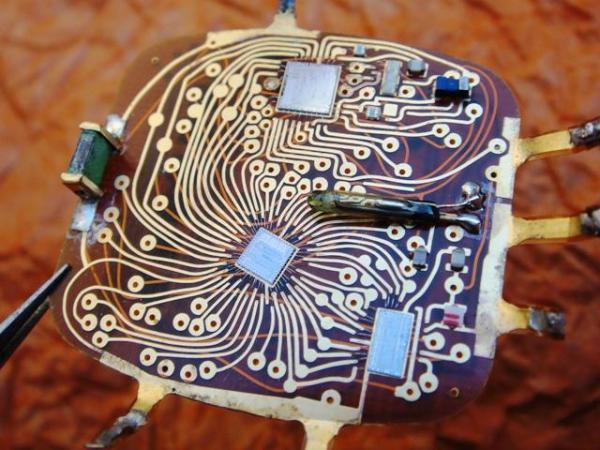
There has been an argument raging for years over whether you should design circuit boards with 45-degree corners or 90-degree corners. Why make them with corners at all? This breathtaking circuit board art is from a digital watch circa 1975.
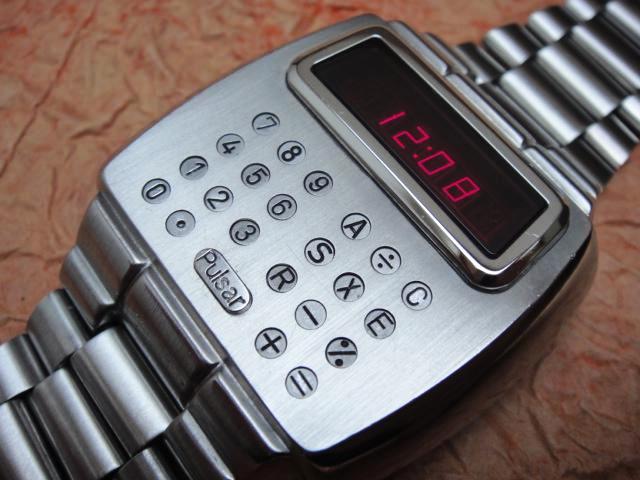
The Pulsar Calculator Watch was the first of its kind and came along with a stylus to operate the miniscule buttons. The circuit board traces would have been laid out by hand, explaining the gentle curves rather than straight lines. The chip-on-board construction is wild, with the silicon die bonded directly to those traces on multiple chips in this image. There is also a mercury tilt sensor on this model that would have switched the display off when not being held up to view the time (or calculate your tip at the Ritz).
We found working models of this watch for sale online for about $225-350. That’s a steal considering the original list price for these is reported to be $550 ($2600 considering inflation).
The beauty of the PCB artwork is hidden away, not just inside the watch case, but obscured by the plastic battery housing to which those tabs on the right are soldered. Think of how many geeks were lucky enough to have one of these and never realized the beauty within. If you’re looking to unlock more of these hidden masterpieces, check out [Greg Charvat’s] article on collecting and restoring digital wristwatches.
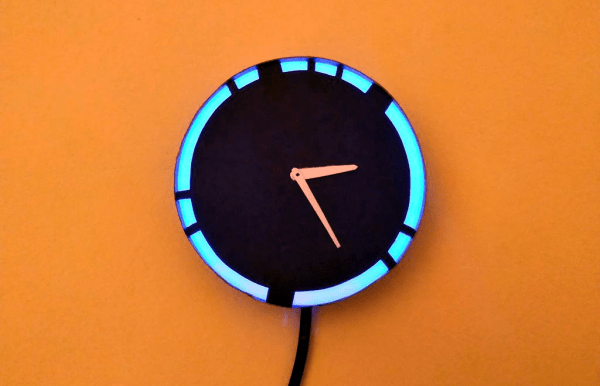
As awesome as space is, we’re inspired by the amount of Earth-saving reuse going on in this project. The actual time-telling is coming from a recycled wristwatch movement. [Artistikk] cut a bigger set of hands for it out of a plastic container, and used the lid from another container for the clock’s body.
The launch inquiries are handled by an ESP8266, which uses a Blynk app and some IFTTT magic to get notified whenever NASA yeets an astronaut into space. Then the ESP generates random RGB values and sends them to a single RGB LED. The clock body is small enough that a single LED is bright enough to light up all the parts that aren’t blacked out with thick paper. In case you’re wondering, the pattern around the edge isn’t random, it’s Morse code for ‘sky’, but you probably already knew that, right? Make a dash past the break to take the tour.