Drive High-Impedance Headphones With This Stylish USB DAC

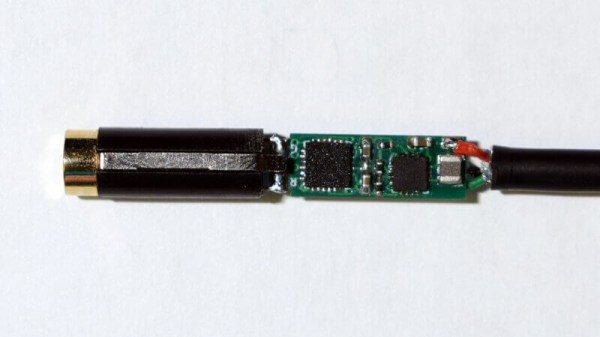
For anyone with an interest in building audio projects, it’s likely that an early project will be a headphone amplifier. They’re relatively easy to build from transistors, ICs, or tubes, and it’s possible to build one to a decent quality without being an electronic engineering genius. It’s not often though that we see one as miniaturized as [daumemo]’s USB-C DAC and headphone amplifier combo, that fits within a slightly elongated 3.5 mm jack cover as part of a small USB-to-headphone cable.

The DAC is an off-the-shelf board featuring an ALC4042 IC, it has a line-level output and a handy place to tap off a 5 volt line for the amplifier. This final part is a tiny PCB with two chips, a TPS65135 that produces clean +5 and -5 volt rails, and an INA1620 which is a high-quality audio amplifier set up for 2x gain. All this has been designed onto a very small PCB, which sits inside a 3D-printed housing along with the 3.5 mm earphone socket. The result is a very neat unit far better able do drive high-impedance headphones than the output from an unmodified DAC, but still looking as svelte as any commercial product. We like it.

This may be one of the most compact USB-to-headphone amplifiers we’ve seen, but it’s by no means the first.
Juuke – An RFID Music Player For Elderly And Kids

[ananords] and his girlfriend wanted to make a simple and easy to use music player for her grandmother. Music players like CD players and MP3s have gotten just a bit too difficult to handle, so they wanted to find a much simpler solution.

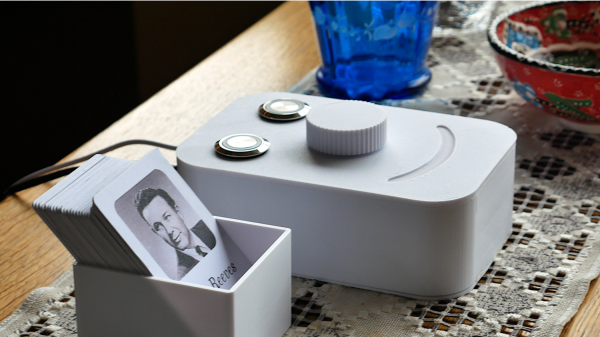
They conceived the idea of creating a little jukebox called Juuk, with a simple and easy to use interface. They created individual RFID cards with the artist’s photo on the front face, making it easy to select different options from the music library. Juuk has a built-in RFID reader that will recognize each RFID card and play the appropriate musical number from an SD card.

This simple interface is much more user-friendly than those awful touchscreen devices that we’re all forced to fiddle with today and also has a cool retro appeal that many of our readers are sure to appreciate. Juuk also has a pretty ergonomic interface with a big, easy-to-use knob for controlling the volume and two appropriately illuminated buttons, one green and one red, for simple stop and play options.

We love when our hacks are able to blend form with function and emphasize high usability. Check out some of our other assistive tech on the blog.

Continue reading “Juuke – An RFID Music Player For Elderly And Kids”

Aesthetic DIY Bluetooth Speakers

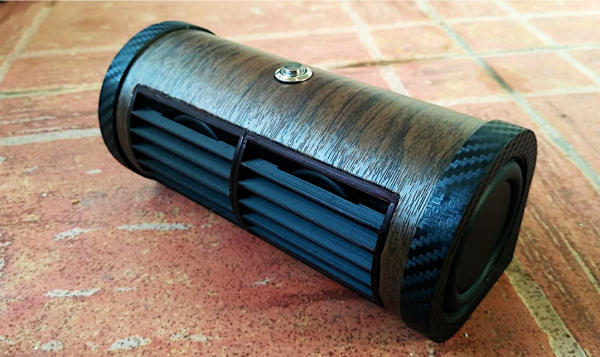
DIY Bluetooth speaker projects are always a staple here at Hackady. In our latest feature of DIY audio builds, we have [Patrick’s] vinyl cylindrical speaker.

He found a pretty inexpensive Bluetooth audio amplifier on AliExpress. However, the amplifier module oddly enough had a few missing components that were critical to its operation, so he had to do a little bit of re-work. Not something you generally expect to do when you purchase a pre-made module, but he was certainly up to the task.

He noticed the board amp module was missing a battery protection circuit even though there was space on the board laid out for those components (maybe an older board revision?). To remedy this problem, he added his own battery protection circuit to prevent any unwanted catastrophes. Secondly, he noticed a lot of distortion at high volumes and figured that some added capacitance on the power supply would help fix the distortion. Luckily, that did the trick.

Finally, and not quite a mistake on the manufacturer’s part this time, but an improvement [Patrick] needed for his own personal use. He wanted the amp module’s board-level LED indicator to be visible once the enclosure was fitted around the electronics. So, he used the built-in status trigger as a digital signal for a simple transistor circuit powering a much brighter ring LED that could be mounted onto the enclosure. That way, he could utilize the firmware for triggering the board-level status indicator for his own ring LED without any software modifications to the amp module.

Now, all that was left was to construct the enclosure he had 3D-printed and fit all the electronics in their place. We’ve gotten pretty used to the always impressive aesthetics of [Patrick’s] designs, having covered a project of his before, and this build is certainly no exception. Great job!

While you’re here, take a look at some other DIY Bluetooth speaker projects on Hackaday.

Continue reading “Aesthetic DIY Bluetooth Speakers”

Analog Noise Generator, Fighter Of Other Noises

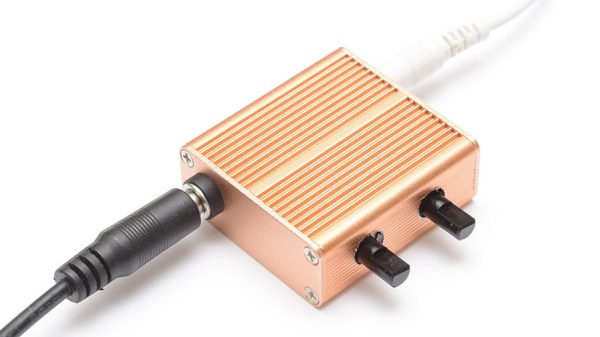
A chaotic drone of meaningless sound to lull the human brain out of its usual drive to latch on to patterns can at times be a welcome thing. A nonsense background din — like an old television tuned to a dead channel — can help drown out distractions and other invading sounds when earplugs aren’t enough. As [mitxela] explains, this can be done with an MP3 file of white noise, and that is a solution that works perfectly well for most practical purposes. However he found himself wanting a more refined hardware noise generator with analog controls to fine tune the output, and so the Rumbler was born.

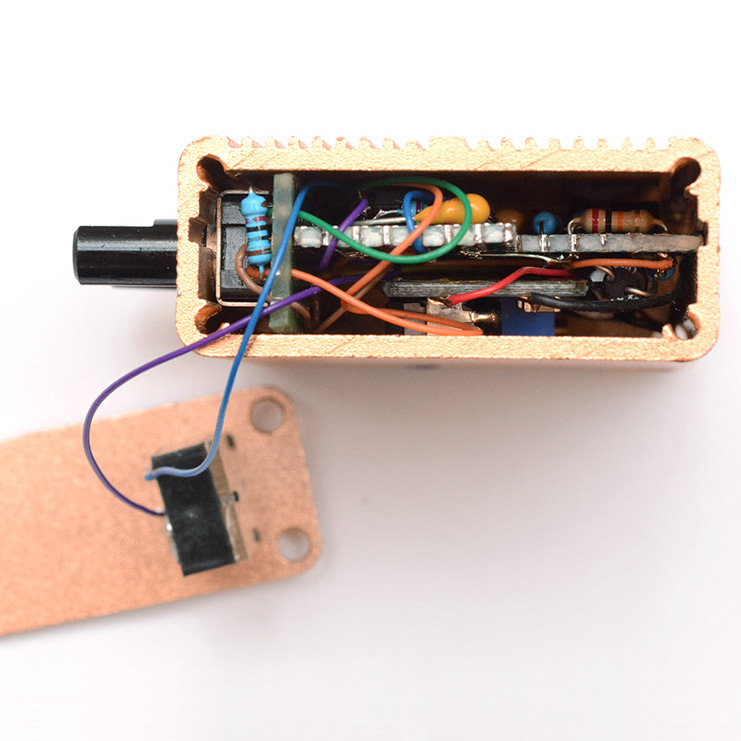
It’s a tight fit, but it does fit.

The Rumbler isn’t just a white noise generator. White noise has a flat spectrum, but the noise from the Rumbler is closer to Red or Brownian Noise. The different colors of noise have specific definitions, but the Rumbler’s output is really just white noise that has been put through some low pass filters to create an output closer to a nice background rumble that sounds pleasant, whereas white noise is more like flat static.

Why bother with doing this? Mainly because building things is fun, but there is also the idea that this is better at blocking out nuisance sounds from neighboring human activities. By the time distant music (or television, or talking, or shouting) has trickled through walls and into one’s eardrums, the higher frequencies have been much more strongly attenuated than the lower frequencies. This is why one can easily hear the bass from a nearby party’s music, but the lyrics don’t survive the trip through walls and windows nearly as well. The noise from the Rumbler is simply a better fit to those more durable lower frequencies.

[Mitxela]’s writeup has quite a few useful tips on analog design and prototyping, so give it a read even if you’re not planning to make your own analog noise box. Want to hear the Rumbler for yourself? There’s an embedded audio sample near the bottom of the page, so go check it out.

For a truly modern application of white noise, check out the cone of silence for snooping smart speakers.

DIY Pocket MP3 Player

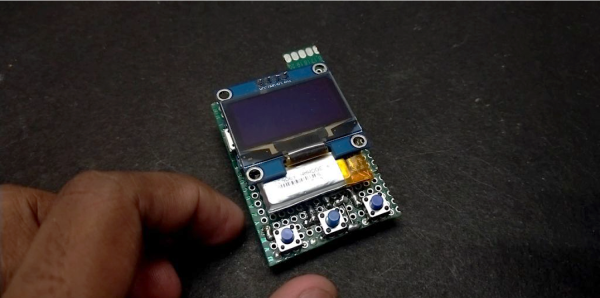
When [Neutrino-1] saw DFRobot’s DFPlayer module, he decided he wanted to make his own retro MP3 player. This tiny module comes packed with a ton of interesting capabilities such as EQ adjustment, volume control, and a 3 watt amplifier amongst other things. It can even play ads in between songs, should you want such a thing.

Controlling the DFPlayer module is easy using serial commands from a microcontroller, making it a convenient subsystem in bigger projects, and a potential alternative to the popular VLSI chips or the hard to come by WT2003S IC. [Neutrino-1] does a good job walking readers through the build making it fairly easy to remix, reuse, and reshare.

With the hardware sorted, all you’ve got to do is flash the firmware and load up an SD card with some MP3s. There’s even a small Python GUI to help you get your new player up and running. [Neutrino-1] also introduces users to the U8g2 display library which he says is a bit more feature-rich than the common Adafruit SSD1306 library. Great job [Neutrino-1]!

While you’re here, take a look at some of our other MP3 projects.

Continue reading “DIY Pocket MP3 Player”

Faux Vintage Radio Gets AirPlay Upgrade

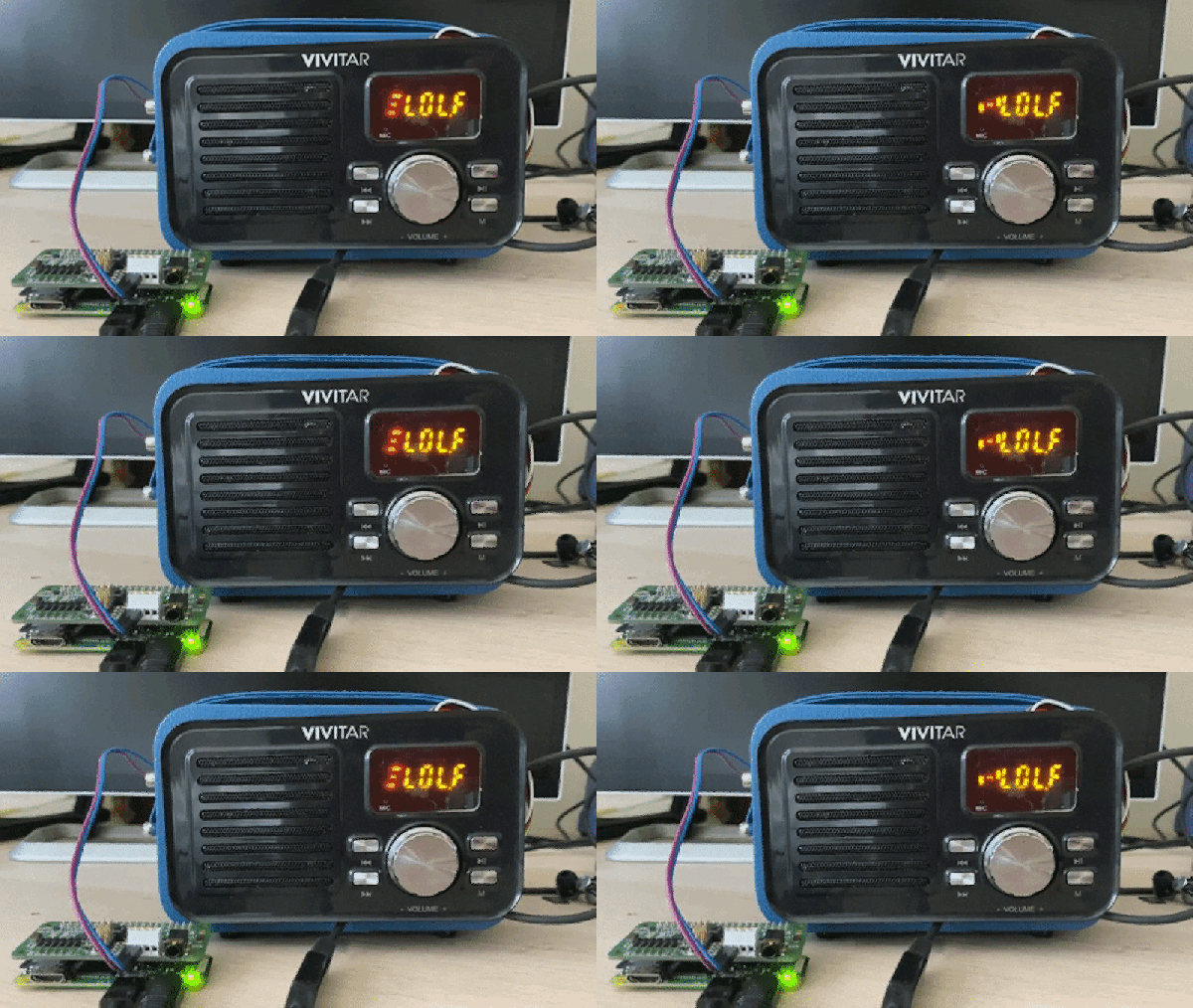
There’s plenty of vintage-styled hardware out these days, with quality and functionality being mixed at best. [Huan] found such a device in the form of an attractively-styled Bluetooth speaker. Deciding he could improve on the capabilities while retaining a stock look, he got down to hacking.

The aim of the project was to keep the original volume knob, buttons and screen, while replacing the internals with something a bit more capable. A Raspberry Pi Zero was sourced as the brains of the operation, with the Google Voice AIY hardware used as the sound output after early attempts with a discrete amplifier faced hum issues. An Arduino Pro Micro was pressed into service to read the volume encoder along with the buttons and drive the charlieplexed LED screen. Shairport Sync was then installed on the Pi Zero to enable Airplay functionality.

It’s a basic hack that nonetheless gives [Huan] an attractive AirPlay speaker, along with plenty of useful experience working with Arduinos and Raspberry Pis. We’ve seen similar hacks before, too. If you’re working on your own stereo resurrection at home, be sure to drop us a line!

Ultrasonic Sound Gun Precisely Aims Your Music

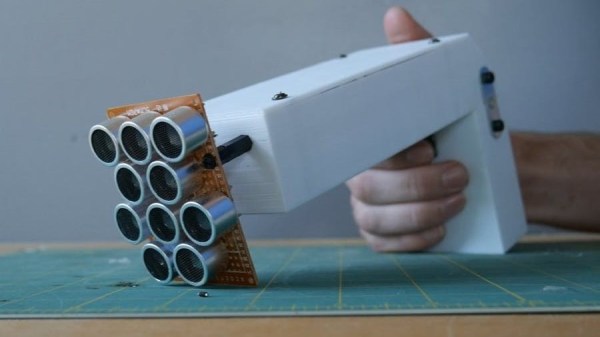
When listening to music you sometimes cannot avoid the situation where other people get annoyed because they feel it disrupts their important doings or they do not share your taste in avant-garde doom metal. Of course one could just use headphones. But a hackier way would be to build a parametric speaker that focuses soundwaves into a narrow beam like [Shane] did with this ultrasonic sound gun.

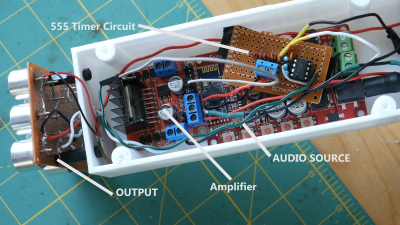
As the directivity of a soundwave depends on the size of the source and its frequency, a directed beam can practically only be achieved with ultrasound. Even though we are not able to perceive frequencies above ~20 kHz, the nonlinear properties of air make it possible to hear the audio modulated onto an ultrasonic carrier signal. For his sound gun [Shane] was inspired by another parametric speaker project. It took him some time to get the 555 timer circuit oscillating at the right frequency and he fried a cheap Bluetooth audio module while trying to increase the output volume but in the end, he managed to get everything working. As the project name suggests, he also 3D printed a gun-shaped enclosure. The video below shows that the sound from the gun behaves really similar to a beam of light and can, for example, be bounced off other objects.

If you are looking for other inspiration there is a whole list of cool ultrasonic projects from distance sensors to acoustic levitation.

Continue reading “Ultrasonic Sound Gun Precisely Aims Your Music”