posted Jan 16th 2009 8:30pm by
Eliot Phillips
filed under:
news,
security hacks

Zero Day has an interview with German researchers who have found a way to take down the Storm Worm botnet. Their program, Stormfucker, takes advantage of flaws in Storm’s command network: Nodes that are NAT‘d only use a four-byte XOR challenge. Nodes that aren’t NAT’d are only using a trivial 64bit RSA signature. Their solution can clean infected machines and also distribute to other nodes. Unfortunately, installing software without the user’s consent is the exact same behavior as malware. Don’t expect to see this in any sort of widespread use. The researchers did point out that some ISPs have moved to shutting off service for infected customers until their machines are cleaned.
posted Dec 30th 2008 10:51am by
Eliot Phillips
filed under:
cellphones hacks,
news,
security hacks

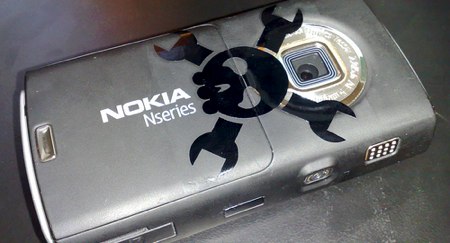
[Tobias Engel] released a serious Nokia vulnerability today. By using a specially crafted SMS message, you can block the recipient from getting any future SMS messages. The attacker changes their Protocol Identifier to “Internet Electronic Mail” and then uses any email address 32 characters or more in their message. The recipient will receive no indication that they got the message and no other messages will be allowed until the phone is factory reset. You can see a demo video here. This affects many different varieties of S60 phones and no fix is known.
[Thanks fh]
posted Dec 30th 2008 9:40am by
Eliot Phillips
filed under:
cons,
security hacks
posted Dec 30th 2008 6:00am by
Eliot Phillips
filed under:
cellphones hacks,
cons,
iphone hacks,
nintendo hacks,
security hacks,
wii hacks

While we had been excited about 25C3’s CTF competition, we couldn’t even venture a guess as to who would win. It seems the iphone-dev team weren’t satisfied to just give an amazing talk. They teamed up with the Wii hackers from HackMii to win the competition. You can see their progress during the eight hour competition above in red. It’s impressive to see hardware hackers jumping over to network security AND completely killing at it.
posted Dec 28th 2008 9:00am by
Eliot Phillips
filed under:
cons,
home hacks

[Florian] and [Xavier Carcelle] started the day at 25C3 by covering power line communication. PLC technology is not widespread in the US, but has gained popularity in countries like France where it’s included in set-top boxes. PLC lets you create a local network using the AC wires in your wall. The team started exploring PLC because despite being newer technology, it had a few principles that made it similar to old networks. There’s no segmentation in the wiring, which means it behaves like a layer 2 hub. You get to see all of the traffic unlike a switched network. Most power meters don’t filter out the signal, so it’s possible that you might see your next-door neighbor’s traffic on your line. [Florian] reports having seen all the traffic in a six-story building just by plugging in. The wiring also acts as a large antenna so you could employ tempest attacks.
Read the rest of this entry »
posted Dec 28th 2008 7:00am by
Eliot Phillips
filed under:
cellphones hacks,
cons,
wireless hacks
posted Dec 27th 2008 8:19am by
Eliot Phillips
filed under:
cons,
peripherals hacks,
solar hacks
posted Dec 25th 2008 9:35pm by
Eliot Phillips
filed under:
downloads hacks,
pcs hacks,
security hacks

With another hacker conference looming in front of us, it’s time to start thinking about hardware security. Hacker conventions have the most hostile network you’ll ever encounter. [Security4all] points out that 25C3 already has an extensive page on securing your hardware. It starts from the ground up with physical security, BIOS passwords, and locking down bootloaders. There’s a section on securing your actual OS and session. Finally, they cover network usage. It mentions using SSH for dynamic forwarding, which we feel is a skill everyone should have. We’ve used it not just for security, but for bypassing brainless bandwidth restrictions too. There’s also the more trick transparent version. Every piece of data you bring with you, you risk losing, so they actually recommend just wiping your iPhone and other devices before attending. It’s important to remember that it’s not just your own data at risk, but everyone/thing you communicate with as well.
posted Dec 23rd 2008 9:00am by
Eliot Phillips
filed under:
cons,
security hacks

Capture the Flag (CTF) is a long running tradition at hacker conventions. It pits teams of security researchers against each other on the same network. Every team gets an identical virtual machine image. The VM has a set of custom written services that are known to be vulnerable. The teams work to secure their image while simultaneously exploiting services on the machines of other teams. A scoring server monitors the match as it progresses and awards points to teams for keeping their services up and also for stealing data from their competitors.
The Chaos Communication Congress in Berlin December 27-30, 2008 will host a CTF competition. Most CTF matches are done head to head in the same room. While 25C3 will have local teams, it will also be wide open for international teams to compete remotely. Remote teams will host their own images on a VPN with the other competitors. Now is a good time to register and familiarize yourself with the scoring system. It will certainly be interesting to see how this competition plays out now that teams that can’t make the trip can still compete.