DIY clapper is the ideal gift for the laziest person in your life

diy-clapper

If you haven’t yet wrapped up your Christmas shopping, you may want to consider building [AlanFromJapan’s] implementation of the ever-classic “Clapper”. With its theme song burned into the brain of anyone old enough to remember the 80s, the clapper was a wonderful device that certainly put the “L” in laziness.

Looking for an excuse to play around with an opamp … Read the rest

Shutter trigger remote with some nice design considerations

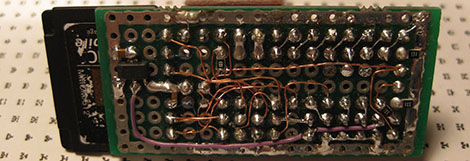
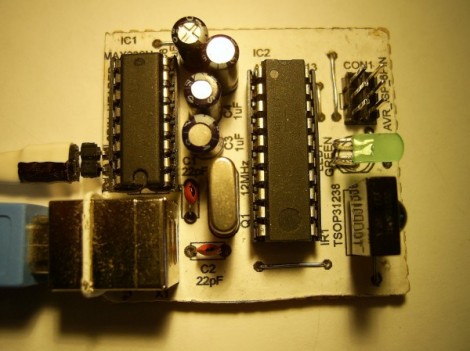
Here are the guts of [Lukasz's] infrared camera remote control. He based it off of an existing design, but looked for places where improvements could be made. He felt the ATtiny2313 was a bit wasteful in this case. But further investigation led him to see why it was chosen. If you were to drop down to an ATtiny13 the … Read the rest

Gaming scoreboard and storage box in one

This game storage box will also keep score for you. [Marcus] built it for playing the card game Munkin, but some clever programming could adapt it for most needs. The hardware is built around an ATtiny2313 to do the thinking, and a MAX7219 to drive the 7-segment displays. Each player has their own two-digit score readout, which is … Read the rest

Roland 808 synced to MIDI

Reading this week’s ATtiny-themed builds, [Thomas] was reminded one of his coolest builds. His midi808 project used an ATtiny2313 to sync a vintage Roland 808 drum machine to his Logic workstation.

Even though MIDI had been around for a few years when 808s were being made, the CPU in the 808 isn’t exactly up to the task of handling MIDI. … Read the rest

ATtiny hacks: 2313 driving a 4x4x4 LED cube

ATtiny Hacks Theme Banner

[Kirill] wrote in to share his ATtiny hack, a 4x4x LED cube. The 64 LED display is a great choice to fully utilize the hardware he chose. It’s multiplexed by level. Each of the four levels are wired with common cathodes, switched by a 2N3904 transistor. The anodes are driven by two 595 shift registers, providing a total of … Read the rest

AVR HVSP on a tiny breadboard

AVR chips are convenient because you can program them in circuit at their operating voltage. That is, unless you screw up the fuse settings and they’ll no longer listen to an In System Programmer. If you find yourself facing this problem, just build this circuit on a breadboard and ‘unbrick’ by holding down the button.

The circuit seen above … Read the rest

Designing a controllable RGB LED driver board

[Paul] wrote in to tell us about this LED driver board he’s been working on with a few friends. The collaborators had been unhappy with the Lumens per Watt ratings (or lack of a rating) on low powered LEDs and set out to find a better solution. They picked up the beefy ASMT-MT00 which houses all three diodes in one … Read the rest