The friendly robotic bartender we’ve covered a couple of times before hit the airwaves last week. [Jamie], the inventor of Bar2d2 sent in a link to video of the barkeeper in action. The story runs from 0:30-4:40 and covers a bit about the build, the conversion to automatic drink mixing, and plenty of happy liquor-guzzling party goers.
We get a good look at the drink ordering interface called Lazy Drinker. It runs on a laptop and communicates wirelessly with Bar2d2. Looks like you can get your hands on the software for free but the hardware, either in kit form or assembled, is going to cost you. Want to see how the dispenser kits are put together? Don’t miss the illustrated assembly instructions.
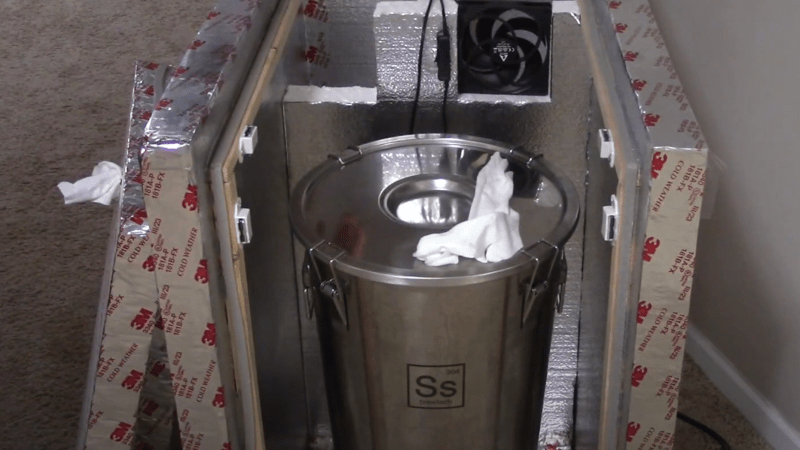
Steady fermentation temperatures, usually at about 65 degrees Fahrenheit, are an important part of brewing beer. Because of this, the wort (unfermented beer) is often temperature controlled during fermentation. [android] needed a temperature controller for fermenting beer in a chest freezer. Much like the energy efficient fridge hack from last month, the chest freezer is switched on and off to achieve the desired temperature. Instead of buying a controller, [android] built around an existing design. His project uses a solid state relay to switch an outlet on and off.
The temperature is controlled by a home thermostat. He removed the thermistor from the unit and extended it with 24 gauge wire so that it can go inside of the chest freezer. Utilizing a junction box, the freezer is plugged into one switched outlet and controlled by the thermostat via the relay. The other outlet is unswitched and provides DC power for the relay using a wall wort transformer. Although this thermostat cannot be set cold enough for lagering, it is perfect for keeping kegs at the correct beer serving temperatures when not being used for fermentation.
It started with a simple need: keep tabs on SparkFun Electronics’ in-house kegerator so the beer won’t run out at inopportune times. But of course SparkFun and “simple need” make strange bedfellows…throw beer in the mix, and you know this can’t end well. The result, as you might imagine, reads like a who’s-who of electronics hackery buzzwords.
They’ve assembled a nice build tutorial on how this all went together, including code, example circuits, an explanation of some of the sensors used, and links to other tutorials for such things as Twittering and persistent storage in EEPROM using Arduino. Not to mention the eye candy: a custom Arduino shield (solder mask and all), custom acrylic tap handle, custom SparkFun pint glasses. They never do anything halfway, do they?
BrewTroller is an open source brewing control system based on the Sanguino. Targeting home beer brewers, this project gathers some of the best features from other DIY brewing controllers and packages them into a hardware and software setup so it’s accessible to those without the skills to design their own. It can interface with 4 heat controllers, 32 pumps/valves, 6 temperature sensors, 3 volume sensors, and 1 steam pressure sensor. The system displays information through a 4 line LCD. It can be used to monitor and maintain temperature during mashing, boiling, and chilling. If you have a more advanced setup that involves automatic valves, it can control those for you with almost limitless reconfigurability through every step of the brewing process.
The folks at Revision3 really know what gets our pulse going. In this episode, they show us how they built a radio controlled keg. Not only is the system built sturdy enough to cart around the keg, it is also built with the capability for the driver to control the beer flow. This isn’t too shabby for a pretty quick project, but it still can’t compare with Bar2D2.
Reader [Will R] sent in a thermostat mod for his brew fridge. His friends had found a perfectly fine bar refrigerator and wanted to repurpose it for brewing beer. A previous batch of microbrew had been mangled by the Australian heat so they wanted something that could maintain the perfect temperature. The fridge’s built-in thermostat wouldn’t rise above 5 degrees so they had to build their own. [Will] used a 10K NTC thermistor to measure the temperature. It’s connected to an ATtiny25 microcontroller that does the comparison and determines whether to turn on the compressor. He referenced SparkFun’s relay tutorial for the switching side. Although he didn’t etch a board for this project, the design file is included along with all the code on the project site.
[Steve] sent us his new years project, a remote beer server controlled by his iPhone. He has built a frame from construx and used ioBridge to connect it to his iPhone. He states that he “wanted to make a project that allows for the perfect pour and take out all of that physical work”. Seems like it could use a little adjustment to be a bit less foamy. Maybe an additional frame to adjust the angle of the glass as it is poured.
It can sometimes be difficult to decide what items we want to fill space in our homes. Our health is valued highly, as is our ability to consume cold beer. Someone out there must have been thinking of us when they designed this exersize bike that chills your beer. Admittedly, it won’t chill it as fast as some other methods we’ve tried. We also may end up forcing our friends and loved ones to do the actual chilling, but beer tastes better when cooled by slave labor anyway.
We love beer and we love robots, so guessing how we feel about this robotic bartender should be a no-brainer. Known as Mr. Asahi, the robot opens bottles and pours beer while taking your orders with aplomb and a jovial British accent. It also has a customized lazy susan with slots for bottles and notches for the robot’s hand to grasp.
Amazingly, this is not Asahi’s first beer pouring robot. That one requires you to do most of the leg work, though, so this one is a marked improvement. Best of all, it won’t ignore you when a person more attractive than you comes into the bar, and it won’t snub you for leaving a lousy tip. We now fear alcohol fueled robot rampages… they get more human every day. Video after the break.
Beer kegs are several things. They are expensive, heavy, but most importantly delicious. We found a nice guide for creating your own 3 liter beer keg. This is an inexpensive solution for homebrewers looking to keg their own beer.
The guide goes into detail on assembly and parts needed to create the bottle adapter. Most of the parts can be picked up locally or through MoreBeer.com. CO2 cartridges are used to pressurize the bottle. To keep everything cool you can use a standard water cooler with a few simple modifications. The 3 liter bottle is too tall for some coolers so you’ll need to cut a hole in the lid. Add a piece of aluminum covered styrofoam to the top and bottom, toss in some ice, and your brew should stay cold for about 3 hours.
The author does note that this is not recommended for long term storage. So drink up!