The prolific [Peter Waldraff] is at back it with another gorgeous micro train layout. This time, there are no plugs and no batteries. And although it’s crank-powered, it can run on its own with the flip of a switch. How? With a supercapacitor, of course.
The crank handle is connected a 50 RPM motor that acts as a generator, producing the voltage necessary to both power the train and charge up the supercapacitor. As you’ll see in the video below, [Peter] only has to move the train back and forth about two or three times before he’s able to flip the switch and watch it run between the gem mine and the cliff by itself.
The supercapacitor also lights up the gem mine to show off the toiling dwarfs, and there’s a couple of reed switches at either end of the track and a relay that handles the auto-reverse capability. Be sure to stick around to the second half of the video where [Peter] shows how he built this entire thing — the box, the layout, and the circuit.
Want to see more of [Peter]’s trains and other work? Here you go.
Scoring an interesting bit of old gear on the second-hand market is always a bit of a thrill — right up to the point where you realize the previous owner set some kind of security code on it. Then it becomes a whole big thing to figure out, to the point of blunting the dopamine hit you got from the original purchase.
Fear not, though, because there’s dopamine aplenty if you can copy what [Buy it Fix it] did to decode the PIN on a used generator control panel. The panel appears to be from a marine generator, and while it powered up fine, the menu used to change the generator’s configuration options is locked by a four-digit PIN. The manufacturer will reset it, but that requires sending it back and paying a fee, probably considerable given the industrial nature of the gear.
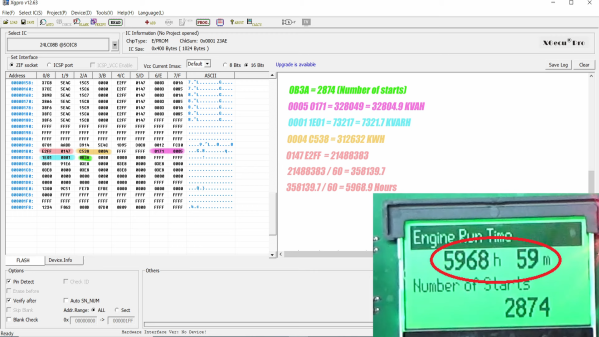
Instead of paying up, [Buy it Fix it] decided to look for a memory chip that might store the PIN. He identified a likely suspect, a 24LC08B 8-Kb serial EEPROM, and popped it off to read its contents. Nothing was immediately obvious, but blanking the chip and reinstalling it cleared the PIN, so he at least knew it was stored on the chip. Many rounds of soldering and desoldering the chip followed, blanking out small sections of memory each time until the PIN was located. The video below edits out a lot of the rework, but gives the overall gist of the hack.
To be honest, we’re not sure if the amount of work [Buy it Fix it] put into this was less than taking a couple of hours to punch in PINs and brute-force it. Then again, if he hadn’t done the reverse engineering he wouldn’t have stumbled upon where the generator parameters like running time and power figures were stored. And it’s not really his style, either; we’ve seen him perform similar heroics on everything from tractors to solar inverters, after all.
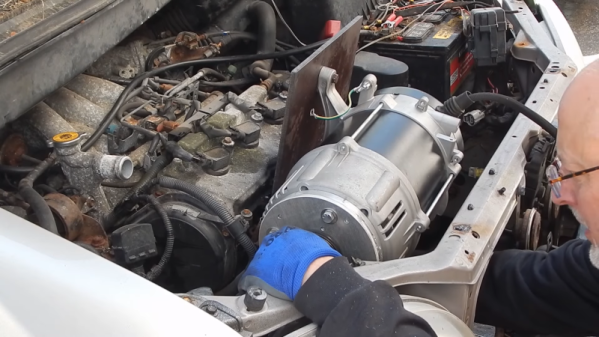
If you live somewhere prone to power outages, you might have thought about buying a generator. The problem is that small generators are cheap but — well — small. Big generators are expensive. [Jake von Slatt] had an idea. He has a “yard car” which we thought might be a junk car but, instead, it is an old car he uses to drive around his yard doing tasks. It has a winch and a welder. Now it has a big generator, too. You can follow the project in the three videos found below.
The project started with a scrap generator with a blown motor. Of course, the car has a motor so — in theory — pretty simple. Remove the generator from the motor and graft it to the car’s motor. But the details are what will kill you.
Here in the West, power going out is an unusual event. But in more remote regions like the Himalayas, reliable electricity isn’t a given. A group of local craftspeople, researchers, and operators in Nepal have worked together to devise a modular waterwheel system.
Based on a 20-30 cm-wide bucket module consisting of only four galvanized steel components, the wheels can be easily built and deployed using resources and tools that are easy to find anywhere in the world. Current test devices generate between 120 and 1,400 Watts of power, depending on the device’s size.
A software tool was also developed that takes the head and flow rate of a location as inputs to calculate the dimensions of the optimal wheel and expected power output for an installation. This lets communities find ideal sites for power generation and calculate the expected costs.
Collecting energy from various small mechanical processes has always been something that’s been technically possible, but never done on a large scale due to issues with cost and scalability. It’s much easier to generate electricity in bulk via traditional methods, whether that’s with fossil fuels or other proven processes like solar panels. That might be about to change, though, as a breakthrough that researchers at Georgia Tech found allows for the direct harvesting of mechanical energy at a rate much higher than previous techniques allowed.
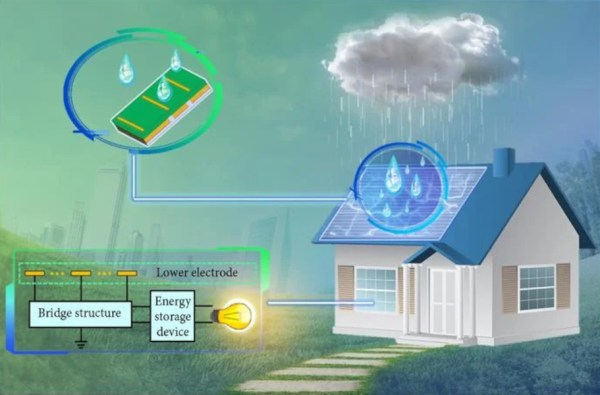
The method takes advantage of the triboelectric effect, which is a process by which electric charge is transferred when two objects strike or slide past one another. While this effect has been known for some time, it has only been through the advancements of modern materials science that it can be put to efficient use at generating energy, creating voltages many thousands of times higher than previous materials allowed. Another barrier they needed to overcome was how to string together lots of small generators like this together. A new method that allows the cells to function semi-independently reduces the coupling capacitance, allowing larger arrays to be built.
The hope is for all of these improvements to be combined into a system which could do things like augment existing solar panels, allowing them to additionally gather energy from falling rain drops. We’d expect that the cost of this technology would need to come down considerably in order to be cost-competitive, and be able to scale from a manufacturing point-of-view before we’d see much of this in the real world, but for now at least the research seems fairly promising. But if you’re looking for something you can theoretically use right now, there are all kinds of other ways to generate energy from fairly mundane daily activities.
A thermoelectric generator (TEG) can turn a temperature difference into electricity, and while temperature differentials abound in our environment, it’s been difficult to harness them into practical and stable sources of power. But researchers in China have succeeded in creating a TEG that can passively and continuously generate power, even across shifting environmental conditions. It’s not a lot of power, but that it’s continuous is significant, and it could be enough for remote sensors or similar devices.
Historically, passive TEGs have used ambient air as the “hot” side and some form of high-emissivity heat sink — usually involving exotic materials and processes — as the “cold” side. These devices work, but fail to reliably produce uninterrupted voltage because shifting environmental conditions have too great of an effect on how well the radiative cooling emitter (RCE) can function.
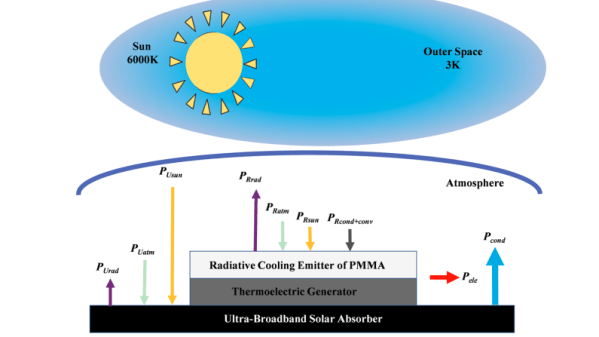
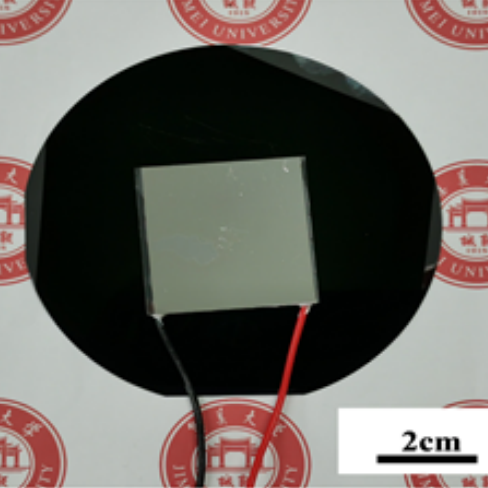
The black disk (UBSA) heats the bottom while the grey square (RCE) radiates heat away, ensuring a workable temperature differential across a variety of conditions.
Here is what has changed: since a TEG works on temperature difference between the hot and cold sides, researchers improved performance by attaching an ultra-broadband solar absorber (UBSA) to the hot side, and an RCE to the cold side. The UBSA is very good at absorbing radiation (like sunlight) and turning it into heat, and the RCE is very good at radiating heat away. Together, this ensures enough of temperature difference for the TEG to function in bright sunlight, cloudy sunlight, clear nighttime, and everything in between.
As mentioned, it’s not a lot of power (we’re talking millivolts) but the ability to passively and constantly produce across shifting environmental conditions is something new. And as a bonus, the researchers even found a novel way to create both UBSA and RCE using non-exotic materials and processes. The research paper with additional details is available here.
The ability to deliver uninterrupted power — even in tiny amounts — is a compelling goal. A few years ago we encountered a (much larger) device from a team at MIT that also aimed to turn environmental temperature fluctuations into a trickle of constant power. Their “Thermal Resonator” worked by storing heat in phase-change materials that would slowly move heat across a TEG, effectively generating continuously by stretching temperature changes out over time.
Harvesting energy from the wind has been a commercially viable way of generating clean energy for around three decades now. Wind turbines are a reliable, proven technology but they do have some downsides, one of which is that since there’s more wind higher above the ground this usually means tall, expensive towers. There is a way around this problem, though, which is using kites to generate energy instead of a fixed turbine.
While kite generators aren’t a new idea, [Benjamin] has been working on this kite generator which has a number of improvements over existing kite generators. Like other kite generators, this one uses a tether to spin a generator which is located on the ground. But while this is similar to other kite systems, this prototype has a much simpler design and sweeps a much larger area while in flight. It also has an autopilot with multiple independent steering systems, which [Benjamin] says will allow it to stay in flight for months at a time provided there is enough wind. If there isn’t, it can land reliably, and launching it is relatively fast and simple as well.
While kites do have some obvious downsides compared to fixed turbines including a single point of failure at the tether and a large amount of cleared area to operate, they have plenty of advantages as well. They’re smaller, simpler, require no complicated yaw system, and can be easily maintained on the ground. In fact, it’s possible to build very simple kite generators out of nothing more than a hobby kite and some readily-available electrical components.


 The crank handle is connected a 50 RPM motor that acts as a generator, producing the voltage necessary to both power the train and charge up the supercapacitor. As you’ll see in the video below, [Peter] only has to move the train back and forth about two or three times before he’s able to flip the switch and watch it run between the gem mine and the cliff by itself.