(Thanks to [Aaron] for the tip) As a promo for [Calvin Harris], some of the creative minds at Sony Music have put together an Arduino-based sythesizer composed of 15 bikini clad babes. By analyzing which circuits are closed, the Arduino Mega is able to tell a sequencer which sample to play. The only innovation happens to be that the circuits are painted onto the aforementioned girls with a conductive body paint known as Bare.
Developed by students at the Royal College of Art, the paint is not available for purchase, but they are willing to mix a batch up for art installations or performances. Technical stats (such as resistance) have not been released, but for a washable paint it seems to be performing quite well.
How was the whole project set up? The video below reveals all:
We’ve coveredsequencersbefore, but reader [Johan] sent in his latest project that is much more minimalistic approach. Dubbed the BBox, he based his drum generator on an Arduino and an LCD display. Rather than synthesizing sound, the Arduino just outputs MIDI which is then interpreted by his Roland Juno-D. In building the device he used a favorite trick of ours to keep the interface clean. He then found an awesome banana box to use as a case. Although, the project may not be as functional as some of the others out there, it certainly has flair. Video of it in action after the break.
Any musician who has ever used a computer to create music will tell you that while this technology is more than capable of producing great music, it is always a much more intimate experience to create by physically playing an instrument. In an effort to bridge this gap, [Randall Jones] has built a passive multidimensional interface that uses multitouch input to create an intimate experience that rivals that of a traditional musical instrument. While this concept may seem very complicated, the interface is made of only copper strips, rubber, and wood. At $50, this interface was designed to be inexpensive and appears to be very easy to use. As seen in the video, this interface can be used as anything from a drum to a multitouch synthesizer.
Sometimes, a little bit of noise can be fun. This little noise synth called the Nandhopper, is a quick simple project to get started. The parts list is pretty short, mainly material for the sensors and a 4093 Quad, 2-input Schmitt trigger and NAND gate. You end up with an easy to use, fairly small 1-Bit synth. If you don’t know what a 1-Bit synth sounds like, watch the demo video. Sure, it just sounds like noise to us, but that’s music to some people.
Matrixsynth pointed out a couple incredibly small optical theremins that look like they’d make for a great afternoon project. [AlexArt] first built the simple circuit on a piece of protoboard (Google translated). Knowing he could go smaller, he then built it freeform with a buzzer instead of a full size speaker. The design is based around the common 555 chip and photoresistor. Here’s a simple circuit you can use to lay out your own. The optical theremin should not be confused with the traditional RF theremin since the name comes from the similar sound, not similar construction.
[Gian Pablo Villamil] at NYC Resistor wondered whether it would work with his custom made Rhythmic Synth, and to his and our delight, it does! The Rhythmic Synth is an older project of his; it is a simple rhythm generator with 4 pitch knobs, 4 modulation knobs, and 4 phase switches. The case was taken from an old external Iomega CD-ROM drive.
Getting the Wall-E to dance isn’t much of a feat, but something about the dancing combined with a synth with embedded lights just screams robot dance party, and that can never be wrong. We’d love to see the Wall-E dancing to a cleaner, more complete synth: maybe this one. Check out Wall-E busting a move after the break.
Here’s another bit of analog synth pr0n for you: Initially sold in 1972, the EMS Synthi AKS was a portable modular analog synthesizer with a built in keyboard and sequencer. The VCS 3 portion of the device had a unique routing matrix pegboard used to connect components together. [firegroove] has opened up his precious machine so that you can see all of the fine little bits that make it tick… and chirp.
This week’s How-To comes from our newest contributor: Logan Williams.
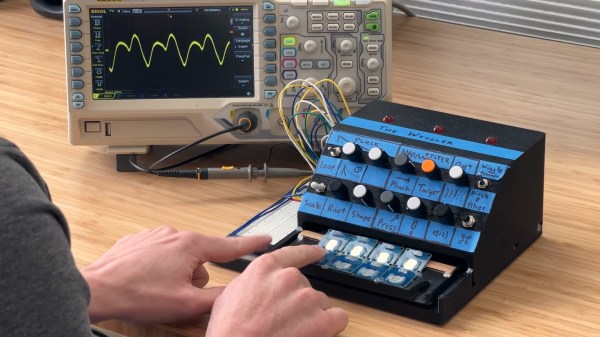
This simple guide will show you how to build a digital synthesizer that generates and manipulates square waves. Your synthesizer will have one oscillator, which produces a variable pitch controlled by a potentiometer, as well as an LFO which modulates that pitch at a variable frequency. The part count for this project is quite low, and it can be built for under $20.