posted Jul 6th 2011 2:01pm by
Brian Benchoff
filed under:
Microcontrollers,
video hacks

[Arthur Benemann] started a little project for his electrical engineering program, and suffered the worst case of feature creep we’ve ever seen. He just posted an instructable of his picChess project that is able to play chess on a VGA monitor with a keyboard, with sound, a clock, temperature sensor. Apparently, [Arthur] was bored one evening and threw in an implementation of Conway’s game of life.
[Arthur] chose a DSPIC33F μC for his project with everything laid out on a bread board. He’s quite proud of his VGA routine, the first time he’s ever used DMA. We’re really impressed by [Arthur]‘s chess engine – his is the first homebrew chess engine we’ve seen on Hack A Day. Although the engine is a brute-force search with Alpha-beta pruning, the engine itself seems fairly advanced that will even supports castling.
Although a few rules aren’t supported and the ELO rating of the engine isn’t known, [Arthur]‘s engine should still be able to beat an amateur player. A fairly impressive feat indeed.
Check out [Arthur]‘s video after the break.
Read the rest of this entry »
posted Jun 2nd 2011 10:48am by
Mike Nathan
filed under:
video hacks

[devb] has been playing around with XESS FPGA boards for ages, and as long as he can remember, they have had built-in VGA interfaces. His newest acquisition, a XuLA FPGA board, doesn’t have any external parts or ports aside from a USB connector. He needed to get video output from the board, so he decided to build a VGA interface himself.
He prototyped a 512-color VGA interface board which worked just fine, but he thought it would be way too cumbersome to use for each and every project. To keep life simple, he designed a small PCB that integrates a VGA connector and all of the resistors he needed to get the signal from the FPGA. His boards plug directly into a breadboard, so only a handful of wires is needed to connect the FPGA to a monitor.
As you can see on his site, the adapter works quite well, allowing the FPGA to put out a crisp 800×600 image with little fuss. [devb] has also posted all of his design files on his site in Eagle format for anyone interested in replicating his work.
posted Jun 2nd 2011 6:29am by
Brian Benchoff
filed under:
Microcontrollers,
video hacks

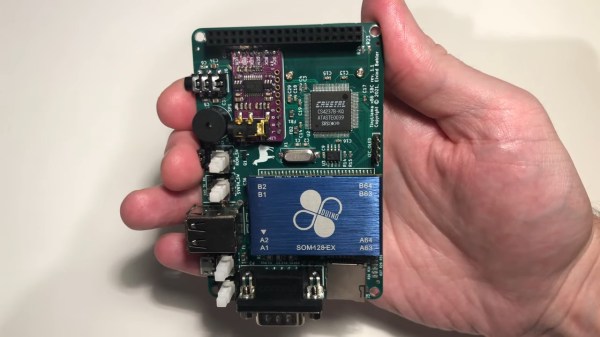
The team at Leaf Labs just released a new library to demonstrate the VGA capabilities of their Maple dev board. Although it’s only a 16 by 18 pixel image, it shows a lot of development over past video implementations on the Maple.
The Maple is a great little Ardunio-compatible board with a strangely familiar IDE. We’ve covered the Maple before. Instead of the somewhat limited AVR, the Maple uses an ARM running at 72MHz, making applications requiring some horsepower or strict timing a lot easier.
We’ve seen a few projects use the increased power, like a guitar effects shield. It’s possible the Maple could be made into a game console that would blow the Uzebox out of the water, but we’re wondering what hackaday readers would use this dev board for.
Watch the video after the jump to see how far the Maple’s VGA capability has come after only a few months, or check out Leaf Lab’s Maple libraries.
Read the rest of this entry »
posted May 10th 2011 8:33am by
Mike Szczys
filed under:
linux hacks,
video hacks

If you’ve got some favorite electronic device that includes an SD card slot but doesn’t have a video out port you may be able to push VGA signals through the card reader conductors. That’s exactly what’s going on above with the Ben NanoNote, a sub-$100 Linux device which we’ve seen using its SD card slot as general I/O before.
The hardware to capture the signals includes a breakout board for the card slot. Free-formed on the other end of that connector card is a gaggle of resistor which handle level conversion for the VGA color signals, with a VGA cable taking it from there to the monitor. The software that makes this happen is a dirty hack, blocking all other functions while it displays a still image. But we’re sure that it can be cleaned up somewhat. Just don’t hold out hopes for full-motion video, this little guy just doesn’t have it in him.
[via Dangerous Prototypes via Slashdot]
posted May 5th 2011 1:01pm by
Mike Szczys
filed under:
Microcontrollers

It seems like all the cool kids are leaving the 8-bit hobby microcontrollers in the parts bin and playing with more advanced parts like Complex Programmable Logic Devices. [Chris] is no exception to the trend, and set out to generate his own VGA signal using one of the beefy semiconductors.
It seems that he’s using the acronyms CPDL and FPGA interchangeable in his post but according to the parts list this setup uses an Altera EPM7128SLC84-7N CPLD. In order to generate the VGA signal he needed a way to convert the digital signals from the chip into the analog values called for in the video standard. He chose to build a Digital Analog Converter for the RGB color values using a resistor network which he calculated using PSpice. The other piece in the puzzle is a 25.175 MHz oscillator to clock the CPLD. As you can see after the break, his wire-wrapped prototype works exactly as designed. The example code generates the rainbow bars seen above, or a bouncing box demo reminiscent of a DVD player screen saver.
Want to know more about programming CPLDs? We did a tutorial on the subject a while back.
Read the rest of this entry »
posted Mar 17th 2011 11:01am by
Mike Nathan
filed under:
tool hacks,
video hacks

[Chris] recently finished building a miniscule AV Test Box, capable of fitting inside a standard Altoids tin. It is a revision of a project he constructed a few years ago. His previous test box worked well, but was large and cumbersome – definitely not something you would want to carry around from place to place with any frequency.
The new test box does everything its predecessor is capable of, which includes displaying an 800×600 VGA test pattern as well as generating sound signals for testing audio systems. He updated the circuit design a bit, employing a newer PIC processor to run the show, otherwise most of the design details have remained the same, form factor aside.
His build log is full to the brim with details as usual. You will find thorough descriptions of all the components he used, schematics, source code, as well as the theory behind the build.
Be sure to check out the video embedded below of his new AV tester in action.
Read the rest of this entry »
posted Mar 2nd 2011 5:05am by
Kevin Dady
filed under:
arduino hacks,
Microcontrollers

Gameduino is an FPGA based sound and graphics adapter for microcontrollers. Laid out as an Arduino shield, all it really takes is a microcontroller with SPI and some code to send commands to the board which lets you toggle registers, handle memory, and drawing functions.
Once the data gets there, it is greeted by a Xilinx FPGA which puts out a 800×600 72Hz SVGA sync signal, large 512×512 pixel character scrolling backgrounds, piles of 16×16 (up to 256 color) sprites, each with per pixel transparency, rotation, flip, and if that was not enough a 12 bit frequency synth that can do 16 independent voices.
All the resources to make one of these is listed on the site under the Making a Gameduino link, but if youre interested in getting a made board there is also a kickstarter page available. There are other ways to squeeze video out of micro controllers from the basic like hackvision to AVGA or even Lucidscience AVR VGA v2, and tons of propeller projects, but this one being stand alone and portable, has a certain appeal.
Join us after the break for a quick video.
Read the rest of this entry »
posted Feb 7th 2011 1:22pm by
Mike Szczys
filed under:
Microcontrollers,
multitouch hacks

This daughterboard lets [Matt Evans] drive a laptop LCD using a Beagleboard. Apparently the Beagleboard gained a VGA header when it moved to revision C but [Matt's] working with revision B4 which is why he had to do all of that ninja soldering with the blue wires. The driver board itself is a thing of beauty, hosting a DS90C363 LVDS serialiser as well as some buffer chips that handle level conversion for it. He’s also included an ATmega48 so that he has some options for future improvements.
The LCD is mounted in a custom acrylic case, with Beagleboard and driver board taped to the back of it. There’s RS232 and a USB hub which opens up the possibility of using a WiFi dongle for communications. So far he doesn’t have much functionality other than displaying images on the screen but there is some talk about using a touchpad for control. We’d love to see a touchscreen overlay, transforming the build into a proper ARM-based tablet.