Project J.A.R.V.I.S.

[brightcove vid=76029544001&exp3=16977198001&surl=http://c.brightcove.com/services&pubid=245991542&w=470&h=325]

Project J.A.R.V.I.S. is an attempt to create a digital life assistant, or DLA. The name comes from the version in the movie Iron Man. While the details of the build are pretty slim, you can see that he’s using a mac mini for the base with an Arduino controlled RFID reader at his door. What is really interesting is how functional he has actually made it. Watch the video on the site to see a pretty good explanation of features.

[via Gizmodo]

Teletype Twitter Frontend

The folks from NYC Resistor got their hands on a teletype machine and hacked it to monitor Twitter. This eighty-year-old beast bangs out messages that it receives at 45.45 baud. This isn’t a project that turns something into a teletype, but rather finds a different way to feed the machine data. In this case, a python script parses Twitter and sends the data it finds to an Arduino board. The Arduino in turn formats the message into the serial format necessary to communicate with the device. To the left you can see a trend plotter, learn more about both in the video after the break.

Continue reading “Teletype Twitter Frontend”

Fully-automated Golf Ball Gun

If you get in the line of fire this golf ball launcher is gonna leave a mark, or worse. It’s based on the same premise as the sausage gun, but now everything is automated and no meat products are used.

A hopper stores a row of golf balls. When it comes time to load, a ball falls into the chamber, starter fuel is sprayed into the combustion area with the aid of a fan, and after both chambers are sealed the propellant is ignited.

We’ve embedded two videos below for your amusement. It looks like [Chrille] and his friends are being careful with their creation. We’re glad for that because this is about as dangerous as the high-velocity ping-pong ball launcher. Continue reading “Fully-automated Golf Ball Gun”

Logic Clock Without An On-board Oscillator

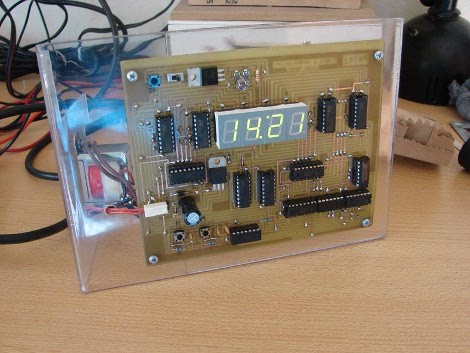
[Lucassiglo21] developed this logic clock without using a crystal oscillator or a resonator. Instead, he’s letting the incoming electricity keep the time for him. The supply is AC at 50 Hz so he’s using some 4017 decade dividers to reduce that down to a 1 Hz signal. From there it keeps track of the ticks just like the last digital logic clock we saw.

If you’ve used AC line frequency as the clock source in your project we’d like to hear about it. Send us a tip and make sure your writeup includes a schematic. We’re especially interested to see if anyone has a good way of using this method with inexpensive microcontrollers.

Third-person Vehicle

Here is something we didn’t expect (NSFW). The machinima crew behind RedVsBlue, Rooster Teeth, actually did a hack!

The idea is simple enough, how could you experience driving a vehicle like in a video game – aka, third-person. With some steel bar, Canon 5D camera, and a 15inch monitor inside of a blacked out cab, they accomplished just that.

What surprised us the most, is the great difficulty and difference there is between the video game vehicle and the real life one. But all of us here at HAD know why; they need to replace the steering wheel with a joystick. While they’re at it they can make it wireless and remote-controlled. Finally a HUD would be easy enough to program (might we suggest processing). Oh dear lord, is the world ready for this!?

On-the-go Prototyping

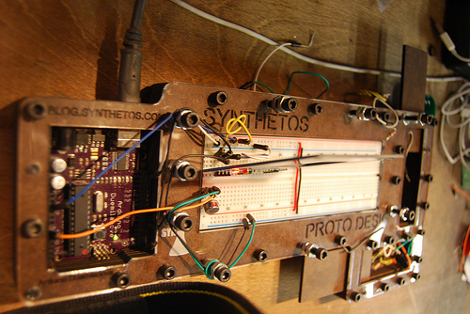
[Riley Porter] has been working on several different custom enclosure designs. Above, you can see his Proto Desk which holds a breadboard, Arduino, and has two recessed boxes with sliding tops for components and patch wires. He’s got a miniature version that gets rid of the breadboard, as well as slick-looking cases for the Bus Pirate, tinyISP, and face plates for word clocks.

Well, if you’ve got a laser cutter you should be using it right? We’ve seen [Riley’s] wares in the past; he wrote the guide for laser cutting solder stencils.

[Thanks Brian]

PC Fan Failure Alarm

[youtube=http://www.youtube.com/watch?v=Jznl8U9zzKM]

Need to monitor not only if a fan is running, but if it is running fast enough? Check out this PC fan failure alarm circuit. After several failed attempts using various circuits, they settled on a Schmitt trigger. They even show a couple variations including a manual reset and a relay instead of a buzzer.

[via HackedGadgets]