Measure Earth’s Rotation With PlayStation Move

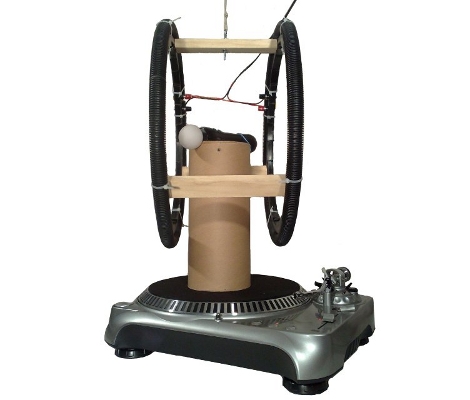
This somewhat odd-looking apparatus is being used to measure earth’s rotation. At the heart of the system is a PlayStation Move controller, used because of its dual-axis gyroscope which has the highest dynamic range compared to other available products like the Wii Motion Plus. It rests on a column perched atop a record player that was chosen because of its precision rotation rate. The two rings that flank the controller make up a Helmholtz coil which is used to cancel out the earth’s magnetic field which was found to be interfering with measurements taken by the Move controller. By recording data over time the experimenter can prove that the earth is indeed rotating, as well as ascertain longitude data and find true north. Check out the data-packed video after the break.

Continue reading “Measure Earth’s Rotation With PlayStation Move”
Plug-in Module Lies About News At Coffee Shops. Real Or Fake?

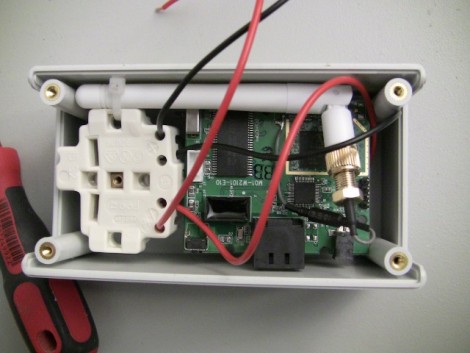
[Mike] sent in a tip about Newstweek, and we’re turning to our readers to tell us if this is real or if we’re being trolled. The link he sent us points to a well-written news-ish article about a device that plugs into the wall near an open WiFi hotspot and performs something of a man-in-the-middle attack on devices connected to the access point. The article describes the device above as it observes, then spoofs the ARP table of the wireless network in order to inject fake news stories in pages you are reading. Apparently once it boots, the small box phones home for commands from its maker over a TOR connection.

The box reminds us of the Sheevaplug so it’s not the hardware that makes us question the possibility of the device. But look at the Linux terminal screen readout. It shows a prompt with the word ‘newstweek’ in it. That’s the address of the site the article is hosted on, giving us a strong sense of being trolled.

What do you think, real or fake? Let us know (and why you think that) in the comments.

Stackable Macro Photography Rig

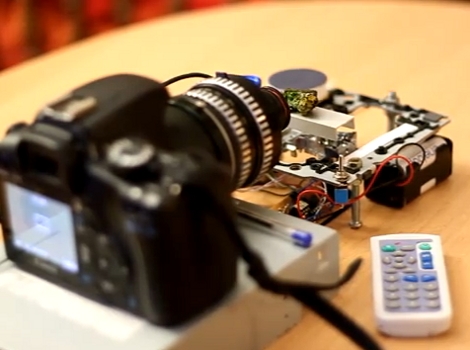
When taking macro photographs you lose a lot of clarity due to a reduced depth of field. One way to get sharp pictures is to take multiple shots at slightly different distances from the subject and then stack them into one image. There’s software to do this for you, but you still need a set pictures to start with. [Dsvilko] built this setup to easily capture a set of macro images.

He’s using the internals from an optical drive as a sled to carry the subject. A PICAXE drives the stepper motor that moves the carriage, which takes input from an IR remote control. This turns out to be a fantastic method as the sled can move in 0.2mm increments. After he’s got his set of images he uses Zerene to stack them together.

Bonus points to [Dsvilko] who used Linux command line tools to edit together the demonstration video embedded after the break.

Continue reading “Stackable Macro Photography Rig”

Hard Drive Password Recovery

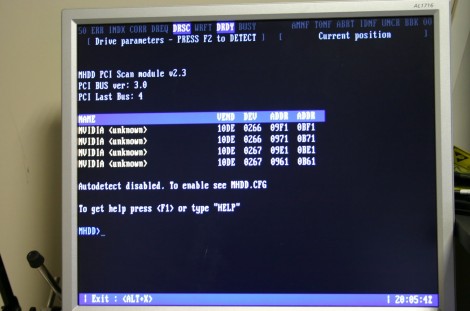
Here’s a guide for recovering protection passwords from ATA hard drives (translated). These passwords are stored in a special area of the hard disk that also contains the firmware for the device. Normally you can’t get at them but [Supersonic] walks us through a method used to grab the data off of a Western Digital Scorpio drive. Booting into a program called MHDD you are able to bypass the BIOS (which won’t allow you to read protected data) and directly drive the SATA or PATA controller on your motherboard. Once you’ve dumped the data it can be viewed with a HEX editor, and if you know where to look you can grab the passwords that are locking the disk.

This reminds us of some of the original Xbox hacks which used a variety of methods to unlock the stock hard disk.

Hacking Teddy Ruxpin

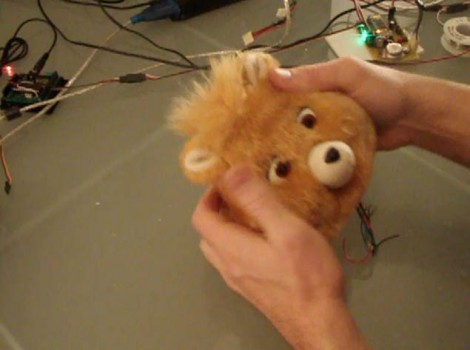
[DJ Sures] got his hands on a broken Teddy Ruxpin doll and decided to give it a new robotic life. You may want to ask the children to leave the room before viewing the video after the break. It starts right off with little Teddy having his throat slashed in order to get at the parts in the head. After retrofitting the eyes, mouth, neck, and arms with servos, Teddy gets a Bluetooth upgrade that lets you control his movements wirelessly. [DJ Sures] even has plans to get the little guy up and walking, far exceeding the original capabilities.

Continue reading “Hacking Teddy Ruxpin”

Valentine’s Gift Counts The Days Spent Together

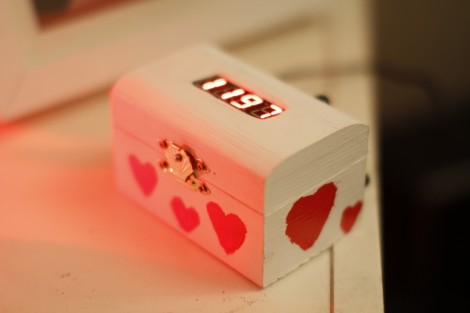
[Vegard Paulsen] dug deep down to the romantic geek at his core and built this box that counts the days he’s spent together with his Valentine. As you can see, it uses a four-digit seven segment display installed in the lid of a wooden box. An Arduino mini is responsible for driving the display, but as you might already know, to keep accurate time you’re going to need a reliable clock source. Instead of using a temperature compensated crystal oscillator like the ChronoDot he decided to pull time data from the Internet via a pair of RF modules.

His closing comments mention that this display will only work for around 27 years but he figures he can always build a bigger display. We’d keep this around, physically unaltered for sentimental value, but switch to a hexadecimal readout to track just over 179 years. Maybe that’s a bit too geeky.

Sniff Ethernet With A Throwing Star

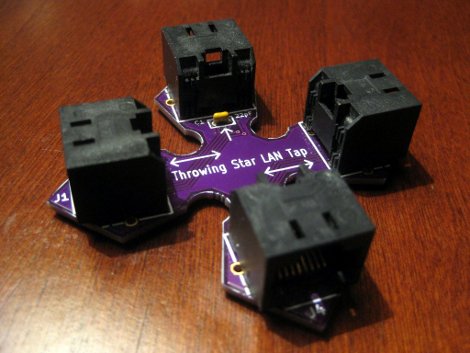
[Michael Ossmann] came up with a nifty little device that arranges RJ45 plugs into a plus shape for the intent of sniffing Ethernet packets, and named it the “Throwing Star LAN Tap”. While the original design worked fine it does suffer some limitations such as being limited to 10/100 base networks, and one way only. This new version of the “Throwing Star LAN Tap” fixes those and adds some much needed convenience.

Gone are the male plugs, which requires couplers and are prone to break, and fiddly splices in favor of a throwing star shaped pcb, and female sockets. 1000 base networks are supported, but due to the workings of 1000 base and wanting to keep the device passive, capacitors are added to filter out the signal and force the network to drop down to 100 base. Sure, it may be an ugly hack, but it’s an ugly hack that fits in your pocket.