Talking Joystick Mouse

Instructibles user [Shadowwynd] shows us a great way to build a joystick/mouse device for people with special accessibility needs. When faced with a case that involved a man with very limited mobility as well as a limited budget, [shadowwynd] set out to find a cost effective solution to computer navigation. They found that his client could use a commercial joystick mouse, but the cost was quite high at over $400. So instead of just purchasing that, they bought a USB game pad and built their own version. They managed to reduce the cost to roughly $45.  While extending the buttons and joystick from a gamepad might not be groundbreaking, we feel that this project is the epitome of hacking. Great job [Shadowwynd] keep up the good work.
Backlit Buttons And Panels

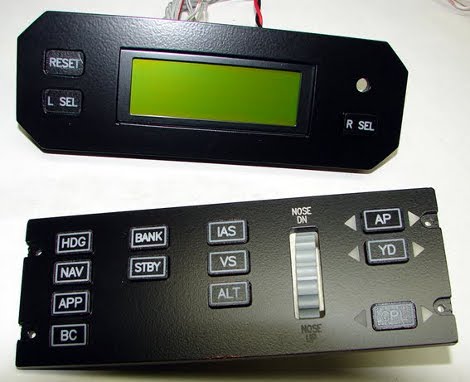
“Kick the tyres & light the fires” is a blog by [Ruscool Electronics] that is focused on building a cockpit simulator from scratch, and while the blog is loaded with all sorts of nifty information, reader [Brian] pointed out one entry which explains how to make back-lit control panels out of acrylic sheet, and a CNC machine.

The parts start off as clear acrylic, and cut to shape and size. Next up is a thick, but uniform coat of paint so the panels are opaque , then its back off into the CNC machine for engraving. What is engraved is now a frosty white, ready for leds behind.

The end result looks fantastic and professional, though, we are left thinking of how to pull off the same look, sans CNC.

Ideas?

Rechargeable Battery Capacity Tester

Rechargeable-Battery-Capacity-Tester

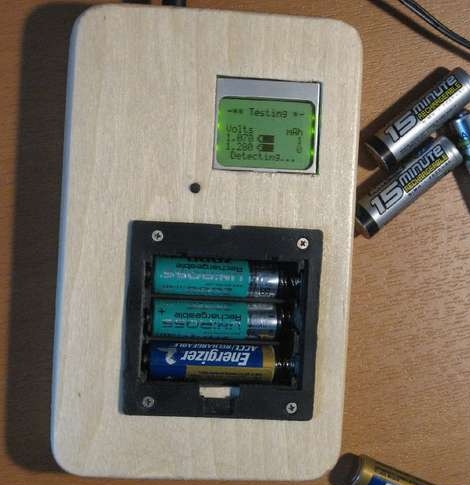
If you are like most people, you likely have a mixed pile of rechargeable batteries sitting around with no idea as to what kind of charge they can hold. You could watch a voltmeter for a few hours while you drain each and every battery, noting when it drops below its stated voltage – but then again, you have a life.  Instead of wasting away in front of his multimeter, [BrianH] decided he would build an automated battery capacity tester to do the job for him.

He created a simple circuit that drains any AA battery, NiMh or NiCd, and records its useful capacity in milliamp hours.  Since the ATMega168 microcontroller used has 6 analog/digital converters on board, he figured that he might as well design his tester to measure the capacity of three batteries simultaneously.  [BrianH] wired the meter up to an old Nokia LCD, then moved his project to a perfboarded ATMega, freeing up his Arduino for other tasks. Once he had things reassembled, he packed it all into a handsome wooden box.

His writeup is chock full of details and source code, so be sure to check it out.  We have video of the charger in action after the jump.

Continue reading “Rechargeable Battery Capacity Tester”

Driving A Salvaged LCD

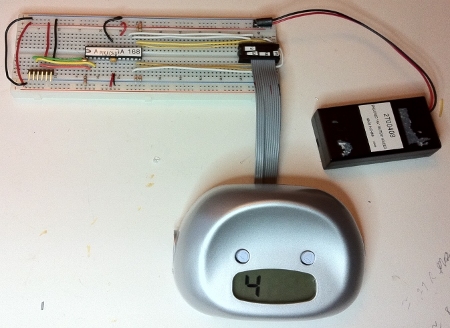
[bill2009] wanted to reuse some common seven segment LCDs, but the question was how to drive them. Armed with a couple application notes from [Microchip] and [Atmel], an oscilloscope and an Arduino, he has made a proof of concept which shows its not super hard to drive those little reflective LCDs that so many devices have.

First finding out that these things are indeed multiplexed, he went on to what is needed to drive them, which is about +-2 volts difference from the backplane, next up was to find a donor, which he found readily at Staples, in the form of a “clocky” style run away alarm clock.

After poking around watching what signals do to the different segments on the LCD he whipped up a little circuit to control the display from the Arduino. The positive and negative voltages the segments require are made possible by the use of a set of pull down resistors, and switching pin modes on the micro controller.

These small type segmented LCDs are everywhere, and being able to use them is a big bonus.

Imploding Vacuum Tubes For Science

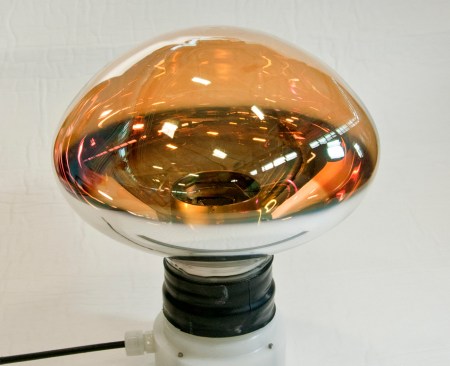
The researchers at Brookhaven National Laboratory are looking for a way to harden photomultiplier tubes. In order to make a more durable tube the researchers decided it would be a good idea to first observe how the tubes are failing. So they got their hands on an old torpedo test bay and smashed some bulbs inside of it. Check in after the break for some high fps bulb smashing.

Photomultiplier tubes are used in massive quantities to detect the highly elusive neutrino particle. The problem is when you have 50,000 photomultipliers submerged in pressurized water the the collapse of just a single bulb can cause a shock wave of destruction. This is what happened in japan in 2001 when a maintenance worker unknowingly compromised a single bulb in a 11,000 bulb array. When the tank was repressurized that single compromised bulb caused them to lose 7,000 more.

[via wired]

Continue reading “Imploding Vacuum Tubes For Science”

Multitool Alarm System

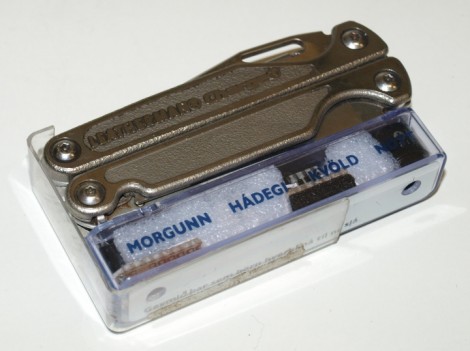
Here’s a way to make sure you don’t leave your Leatherman multitool somewhere. It’s an alarm system that will start a timer when the tool is removed from the holster. After five minutes the module beeps to remind you to put the tool back where it belongs. Annoying? Possibly, but if you’re not done with your work just press the reed leaf switch on the module to reset the timer. A PIC 12F683 handles the timing and generates the waveform for the piezo buzzer. Perhaps this could have been accomplished with a dual 555 chip like the LM556 (one timer for the countdown and another for the piezo waveform) but the PIC has power-down modes available that should make the button batteries last a long time.

Daft Punk Module – Just Add Table

This is just an 8×8 LED matrix, but the size and execution make it look marvelous. [Michu] built this module using foam board dividers to separate the cells, a foam board back to host the 64 RGB LEDs, and a sheet of heavy frost diffusion gel that is a stage lighting product. The display is driven by a Rainbowduino with input from a processing sketch. The effects seen in the video after the break are quite pleasing, and are just begging to be installed in your next coffee table project.

Continue reading “Daft Punk Module – Just Add Table”