Hackaday Links: Monday June 13

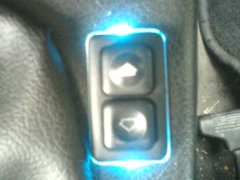
Tim wrote in to tell us about this simple hack where he replaced the stock button lights with some really cool Blue LEDS on an ’87 BMW. He uses some capacitors, to achieve the effect that it takes a bit for the charge to drain out so the lights stay on for a bit after being turned off.  The lights themselves look really nice, so check out the pic.
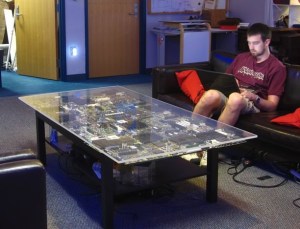
Here’s an awesome coffee Table built using a large electrical board. It definitely would look good in anyone’s den, although it most likely has a low wife approval factor (WAF). This is actually based on a “motherboard wall that HAD covered before, but the “coffee table” form probably looks even better.

Finally, after the break is a video of someone washing an interactive art exhibit. Not sure if it qualifies as a hack, but it looks pretty cool to see lights following someone around when he’s washing the screen/window.

Continue reading “Hackaday Links: Monday June 13”

An Autonomous Car Using A “Webcam”

This autonomous remote control-style car from Cornell students was designed for a senior level engineering course there. It’s main “sensor” is a low-res webcam style camera. As shown in the video after the break, this car does quite well staying within two black lines on a white surface using it’s vision processing. It also has an IR sensor to detect objects in front of the car and stop without crashing.

All “vision” computations are handled by an Atmel Mega644 MCU, an 8-bit processor. Because of the processing limits of this chip, much work had to be done to make this process computationally efficient. These students go through an incredibly detailed account of their project, focusing on the code and electrical design. Check out the video of their car in action after the break. Continue reading “An Autonomous Car Using A “Webcam””

Wifi Sniffing Digital Picture Frame

[AUTUIN] sent in a tip for his wifi sniffing digital picture frame.

A soon-to-be-trashed Pentium II laptop was rescued from Free Geek Vancouver. A lot of coffee shops around Vancouver feature local art and free wifi, so [AUTUIN] decided to combine the two. The project is designed to hang on the wall of a cafe and sniff images transmitted on the wireless network – an invasion of privacy, but as [AUTUIN] says, “that’s kind of the point.”

After gutting the laptop and putting it in a custom picture frame, Driftnet, a program that listens network traffic and picks out images from TCP streams, was installed. [AUTUIN] tested his build with an open wireless connection in his building. The results provided a wonderful narrative that started with pictures from news sites than slowly devolved to pictures from a hot-or-not style website, an online dating site and finally pictures from the inevitable conclusion of that browsing session.

[AUTUIN] is now looking for either a brave or foolish local coffee shop in Vancouver to feature his wifi sniffing picture frame. We think this would be very amusing if we weren’t using that network, not that we have something to hide or anything.

Hacking Cakes With LEDs, The Sequel!

A few weeks back we ran a piece about the convergence of making and baking in an attempt to create a cake festooned with working LEDs. The moral was that not every creative idea ends in victory, but we applauded the spirit it takes to post one’s goofs for the whole internet to see and to learn from.

[Craig]’s LED matrix proved unreliable…and the underlying cake didn’t fare much better, resembling that charred lump in the toaster oven in Time Bandits. The cakes-with-lights meme might have died right there if not for a fluke of association…

Continue reading “Hacking Cakes With LEDs, The Sequel!”

How Canonical Automates Linux Package Compilation

pandaboard

What do you do when it’s time to port the most popular Linux distribution to a completely different architecture? Canonical employee [David Mandalla] works on their ARM development team and recently shared the answer to that question with his fellow Dallas Makerspace members.

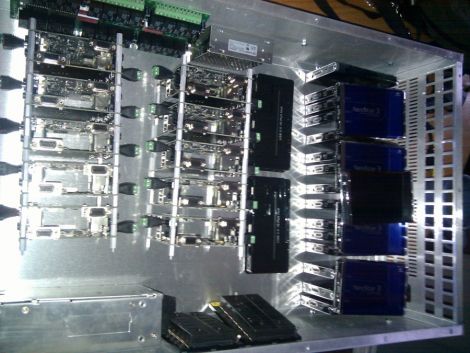
Canonical needed a way to compile about 20,000+ packages for the ARM platform, however they did not want to cross-compile, which is quite time consuming. Instead, they opted to build a native solution that could handle the load while ensuring that all packages were compiled securely. To tackle this immense task, [David] and his team constructed a 4U server that runs 20 fully-independent ARM development platforms simultaneously.

The server is composed of 21 PandaBoards, small OMAP development boards featuring a dual-core ARM cortex processor with just about all the connectivity options you could possibly ask for. One board operates as the server head, keeping track of the other 20 modules. When someone requests server time to build a package, the main board checks for unused server, triggering a relay to reboot it before the server is automatically reimaged. Once the pristine, secure environment is ready to go, it’s handed off to the customer who requested it.

If you’re interested in learning more about the build process, [David] has put together a blog with additional details.

[Thanks Leland]

Crosshair Aiming System For Your Laser Cutter

diy_laser_crosshairs

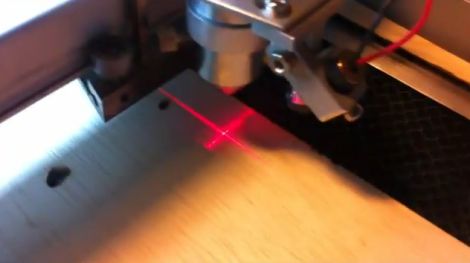
[Rich] was having quite a bit of fun with his newly-acquired laser cutter, but was not impressed by the stock aiming laser that came with it. The problem with the built-in laser is that it did not actually follow the cutting laser’s path – instead, it has to be calibrated for a fixed focal length. This becomes problematic when engraving and cutting since they require different focal lengths, so it becomes a guessing game as to where the cutting laser will actually end up in respect to the aiming laser.

An additional optic module that solves this problem can be had for about $300, but after sinking $2500 into the laser setup, [Rich] was not inclined to purchase one. Instead, he bought a pair of cheap laser levels online and scavenged the line lens from one module, which was mounted on the laser cutter’s existing aiming laser. The second module was epoxied to the top of the cutting head, to create a set of cross hairs on the work surface.

As you can see in the video below, the hack works quite well, and the lasers are accurate at a variety of different focal lengths.

Continue reading “Crosshair Aiming System For Your Laser Cutter”

Rescuing Surplus Blinkenlights

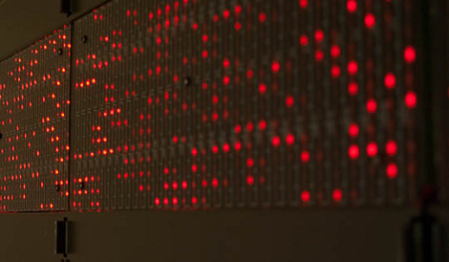
Because surplus LED panels from an early 1990s supercomputer is a completely reasonable thing to own, [William Dillon] set to work displaying them on his wall.

The LED panels came from a surplus CM-5 Connection Machine, best known from it’s role as the mainframe in Jurassic Park (only an empty case with LED panels were used in the movie). When not on Isla Nublar, the Connection Machine was a fabulous piece of engineering from the 1980s Artificial Intelligence revival. With some machines having 65,536 processors, it was used for AI research using Lisp (although we were never very good at Lisp.

[William] built a wooden frame out of 1×2 inch maple and installed an X10 module behind the panels as a remote switch. The panels themselves aren’t controlled by a computer, so the only thing left to do was to mount the power supplies. It’s impressive to see the massively over-engineered power supplies that were designed to source 5V @ 30A when the panels only draw 7 Amps. [William] says it was a design feature of the Connection Machine to spare no expense.

[William]’s next plan is to reverse engineer the panels to display custom messages, and we can’t wait to see what he comes up with. We can’t explain why, but we really want to build one of these panels. Check out the pictures of [William] decommissioning the CM-5.