Homemade Silicon Carbide LED

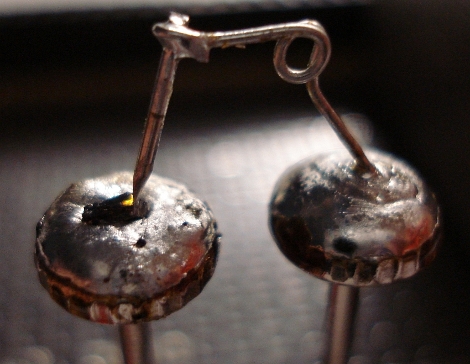
Here’s an LED indicator which was made at home out of a Silicon Carbide (SiC) crystal (Internet Archive Mirror). The concept is simple, but a bit of trial and error goes into getting that tiny amber spot to light up.

The guesswork comes in finding the right piece of crystal. First [KOS] broke it into tiny pieces, then he started poking the chunks with electrified probes to see if he could get some light out of them. Once an active area was found he needed a base for the crystal. The image above shows the two nails which he used. This provides a large mounting area that also acts as a heat sink to make sure the LED won’t burn itself out. There’s a solder blob which he kept molten with his iron until the crystal could be pushed into place. That holds it securely as the pin which serves as the cathode is positioned.

The whole setup is soldered to some protoboard and is ready to use. This is the second time we remember seeing this technique used to fabricate LEDS. The first time was an accident.

Blu-ray CNC Looks Great For Branding And Engraving

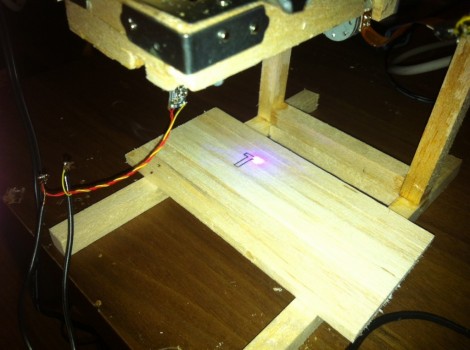
[Nav] got the bug for a tiny little laser cutter. He pulled off the build, and has just finished the second rendition which makes some nice improvements. He’s was hoping for a laser cutter, but we think this really shines when it comes to branding objects like the scrap wood seen above.

This joins a long line of optical drive parts builds. For instance, we saw this plotter that used the lens sleds from some CD-ROM drives. You may think that [Nav] doesn’t need to worry about the Z axis since this is a laser but you’d be wrong. The focal point of the light needs to hit at the right place to cut efficiently, and this is often the trouble with laser cutters. As material is burned away the laser becomes less efficient if you don’t adjust the lens for vertical position. That’s why we think it’s best as an engraver, but the original build writeup for his cutter does show some success cutting letters in dark paper.

Check out a clip of this design being burnt into the wood after the break.

Continue reading “Blu-ray CNC Looks Great For Branding And Engraving”

Open Source Graphics Card

Even though NVidia and ATI have been open-source friendly for a while now, there still isn’t a true open-source graphics card. [Anton] and [Per] are trying to fix that by building his own graphics card around an FPGA. The project is called ORSoC, and it’s available on opencores.com.

The guys are building the ORSoC graphics card around a Digilent Atlys FPGA dev board. So far, he can draw lines, textured triangles, bitmap or vector fonts, and throw a few 3D meshes up on the screen. This project isn’t intended to run advanced OpenGL or Steam on Linux, but for all the work that into this graphics accelerator, it’s an amazing piece of work.

There are a few demos after the break; a cube rotating in 3D and a demo drawing and translating polygons and a few textures. The ORSoC is a bit slow, but that’s an artifact of the build not being optimized for the FPGA the team is using. If you’d like to test this graphics card, there’s a Git available. As a bonus you don’t even need an FPGA to play around with this project. There’s also a software emulation of all the functions. Very neat.

Continue reading “Open Source Graphics Card”

Large-scale Arduino Controlled Greenhouse Does Some Serious Farming

[Instrument Tek] isn’t messing around with a hobby-sized greenhouse. In fact if it were any bigger we’d call it a commercial operation. But what interests us is the professional-quality greenhouse automation he built around and Arduino board.

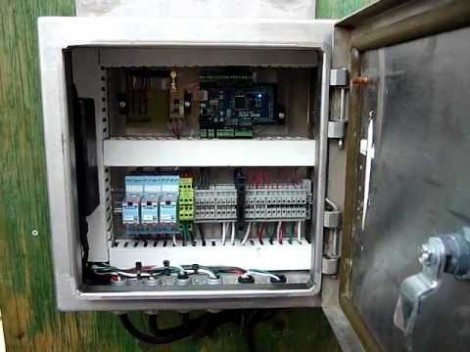
The greenhouse is about what you’d expect to see at a nursery, except the footprint is somewhere around 10’x10′. It’s a stick-built frame with walls made of poly. Professional greenhouses monitor and regulate temperature and humidity and this one does just that. The video after the break starts off by showing the controller box. It has temperature, humidity, and light sensors that allow the Arduino to judge growing conditions. If it gets too hot, some slats are opened and a fan exhausts air from the structure. If it gets to cold, a series of light fixtures are energized. They contain heat lamps, as this setup is in northern Alberta, Canada and it can get quite cold some nights. The drip system is also automated, with a solenoid to turn water on and off.

In addition to that 3:26 show-and-tell, we’ve embedded a 27-minute video that shows how to build the controller box. So you can start you plants indoors on the rack, then populate the greenhouse when they get large enough.

Continue reading “Large-scale Arduino Controlled Greenhouse Does Some Serious Farming”

Home Automation With RC Wall Plugs And Raspberry Pi

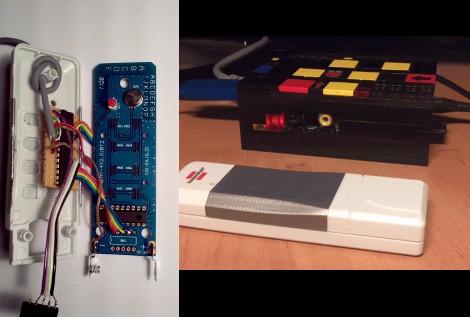
[Jake] took some cheap hardware and figured out a way to use it as a huge home automation network. He’s chose a Raspberry Pi board to connect the radio controlled power outlets to his network. He wrote about his project in two parts, the first is hacking the RC outlet controller and the second is using the Raspberry Pi to manipulate it.

These RC outlets are a pass-through for appliances that connect to mains (lamps, consumer electronics, christmas trees, etc). Often the protocol used by the cheap-as-dirt remote is difficult to work with, but [Jake] really hit it out of the part on this one. In addition to simulating button presses for up to fifteen devices on the remote, he replaced the DIP switch package. This lets him change the encoding, essentially allowing the one device to control up to 32 sets of outlets. Theoretically this lets him command 480 devices from the Raspberry Pi. Since that board is a web server it’s just a matter of coding an interface.

Some of the inspiration for this hack came from the whistle-controlled appliance hack.

Tearing Apart A Hot Glue Gun For A 3D Printer

If you’re building a 3D printer, the most complicated part is the extruder. This part uses a series of gears to pull plastic filament off of a spool, heats it up, and squirts it out in a manner precise enough to build objects one layer at a time. [Chris] made his own extruder out of a hot glue gun and made it so simple we’re surprised we haven’t seen this build before.

The basic operations of a plastic extruder – pushing a rod of plastic through a heated nozzle – already exists in a hot glue gun available for $3 at WalMart. To build his printer, [Chris] tor apart the hot glue gun and mounted the nozzle on a piece of plywood. The hot glue sticks are fed into the nozzle with the help of a 3D printed gear and a stepper motor driver.

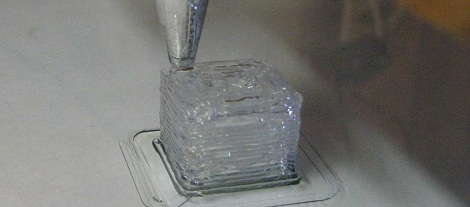
After the break, you can see [Chris]’s hot glue gun RepRap printing a 10cm cube. It’s not fast, but the quality is exceptional, especially considering he made it out of a hot glue gun.

Continue reading “Tearing Apart A Hot Glue Gun For A 3D Printer”

Update: Many Improvements To Optical-sensor-based Piano

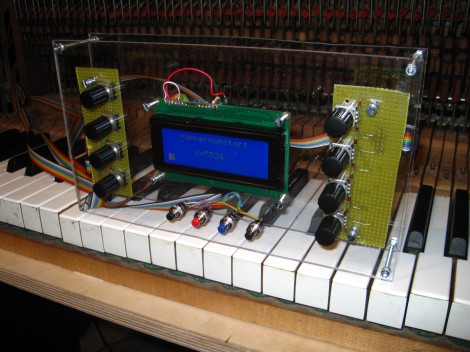
[Sebastian] wrote in to update us about the optical sensor project he started a couple of years ago. You’ll find his most recent update here, but there are four different post links after the break that document various parts of his progress.

You may not recall the original project, but he was looking to add resolution and sensitivity to the keystroke of an electric keyboard. With the sensors built, he started experimenting with using the force data to affect other parts of the sound. His post back in January shows this bending the pitch as the keys receive more force from the player.

In March he installed the sensor array in an old piano. The video he posted where he plays the piano, but we hear the sound generated from the sensor inputs. We’ve embedded it after the break.

Last week he published two posts. They cover a redesign of the sensor boards, and the panelization work he’s done to help bring down manufacturing costs. The base unit was redesigned to use an AT90USB microcontroller which consolidates the separate chips used in the previous version.

Continue reading “Update: Many Improvements To Optical-sensor-based Piano”