Visual Rain Sensor — So You Never Have To Look Outside

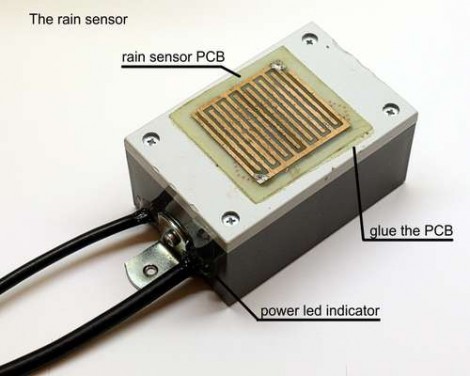
Now you can find out how hard it is raining outside without leaving the confines of your mancave/womancave. Pictured above is the sensor portion of what [Frapedia] calls his visual rain sensor.

Most rain gauges just use a graduated cylinder to capture water as it falls from the sky. That will give you a reasonably accurate measure of how much it rained, but it tells you nothing about how hard it rained. The measurement made here is based on sound. The harder it rains, the lounder the sound will be from water hitting an up-turned metal bowl. The unit above turns the system on when water bridges the traces, then a microphone is used to monitor the sound from the bowl. This is visualized by a VU-meter chip on a column of LEDs mounted inside the house.

After the break you can see the project box that houses the status display. We say it’s too small an needs to be replaced with a much larger LED meter.

Continue reading “Visual Rain Sensor — So You Never Have To Look Outside”

Pneumatic Car Launcher Is Actually More Than Just A Hacker’s Fantasy

So if you had to launch a car through these goal posts how would you do it? Certainly not with a slingshot (although we might have gone with a steam-powered catapult a-la an aircraft carrier). That maroon car with the white stripe is about to make the flight thanks to a very powerful pneumatic launcher.

We don’t usually attend the demolition derby, so this sort of thing is new to us. And we were even more surprised to find that this isn’t strictly a novelty act. The system is actually how some of the more dangerous automotive stunts are done for the movies. This launch sends the car in a graceful arc that is right on target and reminds us of the cliffhanger stunts from The Dukes of Hazzard (TV, not the recent movie). But if you’re a director looking for a horrific car accident, the rig can be altered to send the car spiraling through the air. Sounds like the record is nearly eight turns while airborne.

We don’t have any extra cars to launch, so we’ll stick to making the confetti fly.

Continue reading “Pneumatic Car Launcher Is Actually More Than Just A Hacker’s Fantasy”

Building A DIY GPS Cube

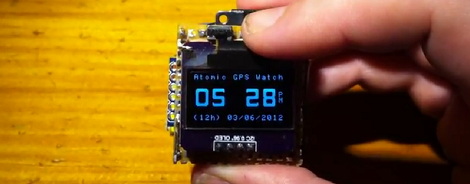
Originally, [Karman] wanted to build a speedometer for his bike. Feature creep makes fools of us all, so after a month of work [Karman] had a  GPS-enabled cube that tells him his current latitude and longitude, current time, course, direction and speed.

[Karman]’s GPS cube uses a cheap GPS module, Arduino Mini Pro, a magnificent OLED display, and a LiPo battery salvaged from a first gen iPod nano. Surprisingly, the build is very clean – there are no wires, headers, or random epoxy globs sticking out everywhere. The entire build is just a bit larger than one cubic inch, allowing [Karman] to carry around the power of a GPS device in his pocket.

The code for [Karman]’s GPS cube uses the TinyGPS library for Arduino, that has a few great functions that track the number of satellites visible and report the current time. Now all that’s left to do is fabricate a case for this awesome little project. As always, video demo after the break.

Continue reading “Building A DIY GPS Cube”

Electronic Bike Derailleur

[Nabil] sent in an awesome electronic bicycle derailleur. Now, instead of pulling a steel cable with a shifting mechanism, [Nabil] can change gears electronically. As a bonus, the derailleur can be controlled by a small bicycle computer, so he’s always in the right gear.

The new electronic derailleur is controlled by a pair of servos with push buttons in the handle bar. This allows [Nabil] to automatically trim his chain, completely eliminating chain rub.

This electronic shifter is part of [Nabil]’s much large bike computer project. In addition to electronic control of what gear the bike is in, [Nabil] will be adding a GPS, accelerometer, an altimeter and a heart rate monitor and pulse ox meter. That’s an impressive bit of kit, and we cant wait to see the entire project finished. You can pick up the current version of the design over on GitHub and follow all the updates on [Nabil]’s blog.

Outdoor Stereo Helps Your Neighbors Learn To Issue Noise Complaints

Backyard parties are going to rock over at [Effin_dead_again’s] house. That’s because he just finished building this outdoor stereo. It carries its own power supply so you can take it on the road with you, and we don’t think you’ll have trouble hearing it with the 240 Watt amplifier hidden inside.

He shared the equipment details in his Reddit conversation. A 12V lawn mower battery sits in the base of the wooden enclosure. One of the commenters mentioned the dangers of hydrogen off-gassing from that power source, but [Effin_dead_again] thought of that and included venting around the lid. The subwoofer is an 8″ Alpine, and speakers are out of a Hyundai car. The head unit has Bluetooth built in for easy connection to your smart phone. It of course has the ability to play CDs and MP3s too, and we’d bet you can tune the radio if there’s an antenna connected.

Need similar power but a bit more portability? Check out this stereo built into a cooler.

Arduino Rover Doubles Up On Obstacle Avoidance

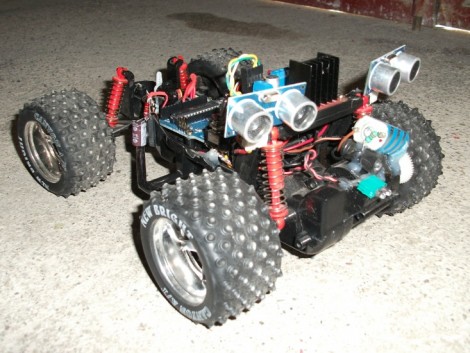
[Eduard Ros] wrote in show off his first attempt at building an autonomous rover (translated). As with many of these projects, he started with the base of a remote control toy truck. This solves so many mechanical issues, like steering, locomotion, and power source.

He just needed a way to control the vehicle. The recent LayerOne badge hacks either did this through the wireless controller protocol or by adding an Arduino directly to the vehicle. [Eduard] chose the latter, and also included obstacle avoidance sensors in the process. We’ve seen quite a few that use these ultrasonic rangefinders. He decided to go a different route by adding two of them rather than scanning by mounting one on a servo motor.

The video after the break shows the vehicle successfully navigating through a tight space. This makes us wonder how much data can be processed from the stationary sensors? We’re not familiar with how wide the horizontal sensitivity is on the devices. If you have some insight, please share you knowledge in the comments section.

Continue reading “Arduino Rover Doubles Up On Obstacle Avoidance”

Retrotechtacular: The Mother Of All Tech Demos

Most bits of a computer we take for granted today – the mouse, hypertext, video conferencing, and word processing – were all invented by one team of researchers at Stanford in the late 60s. When the brains behind the operation, [Douglas Engelbart], showed this to 1000 computer researchers, the demo became known as The Mother of all Demos. Luckily, you can check out this demo in its entirety on YouTube.

Even though [Englebart]’s demo looks incredibly dated today, it was revolutionary at the time. This was the first demonstration of the computer mouse (side note: they call the cursor a ‘bug’), a chorded keyboard, and so many other technologies we take for granted today. During the presentation, [Englebart] was connected to the SDS 940 computer via the on-line system 30 miles away from Stanford. Yes, this pre-ARPANET, what is normally cited as the precursor to the Internet.

Sadly, most of [Englebart]’s researchers became disillusioned with the time sharing /mainframe paradigm shown in this demo. Those researchers wanted a more decentralized means of computing, so they went off to Xerox PARC where they helped create the first personal computers. Still, most of the ideas from 1968, such as the mouse, hypertext, and word processing, were in those little Xerox boxes.

On a more philosophical note, [Englebart] began his demo with the question, “If, in your office, you as an intellectual worker were supplied with a computer display, backed up by a computer that was alive for you all day and was instantly responsive to every action you had, how much value could you derive from that?” In the 44 years since this Mother of all Demos, we’ve gotten to the point where we already have a computer on our desks all day that is able to do any task imaginable, and it certainty improved our quality of life.

There are a few great resources covering the Mother of all Demos, including the Douglas Engelbart Institute’s history page and the Stanford Mousesite. Looking back, it’s not only amazing how far we’ve come, but also how little has actually changed.