Mini Pinball MAME Machine Is Small Enough To Fit In Any Game Room

A huge collection of pinball machines in your basement is one of the crowing achievements of a geek, but what if you could have a huge library of physical pinball machines at you fingertips? [veriix] shared an imgur gallery in a reddit post documenting his wee little pinball machine he built from scratch.

Inside the pinball cabinet, there are two monitors. A 4:3 Samsung monitor serves as  the backglass for the machine while a 23″ HDTV provides the playfield. On the software side of things, [veriix] used PINMAME and Visual Pinball 9 running on an old motherboard he had lying around. The result is impressive. The HD monitor playfield provides the right perspective to fool [veriix]’s brain into thinking he’s playing a real pinball machine.

We’ve seen PINMAME builds before, but those were encased in full-size pinball cabinets that took up far too much room. [veriix]’s machine is much smaller, and perfect for the garage, den, basement, or anywhere you’d like to set up an awesome game room.

You can check out [veriix] playing his mini pinball machine after the break. Thanks [Johnny] for sending this one in.

Continue reading “Mini Pinball MAME Machine Is Small Enough To Fit In Any Game Room”
Turning A 1942 Lathe Into A Functional Piece Of Art

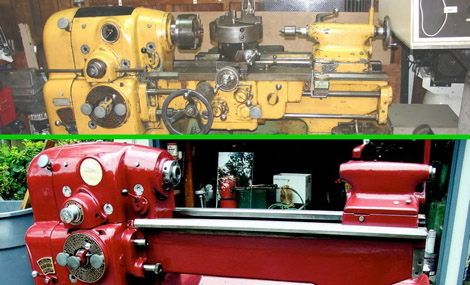
A couple of years ago, [macona] picked up a 1943 Monarch 10EE lathe. This monstrous machine is not only an amazing piece of engineering but an awesome work of art; not only can this lathe manufacture parts with exacting precision, it’s also a wonderful piece of machine age design.

The Monarch 10EE lathe was extremely high-tech for its time, and the War Dept Detroit Ordinance District tag on the cooling pump bears this machines lineage: this lathe was most likely used to make very precise military equipment such as the Norden bombsight.

After 60 years of faithful service, [macona]’s lathe picked up several coats of paint in different colors and generally fell into a state of disrepair. [macona] spent a great deal of time overhauling this lathe by replacing a bent feed rod, troubleshooting the motor problems, and eventually replacing the whole motor with a modern AC brushless servo. You can check out the improvement the AC servo made in a video after the break.

Of course no post about a rebuilt lathe would be complete without a few beauty shots. We’re extremely thankful for [macona] for not only restoring this machine, but also for sharing it with us. Thanks to [macona]’s restoration, this machine will hopefully be around for another 60 years.

Continue reading “Turning A 1942 Lathe Into A Functional Piece Of Art”

Fine Tune Your Morse Code Skills With This Mint Tin Practice Keyer

mint-tin-keyer

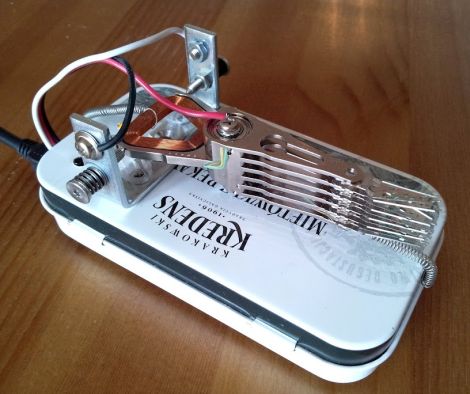
Hackaday reader [svofski] wrote in to share a device he built, which would be useful to any ham operators out there trying to hone their CW skills. He calls his practice keyer the Morseshnik, and it is a combination of various items [svofski] found while digging through his parts drawer.

He disassembled an old hard drive, saving its read arm to serve as the keyer’s paddle. He purchased some small angle brackets to create a set of contacts for the device, between which the lever sits, automatically centered by a pair of springs.

An MSP430, which was also collecting dust in [svofski’s] junk pile, resides inside the Morseshnik’s mint tin base on a small DIY PCB. It allows him to toggle between manual and automatic keying modes with the flick of a switch as he whiles his time away practicing his dits and dahs.

Continue reading to see a short video of the Morseshnik in action, and swing by his site for code and PCB schematics should you want to build one of your own.

Continue reading “Fine Tune Your Morse Code Skills With This Mint Tin Practice Keyer”

The Styharp, An Instrument Modeled After A Pig Sty

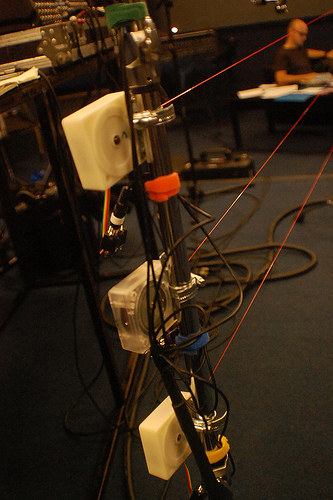
This is a first for us. We’ve never heard of an instrument modeled after a pig sty before. The Styharp, built by [Yann Seznec], for [Matthew Herbert] is meant to be a mix between performance and visual art. [Matthew]’s followed a pig from birth to the plate and made an album from the sounds he recorded. The project is called “one pig”. This would explain the reason behind modeling an instrument after a sty.

[Yann] started with a Gametrak controller, basically a reel of line connected to a potentiometer. He ended up using 12 of these, which each have 3 outputs. This gave him plenty of ways change the sound during the performance. You can see a little bit of him demoing it after the break.

Continue reading “The Styharp, An Instrument Modeled After A Pig Sty”

The Bicycle Can Tell Us How To Make It Better

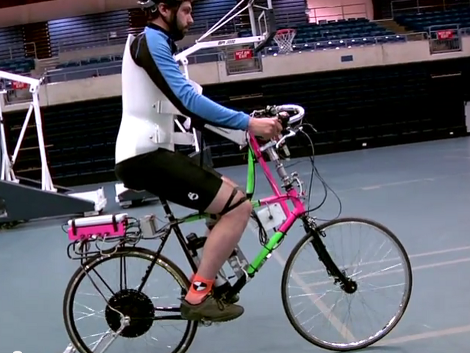
Over the years bicycle design has changed. Materials were upgraded as technology advanced, and accumulated knowledge helped bicycle builders make improvements along the way. But deep analysis with the intent to make meaningful improvements has not been widely embraced. Reasearchers at UC Davis are looking to expand into this frontier by letting the bicycle tell us how it can be improved. This is one of the test bikes they’ve been working on, which is mainly aimed at data harvesting. They’re hoping to find some real improvements based mostly on how the machine can get out of the rider’s way as much as possible. The thought here is that the rider’s body makes up 80-90% of the volume of the vehicle and should be accommodated in every way possible.

Sure, this could be a case of trying to build a better mouse trap. But listening to the discussion in the video after the break really drives home the complex issues of stability and locomotion that go into these seemingly simple vehicles. We’re going to guess the final recommendations will not involve making the bike five times taller.

Continue reading “The Bicycle Can Tell Us How To Make It Better”

Making Capacitive Touch Sensors With Pencil And Paper

capacitive-touch-sensor

There are few things more frustrating than being in the middle of working on a project and realizing that you are missing some crucial component that ties the whole thing together. According to Murphy’s Law, this sort of thing will only happen when parts are completely impossible to procure.

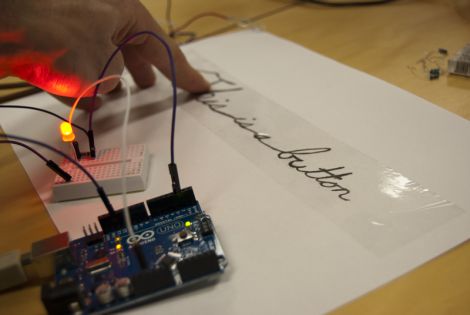
If you’re ever hunting for a touch sensor but can’t get your hands on one, [Alan Chatham’s] tutorial on simple DIY capacitive touch sensors might be just what you need to keep things moving along.

[Alan’s] sensors rely on the conductive properties of graphite, which is easily found in just about any pencil on the market. The sensors are created by simply drawing on a piece of paper with a pencil, then wiring the images or text up to your favorite microcontroller via some paperclips and a couple of resistors.

Paper and pencil might not make for the most durable means of input, but we’re pretty sure that [Alan’s] capacitive touch sensors would be very helpful in a pinch. He doesn’t have video of the sensors in action just yet, though he says he’ll put something together here shortly.

An Arduino Based Quadruped Robot

Arduino-Based-Four-Legged-Robot

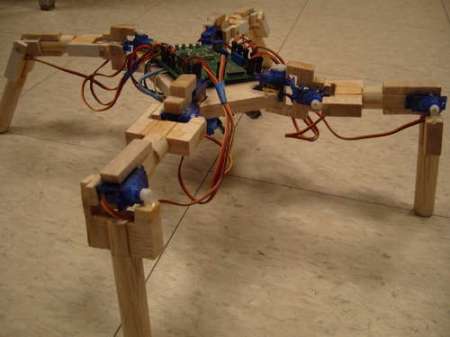
Sure, we see hexapods all the time at [HAD], but moving around with four legs can be more tricky kinematics-wise. This Instructable shows you how to make one out of balsa wood.

Although one might not think of balsa to make their robot out of [vexedpheonix] explains that this was chosen because it’s extremely light and easy to work with. Since he was trying to keep costs down, the cheapest servos available were used. These weren’t all that powerful, so the lighter the body the better! According to the included bill of materials, he was able to keep the entire robot build under $100.

According to the article, the hardest part was making four copies of the same leg. We might suggest using a CNC router, but building one would obviously add a huge layer of complication to the project!

Thanks for the tip on this one [SteveT]! Be sure to check out the video of this little robot waving one of it’s legs or trying to walk after the break! Continue reading “An Arduino Based Quadruped Robot”