Pedal-powered 32-core ARM Linux Server

Sure, it’s probably a gimmick to [Jon Masters], but we absolutely love the pedal-powered server he built using a group of ARM chips. [Jon] is an engineer at Red Hat and put together  the project in order to show off the potential of the low-power ARM offerings.

The platform is a quad-core Calxeda EnergyCore ARM SoC. Each chip draws only 5 Watts at full load, with eight chips weighing in at just 40 Watts. The circuit to power the server started as a solar charger, which was easy to convert just by transitioning from panels to a generator that works just like a bicycle trainer (the rear wheel presses against a spin wheel which drives the generator shaft).

So, the bicycle generator powers the solar charger, which is connected to an inverter that feeds a UPS. After reading the article and watching the video after the break we’re a bit confused on the actual setup. We would think that the inverter would feed the charger but that doesn’t seem to be the case here. If you can provide some clarity on how the system is connected please feel free to do so in the comments.


Continue reading “Pedal-powered 32-core ARM Linux Server”

Tearing Through Floppy Drives To Build A Small-format Dot Matrix Printer

The accuracy which [Mario] achieved in his pen plotter dot matrix printer is very remarkable. He tore through a pile of floppy drives to get the parts he wanted, and chose to go with a fine-point Sharpie marker as a print head. In the video after the break he flatters us with a printout of the Hackaday logo, but you also get a look at one problem with the build. The ink doesn’t always flow from the felt tip and he has to coax it (almost like priming a pump) with a piece of scrap paper.

He was inspired by the pen printer we featured back in June. This rendition features a printing area of 1.5×1.5 inches that can accommodate 120×120 black and white pixels. He’s not a microcontroller type of guy and is driving the printer from the parallel port of his computer.

The best printing technique puts the pen down and moves it around just a bit (helps prevent the ink flow problem we mentioned earlier) and produces images like one in the lower right. We love the 8-bit nature of the result and would use this all the time to make our own greeting cards.

Continue reading “Tearing Through Floppy Drives To Build A Small-format Dot Matrix Printer”

Video-based Radar For Your Car

[Gustaf] has been playing around with machine vision for a while and sent in his latest project in on our tip line. It’s a video based car radar system that can detect cars in a camera’s field of vision while cruising down the highway.

Like [Gustaf]’s previous experiments with machine vision where he got a computer to recognize and count yellow cylinders and green rectangles, the radar build uses ADABoost and the AForge AI/Machine Vision C# framework. [Gustef] used an evolutionary algorithm to detect the presence of a car in a video frame, first by selecting 150 images of cars from a pre-recorded video, and the another 1,850 images were selected by a computer and confirmed as a car by a human eye.

With 2000 images of cars in its database, [Gustaf]’s machine vision algorithm is able to detect a car in real-time as he drove down a beautiful Swedish highway. In addition to overlaying a rectangle underneath each car in a video frame and an awesome  Terminator-style HUD in the upper right corner, [Gustaf] also a distance display above the hood of his car.

It’s an awesome build that makes us wonder if [Gustef] is building an autonomous car. Even if he’s not, it really makes us want to install a video HUD in our whip, just to see this in action.

Logic Analyzer Add-on For The MSP430 Launchpad

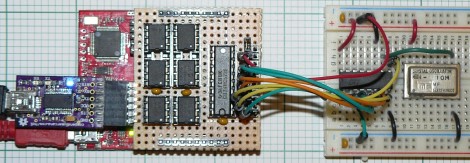
Here’s a 6-channel logic analyzer shield for the MSP430 Launchpad. It manages an eyebrow-raising 16 million samples per second. The prototype seen above is made on a hunk of protoboard with point-to-point soldering. [oPossum] did lay out a PCB — which is just 50mmx50mm — but has not had any produced quite yet.

He calls it the LogicBoost, and based it on the the LogicShrimp design. The sextuplet of 8-pin chips are all SPI RAM. These are responsible for storing the samples, with a 74HC573 latch routing the traffic. The MSP430 chip provides the SPI clock, and the Launchpad’s virtual com port can be used to push the data to a computer for graphing. That’s a bit slow so [oPossum] also included an optional header for an FTDI board that will do a faster job. The sample rate can be adjusted by tweaking the internal oscillator setting of the chip; there’s plenty to choose from so it will work for just about any purpose (as long as you don’t surpass the 16 Msps speed limit).

[via Dangerous Prototypes]

On Not Designing Circuits With Evolutionary Algorithms

[Henrik] has been working on a program to design electronic circuits using evolutionary algorithms. It’s still very much a work in progress, but he’s gotten to the point of generating a decent BJT inverter after 78 generations (9 minutes of compute time), as shown in the .gif above.

To evolve these circuits, [Henrik] told a SPICE simulation to generate an inverter with a 5V power supply, 2N3904 and 2N3906 transistors, and whatever resistors were needed. The first dozen or so generations didn’t actually do anything, but after 2000 generations the algorithm produced a circuit nearly identical to the description of a CMOS inverter you’d find in a circuit textbook.

Using evolution to guide electronic design is nothing new; an evolutionary algorithm and a a few bits of Verilog can turn an FPGA into a chip that can tell the difference between a 1kHz and 10kHz tone with extremely minimal hardware requirements. There’s also some very, very strange stuff that happened in this experiment; the evolutionary algorithm utilized things that are impossible for a human to program and relies on magnetic flux and quantum weirdness inside the FPGA.

[Henrik] says his algorithm didn’t test for how much current goes through the transistors, so implementing this circuit outside of a simulation will destroy the transistors and emit a puff of blue smoke. If you’d like design your own circuits using evolution, [Henrik] put all the code in a git for your perusal. It’s damn cool as it stands now, and once [Henrik] includes checking current and voltage in each component his project may actually be useful.

Refurbing A C64 With A Raspberry Pi

When [Carl] first heard of the Raspberry Pi, he immeidatly though how freakin tiny this board is compared to a Mini ITX motherboard. After ordering a Raspi, [Carl] decided to put his barely-larger-than-a-credit-card computer inside a Commodore 64.

[Carl]’s updated C64 functions exactly like the original – the 30-year-old keyboard works thanks to the help of a Keyrah keyboard and control port adapter. This adapter was soldered to a stripped USB cable, allowing [Carl] to keep the finished project looking very clean and tidy. Of course, the composite, HDMI, and Ethernet ports are broken out, allowing for this computer to connect to any network or TV.

For a final touch, [Carl] painted the case. He originally wanted to spray on a black, red, and purple motif to match the Raspi, but he eventually settled on a beige and red style. [Carl] really put together an awesome build, and for much, much less money than the rereleased C64 Windows-powered monstrosity goes for. You can check out the build log video after the break.

Continue reading “Refurbing A C64 With A Raspberry Pi”

Make Your Own Integrated Circuits At Home

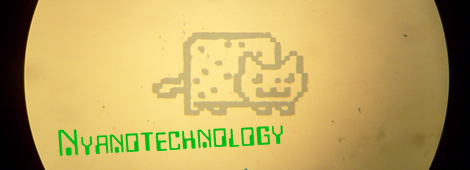
The Nyan Cat you see above is only 600 micrometers from head to tail. To put that into perspective, that’s about 10 times the diameter of a human hair. Also, that Nyan is etched into 200 nanometer thick copper foil and is the work of the HomeCMOS team, who is developing a hobbyist-friendly process to make integrated circuits and MEMS devices at home.

The project is far from complete; HomeCMOS has yet to produce a working IC but a few experiments – getting wet etching down pat and even building an almost working quantum qbit – are remarkable given the small amount of equipment and tools involved.

The HomeCMOS team has yet to actually make an integrated circuit or MEMS device, [Jeri Ellsworth] has shown this is possible by making transistors and integrated circuits at home. While there won’t be chips with millions of transistors coming out of the HomeCMOS lab anytime soon, it’s more than possible to see a few small-scale integration-level tech such as a few logic gates or a regulator.