Giving The Nexus 7 HD Video Recording

As released, the Nexus 7 tablet includes a 1.2 Megapixel front-facing camera. Even though the camera supports taking pictures at a resolution of 1280 x 960, recording video is limited to a paltry 480p resolution. It turns out the inability to record HD 720p video isn’t a hardware limitation; engineers at either Google or Asus simply didn’t bother telling the Nexus 7 how to record in 720p.

[hillbeast] over on the XDA developers forum came up with a very easy fix for this problem that only involves a quick copy and paste job into the media_profiles.xml file.

After the break you can see two videos recorded with [thehillbeast]’s Nexus 7. The first is a 480p video of a bit of shrubbery and a fence, while the second video is the same scene recorded at 720p. A noticable difference in quality, and a neat hack to give the already awesome Nexus 7 some additional capabilities.
Continue reading “Giving The Nexus 7 HD Video Recording”

Disco Planet, A Massive RGBW LED Array In A 6′ Globe

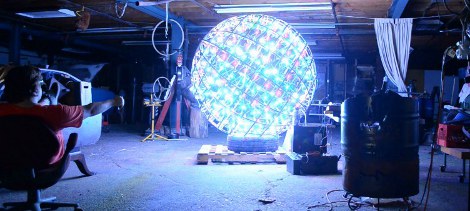
About half a year ago [John] over at Frank’s Kitchens came to me with an idea for a giant lighting project. He had this 6ft diameter aluminum frame globe rescued from the Philadelphia Theater Company and wanted it to be an interactive display of sorts. After a few discussions we got together and somehow managed to order 800 3 watt LEDs in red, green, blue, and white. We had a system that worked great on paper, and managed to get it built by Valentines day for a big show. It failed miserably and hardly even illuminated the LEDs. I, naturally, took this far too personally and set out for a complete redesign, looking in the direction of digitally addressable LED strips.

In addition to building a crazy turbo charged LED array I also spent a lot (a whole lot) of time coding a nice clean fully functioning RGB LED strip controller using an Arduino Pro Mini (5V 16 MHz), the MSGEQ7 audio frequency multiplexer (PDF) , and an IR remote. I plan on using this for other projects so the code can be easily reconfigured to use many different LED strips and a whole slew of IR remotes.

The schematic of the globe is here. The top half  of that schematic be catered to other projects using a variety of pre-built LED strips. The pastebin with code is here,  fastSPI_LED and IRRemote here and here. Some code jockeying was required to get IRRemote.h and FastSPI_LED to play nicely together, so check the code comments.

Continue reading “Disco Planet, A Massive RGBW LED Array In A 6′ Globe”

Bed Of Nails And Accuracy In PCB Manufacturing

A few days ago, we mentioned the new ARM-powered Teensy 3.0 project on Kickstarter. The creator, [Paul Stoffregen], decided to share the trials of building a test fixture along with a shocking comparison of the accuracy of different PCB manufacturers in an update to his Kickstarter.

Because [Paul]’s Teensy 3.0 has more IO pins than should be possible on such a small board, the test fixture to verify if a board is defective or not is fairly complex. To test each board, a Teensy is placed on dozens of spring-loaded contacts arranged like a bed of nails. From there, another Teensy (this time a Teensy 2.0) performs a few tests by cycling through all the pins with several patterns.

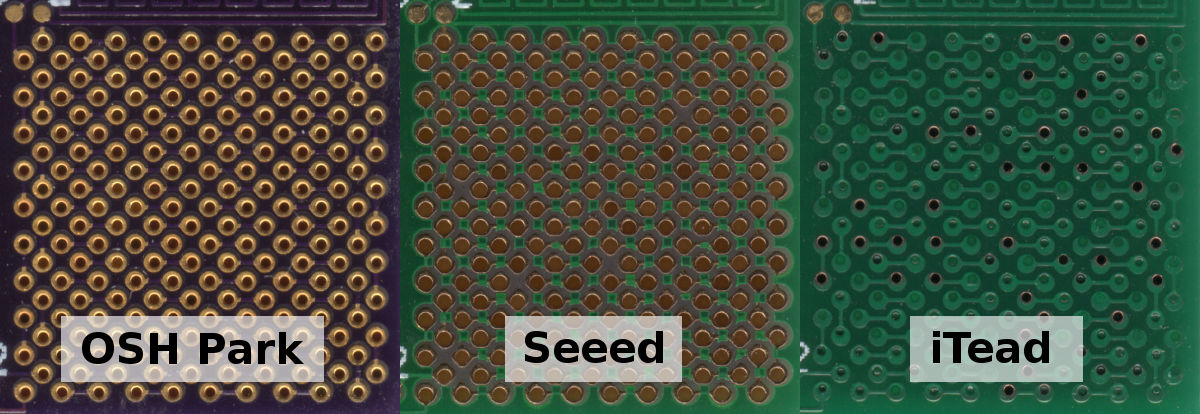
Because the spring-loaded contacts require rather precise drill holes in the PCB of his test fixture, [Paul] thought it would be neat to compare the accuracy of several board houses. In the title pic for this post (click to embiggen), [Paul] demonstrates the capabilities of OSH Park, Seeed Studio, and iTead Studio. The lesson here is probably going with a US company if quality drill work is a necessary requirement of your next project.

Breadboarding A 4-bit ALU

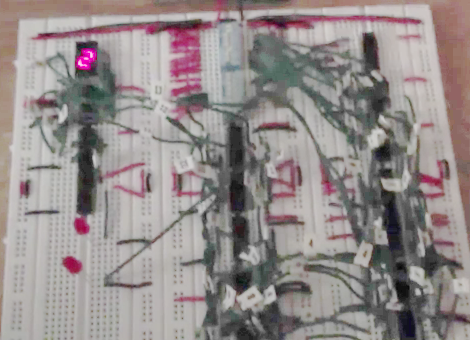
[TGTTGIT] recently took the plunge and decided to build his own computer using logic chips. He just completed a 4-bit ALU which can compute 18 functions. It took a long time to get the wiring right, but in true geek fashion his build was accompanied by an alternating Chapelle’s Show and Star Trek: TNG marathon playing in the background.

This project is the stepping stone for a larger 16-bit version. The experience of wiring up just this much of it has convinced him that an FPGA is the only way to go for the future of the build. But since he had already ordered the chips it was decided that the only thing to do was to see this much through. He used the truth table from The Elements of Computing Systems for the design and posted several times about the project before arriving at this stopping point so you may be interested in clicking through the other post on his blog. There’s also a lot of other TTL computer projects around here worth checking into.

Continue reading “Breadboarding A 4-bit ALU”

Adding A Sound Synthesizer To A ‘don’t-touch-the-sides’ Maze Game

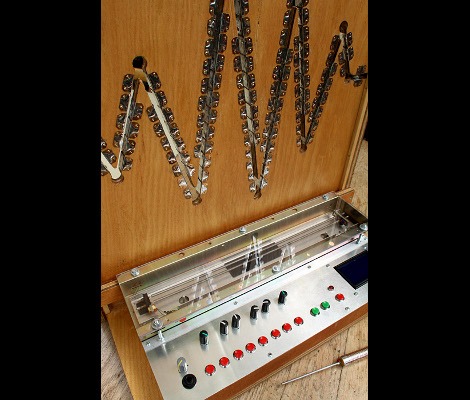
Part of the fun of the classic game of Operation is the jump you get from the loud buzzer which sounds if you touch the sides. This exhibit piece uses the same principle of lining the edges of a track with metal, but instead of an annoying buzz, each touch will issue a bit of music. That’s because the maze has been paired with a synthesizer. Instead of one sound wherever the stylus touches the sides, different parts of the maze act as one of 94 keys for the synthesizer.

There’s a lot more built into the base of the device than just a maze game. The knobs are used to alter the audio effects and the buttons work in conjunction with they stylus to sequence audio samples. There’s even a graphic LCD screen which shows the currently playing wave form. You can get a better look at the project in the video after the break.

Continue reading “Adding A Sound Synthesizer To A ‘don’t-touch-the-sides’ Maze Game”

2708 EPROM Dumper

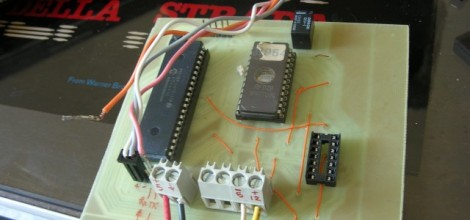
[Andrea “Mancausoft” Milazzo] has been restoring old equipment which often contain EPROM chips. He thought he was all set with an EPROM reader which easily dumped the data from 2716 chips and a few others. But he found that the hardware was unable to read 2708 and 2704 chips. His solution was to build a PIC-based EPROM dumper.

You may remember from some of our recent features that these chips are something of a ticking clock. They store program code and other information vital to the functioning of old hardware. Since they’re erased with UV light, years of exposure to ambient light can zap some of the data.

The specs needed to read a chip of this type are rather rudimentary. There are ten address pins and eight data pins. [Andrea] also needed a way to get data from the microcontroller to a computer for backup. He uses two more pins for this purpose, bringing the I/O count to 20. He went with  PIC 18F4610 and built the rest of the reader around it.

Mind-controlling Cockroaches

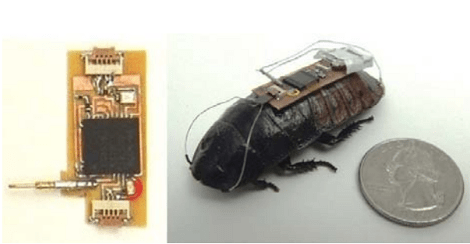
Producing micro robotics is not yet easy or cost-effective, but why do we need to when we can just control the minds of cockroaches? A team or researchers from North Carolina State University is calling this augmented Madagascar Hissing cockroach an Insect Biobot in their latest research paper (PDF). It’s not the first time the subject has come up. There have already been proofs in research and even more amateur endeavors. But the accuracy and control seen in the video after the break is beyond compare.

The roach is being controlled to perfectly follow a line on the floor. One of the things that makes this iteration work so well is that the microcontroller includes a new type of ADC-based feedback loop for the stimulation of the insect brain. This helps to ensure that the roach will not grow accustom to the stimulation and stop responding to it. Since this variety of insect can live for about two years, this breakthrough makes it into a reusable tool. We’re not sure what that tool will be used for, but perhaps the next plague of insects will be controlled by man, and not mother nature.

Continue reading “Mind-controlling Cockroaches”