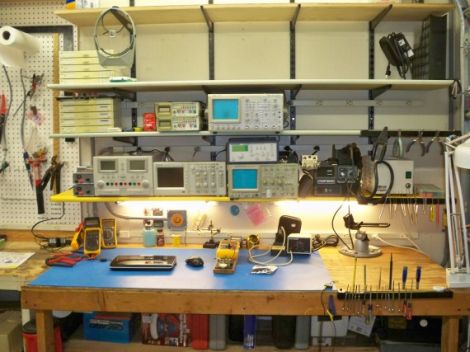
Updating Your Workspace For More Organized And Efficient Hacking

workspace-upgrade

If you’ve ever looked at one of [Todd Harrison’s] teardown or how-to videos closely, you would likely notice that his work bench looks like a standard hacker workspace. While we all try to keep our work areas clear of clutter, it’s not uncommon for components to pile up, cords to tangle, and things to get messy. [Todd] decided it was time to get a bit more organized, so he recorded a video showing how he went about the process.

Part of [Todd’s] work revolved around adding shelves to his bench so that he didn’t have measurement equipment stacked on top of one another. He also spent a good amount of time adding 30 additional plug sockets to his work space, replacing the single socket he had been struggling with for years.

Obviously this is not really a hack in and of itself, though this sort of reorganization is an important to efficient hacking all the same. We like the fact that [Todd] took the time to explain his process and materials in great detail – it will no doubt be helpful to those new to hacking.

Continue reading to see [Todd’s] video in its entirety, or swing by his blog for more pictures and details.

Continue reading “Updating Your Workspace For More Organized And Efficient Hacking”

Quieting A Pendulum Clock Every Night

[Vinnie] has a wonderful old clock from his grandmother; it’s an exquisite antique with a real mechanical movement and a charming set of bells that ring every hour. Unfortunately, those chimes are a bit of a disturbance to neighbors at 2 o’clock in the morning. Previously, [Vinnie] had been stopping the clock every evening, and hoped he would remember to start the pendulum in motion 12 hours later. This was a chore, so he decided to automate the process.

The build is simple and clever; a small stepper motor is mounted in the clock just underneath the pendulum. Every 12 hours, the stepper motor moves a lever and slowly stops the pendulum over the course of a dozen or so seconds, silencing the clock movement. Twelve hours later, the motor turns again setting the pendulum in motion.

The parts count for this build is very low – basically just an ATmega88, a Darlington array to drive the stepper, and a 32.768kHz crystal. We can think of a few friends and relatives with loud clocks in their house, so we might have to build a few of these to give away.

Take a look at the demo video after the break to see how [Vinnie] stops his grandmother’s clock every night.

Continue reading “Quieting A Pendulum Clock Every Night”

Sand Flea Literally Leaps Tall Buildings In A Single Bound

The hidden abilities of this robot that is no larger than a dinner plate are quite impressive. It doesn’t let an obstacle like a building get in its way. The Sand Flea, like its namesake, posses a remarkable jumping ability. When it encounters a tall obstruction two levers incline the front of the robot and it launches itself up to thirty feet in the air. In the case of a one-story build this means it will end up on the roof, and it’ll do so much quicker and more reliably than any wall climber we’ve seen.

It’s being developed for the US Army by Boston Dynamics, and this isn’t the first time we’ve seen the concept. But the video after the break gives a much better look than the grainy twenty-second clip from last year. Of course they’re not giving up too many details so we have to guess a bit. We’d wager the launching mechanism is a solenoid, but at about eleven pounds you need a lot of juice to get that much of a jump. We suppose it’s also possible that there’s an explosive system like the butane combustion used in a framing nailer. The video summary mentions that there’s a stabilization system to keep the body oriented during flight. That’s got to be a gyroscope. Let us know what you think in the comments. Continue reading “Sand Flea Literally Leaps Tall Buildings In A Single Bound”

Wireless Camera Mount Offers Pan And Tilt Functions

[Chris] put together a bunch of common components to create this wireless pan and tilt system for a security camera or a robot.

The motorized base is simple enough, using two servos to make up a mount for the digital camera. In this case he used a parts package which is designed to mount the servos perpendicular to each other. You could also 3D print, our build your own brackets quite easily. The control circuitry consists of a pair of PIC 18LF4520 microcontrollers and a set of Xbee modules. This is where the wireless connectivity comes in.

On the transmitter side, a pair of potentiometers are read by the microcontroller’s ADC and translated into position values. The receiver takes those values and drives the servo motors accordingly. In the clip after the break [Chris] is using micro trimpots which require a screw driver to adjust. You might want to hit the parts bin and see if you can get some that have a more user-friendly shaft or knob.

Unfortunately this system doesn’t transmit video. But WiFi webcams are getting quite affordable so that might be a good option in this case. Continue reading “Wireless Camera Mount Offers Pan And Tilt Functions”

Floppy Autoloader Takes The Pain Out Of Archiving 5000 Amiga Disks

floppy-autoloader

Archiving data from old floppy disks can be a tedious process at best. Poorly labeled disks combined with slow transfer speeds put it high on the list of things we would rather not do, and it turns out that [Dweller] was of the same opinion. With an estimated 5,000 floppies in his collection, he finally decided it was time to clean house.

With no idea of what was stored where, he decided the best way to go about the process was to read all of the disks, archiving everything, saving the sorting process for later. He originally started by building a floppy autoloader out of Lego Mindstorm parts, which looked good on paper, but performed pretty poorly.

He came across an old floppy duplicator on eBay and figured that since the machine was built for handling gobs of disks, that it was the perfect base for his autoloader. He pulled the mechanical bits from the machine, incorporating them into the rig you see above. He swapped out the duplicator’s brains for an Arduino, which allows him to batch copy his disks and save a picture of each label with little effort.

He says that the system works great, making his life a lot easier (and less cluttered!)

Check out the video below to see his floppy autoloader in action.

Continue reading “Floppy Autoloader Takes The Pain Out Of Archiving 5000 Amiga Disks”

Loudest Telepresence Robot Ever

This telepresence robot will never let your Skype callers sneak up on you. [Priit] built the project, which he calls Skype Got Legs, so that his distant friends could follow him around the house during chats. But as you can hear after the break, the electric drills used to motorize the base are extremely loud.

Noise pollution aside, we like the roughness of the hack. It’s utilitarian but seems to work quite well. Commands are sent via the web using a combination of Ajax and PHP function calls. The two drills are controlled by an Arduino via a couple of automotive relays. The drills are powered by their original rechargeable battery packs. So as not to alter those batteries, [Priit] figured out a way to use synthetic wine bottle corks as a connector. They’ve been cut to size, and had tinned wires pushed through holes in them. Now, when he inserts the altered corks they press the wires against the battery contacts. Continue reading “Loudest Telepresence Robot Ever”

New Dirigibles Are Power Plants In The Sky

We wonder if a floating wind turbine generator (translated) like this one would alleviate some of the complaints we hear about ground-based turbines. This huge helium-filled structure is designed to generate electricity at high altitude, where winds are stronger and blow much more consistently than near ground level. We’ve read complaints at the unsightliness of wind farms, and the noise that they make as the turbines spin. A test run took place at only 350 feet, but this generator is meant to fly at an altitude of 2000 feet. We’d bet it’s much less obtrusive and much quieter at that distance.

There isn’t a whole lot to the lighter-than-air assembly. It’s got an aerodynamic balloon with stabilizing fins, and a propeller attached to a generator at the center. The tether that holds it in place also carries the conductors which translate the power down to the ground. There is mention of a fail-safe system that allows for a slow descent if it get gets away from its tether, so you shouldn’t have to worry about the sky falling on you.

It’s certainly an interesting idea. For some reason this makes us think of the space-based solar generator panels found on Larry Niven’s Ringworld.

[via Reddit]