A Full Auto PVC Battery Gun

full-auto-battery-gun

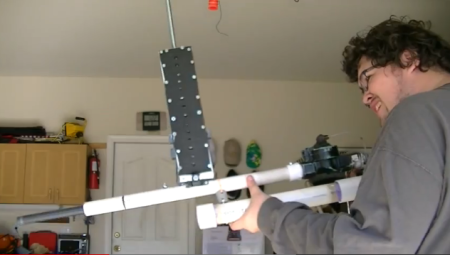
So what’s better than a battery gun? A full auto pneumatic battery gun of course!  [ukilliheal], decided to build one of these, and show us the results in his video after the break.  After turning the gun on, this contraption shoots at a pretty impressive rate of fire (although, apparently not as fast as some of his other experiments).  Apparently batteries can do a pretty fair amount of damage to a cardboard target as shown around 1:20. [ukilliheal] apparently thinks this is pretty hilarious, but we wouldn’t want to be on the other end of this device!

Although details on this build are fairly slim in this video, [ukilliheal’s] other videos should provide some clues, especially those where he explains how to make a full auto paintball gun.  If the same technique is used, a piston reloads the chamber using a homemade valve that releases pressure when it gets too high.  Electronics could also be used, but keeping everything mechanical will allow for the batteries to be used solely as ammuntion.

[youtube http://www.youtube.com/watch?v=A6Gs2mKNjV0%5D

If full-auto guns aren’t your thing, why not check out this bolt-action miniature pneumatic spud gun!


StorageBot Finds All Your Components, Makes Your Storage Drawers Feel Inadequate

Your experience with making things, building projects, and hacking hardware is directly proportional to the amount of components you have on hand; as our experience grows, so do our space and storage requirements, it seems. [Danh Trinh] must have decades of experience, because his StorageBot robotic parts drawer is as awesomely absurd as it is clever and useful.

At first glance, StorageBot just looks like a bunch of small parts drawers mounted to the wall with LED strips along the top and side. The magic happens when [Danh] walks up to the wall-mounted laptop and commands StorageBot to find a component with his voice. A video is worth a thousand words, so you might as well head to the video for the best description available

To get the StorageBot to listen to his voice, [Danh] downloaded Microsoft’s speech recognition SDK and built a VB app to turn his voice into a location of what drawer contains the part he requested. Once StorageBot finds the row and column of the requested part, a pair of stepper motors behind the wall of parts drawers swing into action. Soon enough, the drawer containing the requested part pops out, and [Danh] can go about his business building more awesome stuff.

Because a few paragraphs can’t convey exactly how cool [Danh]’s StorageBot is, take a look at the videos after the break.

Continue reading “StorageBot Finds All Your Components, Makes Your Storage Drawers Feel Inadequate”

Twittertape Machine Keeps Track Of Your Social Media Stock.

During the gilded age, oil magnates, entrepreneurs, and robber barons would have a ticker tape machine in their study. This machine would print stock and commodity prices and chart these men’s assets climbing higher and higher. A lot has changed in 100 years, as now [Adam] can be kept apprised of what @KimKardashian, @BarackObama and @stephenfry ate for breakfast with his Twittertape machine.

Interestingly, [Adam]’s build didn’t start off as a tarnished lump of 100-year-old brass; he built his beautiful ticker machine out of old clock movements he picked up on eBay. Even though the shiny part of the build only holds the roll of paper, it’s still a wonderful build. Right now the machine is connected to Ethernet, but he’s planning on adding WiFi and a few batteries for a completely wireless build.

Unlike the other ticker tape machine we saw this week, [Adam] did away with the loud clashing of gears and solenoids found in 100-year-old ticker machines. This ticker machine prints on cash register receipt paper and a very small thermal printer in the base. Although [Adam]’s build doesn’t sound like two robots trading blows, there’s no ink needed and no danger of the letter wheel becoming misaligned and misspelling everything.

Check out [Adam]’s build in action after the break.

Continue reading “Twittertape Machine Keeps Track Of Your Social Media Stock.”

altoids-pocket-projector

DIY Film Projector Fits In The Palm Of Your Hand

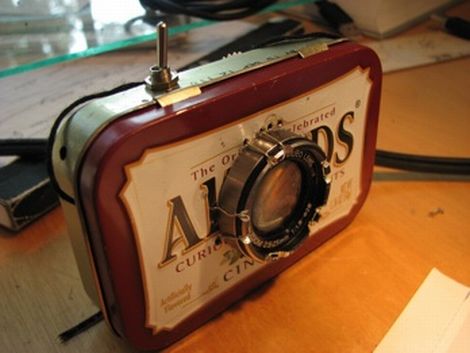
DSLRs aside, the price of digital cameras these days can make it easy to consider just tossing your old one out when it breaks. [Leonidas Tolias] had another idea, and with a few broken cameras he had on hand he constructed a slick little pocket-sized projector.

The project started out as a pair of lenses from busted cameras and an Altoids tin in which he mounted them. The larger lens from a video camera was installed on the exterior of the tin, while the smaller of the two was mounted inside. Bits from disposable cameras were used to create a set of film reels, which he supports with some hand cut scrap aluminum. He made some test photo slides by printing some images on transparency paper, which he can cycle through using a film advancement rig he built out of string and a couple of gears.

While you won’t be using this projector for your next boring PowerPoint presentation, it does work pretty well as you can see in pictures on [Leonidas’] site.

[Thanks, Taylor]

The Gauntlet: A 1 Watt Laser Module

This is the gauntlet; a place where things are tortured in ways that only an engineer could appreciate.

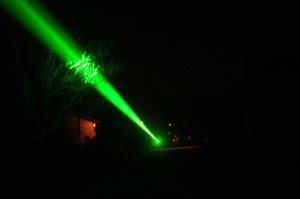
Today’s victim is a 1.0W green laser module, manufactured by Suzhou Daheng under the brand name “DHOM”.

As far as Chinese laser manufacturers go, Suzhou Daheng is about one rung lower than CNI in terms of quality. Although US companies like Coherent blow these guys out of the water, both are still reputable nonetheless.  As far as Chinese lasers themselves go, this one seems a bit conservatively rated; a nice change from the “1000MW 532nm laser cat toy burning module” that’s not too uncommon on dealextreme and the like.

More after the break…
Continue reading “The Gauntlet: A 1 Watt Laser Module”

Self-balancing Transport Is Arduino-controlled

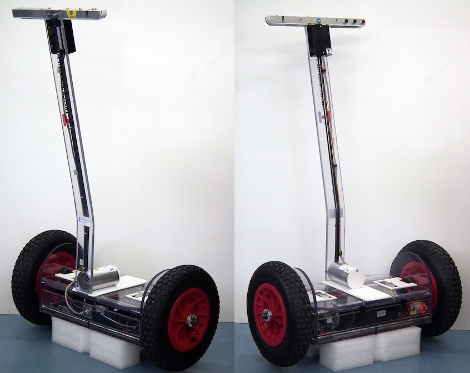
[Nick Thatcher] has built several iterations of a homebrew Segway, and the latest version is very impressive. When developing the project he figured there was just no way the thing would ever work, which led to its name, the No-way.

After the break you can catch a video of [Nick’s] test-ride. Looks like the two-wheeler is ready for daily use. You can just make out a red kill-switch on the right side of the polycarbonate body. This lets you disconnect the power if things get out of hand, or just when you’re done riding it. But there is also a dead-man’s switch which we believe uses two sensors where your feet go on the enclosure’s top surface. The handle has some indicator lights built into it, as well as buttons under each thumb which are used for steering. Control circuitry includes an Arduino UNO which reads a gyroscope/accelerometer sensor board from SparkFun. Two 7.2 Ah batteries provide 24V for the pair of electric scooter motors that turn the wheel-barrow wheels.

We love looking at these Segway clone project. So if you’re working on one of your own don’t forget to document your progress!

Continue reading “Self-balancing Transport Is Arduino-controlled”

Automated Sky Tracking To Catch UFOs

If you were to try to take a picture of a UFO, how would you do it? Sit by the side of a road in Nevada near Area 51? Pie tin on a string? A French team of UFO enthusiasts put together an automated UFO detection device (Google translate) out of a disco light and CCTV camera so long nights of watching the skies can be automated.

The build uses a disco light with an altitude and azimuth mount to constantly scan the skies on the lookout for strange, unexplained lights. Attached to this swiveling mount is a camcorder and a CCTV camera that streams video to the command and control laptops for image analysis.

In addition to object tracking, there’s also a diffraction grating in front of the CCTV camera. The team behind this project previously used this for some very low tech spectroscopy (translation) to identify emission lines in a light source. Light that have a signature including Oxygen and Nitrogen will probably be ionized air, while less common elements may be the signature of “advanced propulsion.”

While this build is going to detect a lot of satellites and meteors, there’s a definite possibility of capturing an unexplained phenomenon on video.